

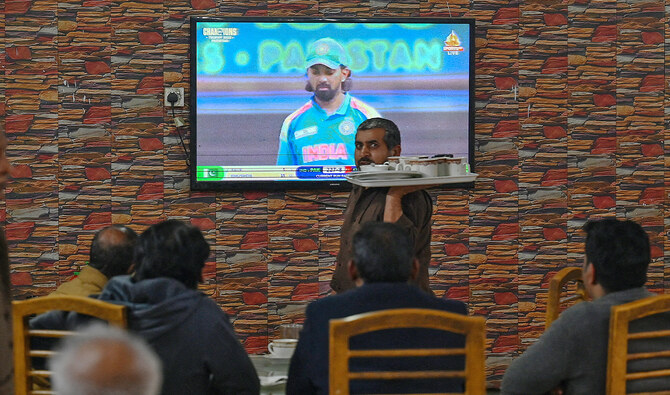

ISLAMABAD: While eight cricket teams are fighting for the ICC Champions Trophy which started last week, bookies and police will be playing a game of cat and mouse as fans in cricket-crazy Pakistan are expected to wager huge amounts during the international tournament.
Cricket betting exists as a complex, underground market in Pakistan, thriving through unregulated bookies, online platforms and informal betting networks. Authorities say they frequently crack down on betting rings but enforcement remains a challenge due to the widespread use of mobile apps and international betting websites.
Arab News spoke to two bookies and two regular sports bettors to gain insights into Pakistan’s underground betting market, its stakes and how it operates, its evolution in the digital age and the impact of major cricket events on betting activity in the country.
One bookie, who wanted to be referred to by the initials AB due to fear of legal action, said sports betting had always been popular in Pakistan but had become more accessible in recent years with the rise of online applications.
While he said he usually made the equivalent of about $1,700 — $3,500 during a regular international cricket match, he could expect to make up to $10,000 during a major tournament like the ICC Champions Trophy.
“Millions of dollars throughout the world and billions of rupees in Pakistan are expected to change hands [during the Champions Trophy],” AB told Arab News in a telephone interview.
When asked about the maximum amount people were willing to bet on a game between Pakistan and India, one of the world’s most intense sports rivalries, he said:
“The more money a person has, the more he bets. We are talking billions of rupees here.”
One bettor Arab News spoke to, who wanted to be referred to by the assumed name Bilal, said the largest bet he had placed in one go was around $5,400, while the most amount of money he had won from a single cricket match was a staggering $89,538.
“But then I lost around $32,233 in the next match,” Bilal said, adding that he had learnt his lesson and did not place big bets anymore. The highest he would go during the Champions Trophy was around $350 a match.
OLD VS NEW SYSTEM
Explaining the evolution of Pakistan’s betting scene, AB said the betting process had been entirely manual until about a decade ago.
“Bookies were connected to international betting networks and offered players the rates from those platforms while charging a commission,” he explained.
Under the old system, new players could only place bets if an existing player vouched for them, making the guarantor responsible for covering the new player’s losses if they failed to pay. This also protected against the risk of infiltration by undercover cops.
This is how the system worked: Players would call the bookie directly to ask for betting rates and then place a bet, and the call was recorded as proof of the transaction.
That system gave bookmakers a greater margin, as the odds could fluctuate between the time a player inquired about a bet and when they actually placed it.
Today, bookies use betting apps, which eliminate the need for guarantors. Any player can contact a bookie directly, deposit a certain amount and receive a login ID with funds added to their account.
“Players can now access the app directly to place bets and withdraw their winnings after a match or tournament,” AB said. “We still allow our long-term players to bet now and pay later.”
A seasoned bettor from Karachi, who requested to be identified as Tariq, told Arab News he had been betting for the past 15 years, not just on cricket but also on football, horse racing and other sports.
“The manual process used to favor the bookies because players couldn’t see the real-time fluctuations in betting rates,” he said. “This allowed bookies to manipulate the odds and increase their profits.”
Web-based betting had made the operation, including payouts, smoother however, Tariq added.
“Before every cricket match, one team is the favorite while the other is the underdog depending on their previous performance,” AB, the bookie, added. “Betting on the favorite team yields lower earnings compared to betting on the underdog.”
He explained that if the odds for a match were 2:3, a $1 bet on the favorite team would yield $0.67 in profit while betting a dollar on the underdog would yield $1.50.
AB said the most common bets during cricket matches revolved around predicting the outcome of the match or series, while “fancy bets” involved wagering on the number of runs a team will score within a certain number of overs.
Bets could be placed on anything, he added, from which team would win the toss to which bowler would take the most number of wickets.
“For instance, at the start of a match, the first available fancy bet is usually for the first five or ten overs,” AB explained. “A player can bet on whether the batting team will score more or less than a certain number of runs, for example 40, within a specified number of overs, with this type of betting continuing throughout the match.”
PAYING UP
Often, the gambling dens operate under the very nose of the police, bookkeepers said.
KC, another bookie who also refused to be identified by his full name and operates a den from a modest two-bedroom apartment in Karachi, told Arab News the police became active in striking deals with, and demanding heavier bribes from, bookkeepers before major cricket tournaments like the ICC Champions Trophy.
“Corruption runs deep,” he said. “Some policemen even place their own bets.”
The first bookie, AB, said police were helpful both in looking the other way and allowing dens to operate, while raiding the set-ups of competitors or new bookies in the market.
“Small bookies like me pay thousands of rupees weekly as protection money on a regular basis. But the policeman I’m in touch with has told me they won’t come to save me if there is a raid, the most they will do is alert me about the raid beforehand,” he said.
AB said there was a fixed bribe rate on a weekly basis, but a percentage system was used for big matches, with the police getting a cut of earnings from big matches.
“In a month from small bookies, police would be able to make around $5,500,” he added. “Rates don’t increase before tournaments but only for big matches.”
Tariq, the bettor, recalled a time he lost over a million rupees on credit and couldn’t pay on time.
“I received threats from bookies and even policemen called me asking me to visit them,” he said.
The same works for bookies too sometimes:
“If a bookie fails to pay, the police detain them until they clear their dues,” Tariq added.
Speaking to Arab News on condition of anonymity as he was not authorized to speak to the media, a senior Karachi police official said gambling had largely shifted online, bringing it under the jurisdiction of the Federal Investigation Agency (FIA). However, he admitted that some physical gambling may still be taking place though its nature had changed.
“It is rarely played with gamblers physically present in one location. This is why it now falls under the FIA’s jurisdiction,” the official said.
A spokesperson for Sindh police said the issue did not fall under the domain of police.
FIA spokesperson Abdul Ghafoor could not be reached for comment despite several attempts while FIA Deputy Director Media Mehmood Ali Khokhar sought questions via text message but did not respond.


