

Pakistan petroleum dealers threaten nationwide strike over oil price deregulation plans

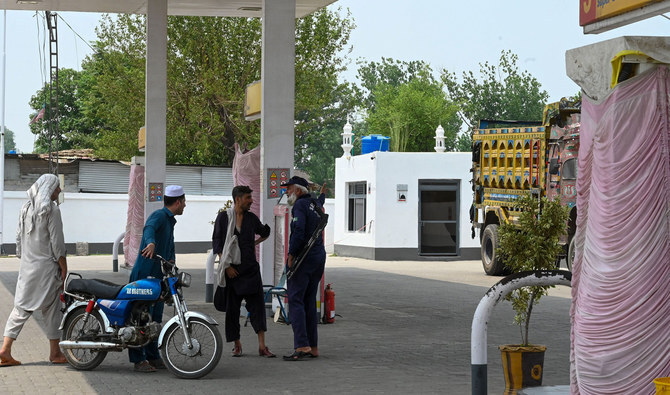
A motorist visits a petrol pump amidst a nationwide strike to protest against the hike in tax, in Peshawar, Pakistan, on July 5, 2024. (AFP/File)
Short Url
Updated 24 February 2025
Follow

Pakistan petroleum dealers threaten nationwide strike over oil price deregulation plans

  • Pakistan’s petroleum minister last week said government was introducing new policy to deregulate oil prices
  • Petroleum dealers association says price deregulation will encourage cartels, fuel inflation in Pakistan

ISLAMABAD: The Pakistan Petroleum Dealers Association (PPDA) said on Monday it would launch a countrywide strike against the government’s decision to deregulate oil prices, warning that the move would trigger an increase in smuggling, inflation and cartels dictating oil prices. 

Pakistan’s Petroleum Minister Musadik Malik said last week the government was planning to introduce a deregulation policy allowing oil marketing companies (OMCs) to sell fuel at competitive rates to increase their market share. Under the policy, OMCs would be allowed to set their prices and sell petrol and diesel below the government’s announced rates.

The PPDA, which represents fuel station owners and petroleum dealers across Pakistan and advocates for fuel retailers’ interests in pricing, government policies and taxation, says it was not consulted on the government’s deregulation plans. 

“The government did not consult us, we oppose this move of theirs,” Abdul Sami Khan, PPDA chairman, told Arab News over the phone on Monday. “Our central organization will hold a meeting on this, following which we will announce a date for our strike if this decision is not reversed.”

In a press release on Sunday, the union warned that deregulation of oil prices would lead to an increase in smuggling of oil from Iran and the formation of cartels, “where only two or three companies will dominate, leading to unfair pricing practices.”

The PPDA also warned that deregulating oil prices would cause inflation to surge, adversely affecting consumers. 

“The PPDA calls for an immediate review of this decision and urges the government to engage with us to address these pressing concerns,” it said. “We stand ready to discuss and collaborate on a more equitable and transparent approach to the oil pricing system.”


Pakistani, Chinese firms sign 79 MoUs worth $4.5 billion at Islamabad agriculture summit — minister

Updated 11 sec ago
Follow

Pakistani, Chinese firms sign 79 MoUs worth $4.5 billion at Islamabad agriculture summit — minister

  • The summit saw participation from over 300 Pakistani, Chinese firms focusing on modern agricultural techniques and solutions
  • Food security minister says these investments will modernize Pakistan’s agricultural value chains and enhance productivity

KARACHI: The Pakistan–China Agriculture Investment Conference in Islamabad has resulted in 79 Memoranda of Understanding (MoUs) between Pakistani and Chinese companies with an approximate investment value of $4.5 billion, Pakistani Food Security Minister Rana Tanveer Hussain said on Tuesday, signaling confidence of Chinese investors in Pakistan’s agriculture and food sectors.

At least 119 Chinese companies and over 191 Pakistani firms participated in the event held on Monday, focusing on fertilizers, seed varieties, machinery, precision farming and smart irrigation systems, according to the organizers.

The conference was billed by Pakistan’s Ministry of National Food Security and Research as a platform for deepening bilateral agricultural ties and supporting broader economic engagement between the two countries.

Hussain said the scale and depth of investment commitments at the conference reflected a decisive shift from dialogue to on-ground, investment-led collaboration between the two countries.

“The conference was specifically structured to deliver tangible outcomes through direct B2B (business to business) matchmaking, targeted sectoral engagement and project-based investment facilitation, rather than conventional discussions,” he was quoted as saying by his ministry.

Pakistan and China have been expanding cooperation in agriculture under the China-Pakistan Economic Corridor (CPEC) framework, with a focus on mechanization, high-yield seeds, livestock development and value-added food processing. Officials say stronger agricultural ties could help Pakistan boost exports, ensure food security and create jobs, while offering Chinese companies access to a large farming market and new investment opportunities.

Pakistan’s exports to China reached approximately $2.38 billion in Fiscal Year 2024–25 that ended in June, while imports stood at $16.3 billion, reflecting growing demand on both sides despite global economic headwinds, according to the minister.

The food security ministry undertook extensive preparatory work prior to the conference, including structured engagements with Pakistani industry bodies and Chinese enterprises, to align investment proposals with market demand, technology requirements and national priorities, according to Hussain.

As a result, investment agreements were concluded across ten high-impact agricultural and allied sub-sectors, including food processing and value addition, agri-technology, seeds and plant protection, livestock and dairy, meat and poultry, fruits and vegetables, fisheries and aquaculture, animal feed, post-harvest infrastructure, and agricultural inputs.

“These investments will modernize Pakistan’s agricultural value chains, introduce advanced production and processing technologies, and significantly enhance productivity,” the minister said.

“The inflow of capital and technology is expected to generate large-scale employment, particularly in rural areas, strengthen farm-to-market linkages, and reduce post-harvest losses, thereby improving farmer incomes and rural livelihoods.”