KSrelief marks a decade of defining humanitarian aid diplomacy

1 / 7
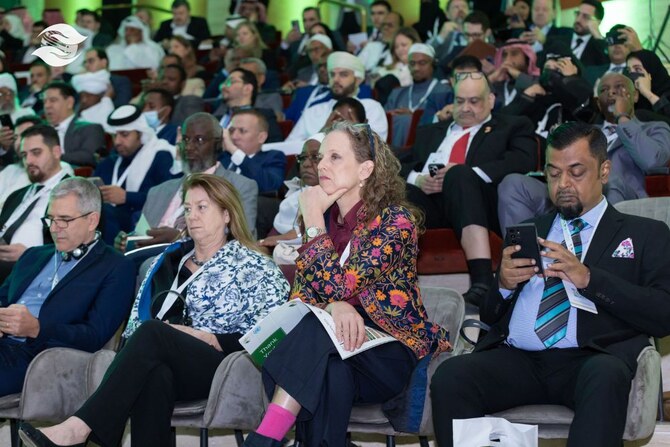
KSrelief’s humanitarian efforts have reached 106 countries with an amount exceeding $7.3bn, said Dr. Abdullah Al-Rabeeah at the Riyadh International Humanitarian Forum. (AN Photo/Rashid Hassan)
2 / 7
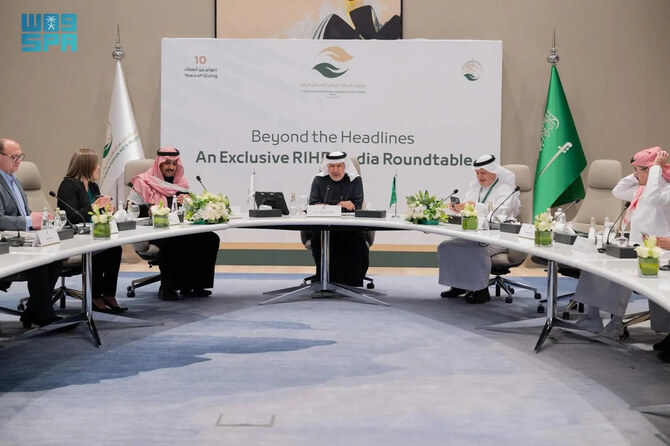
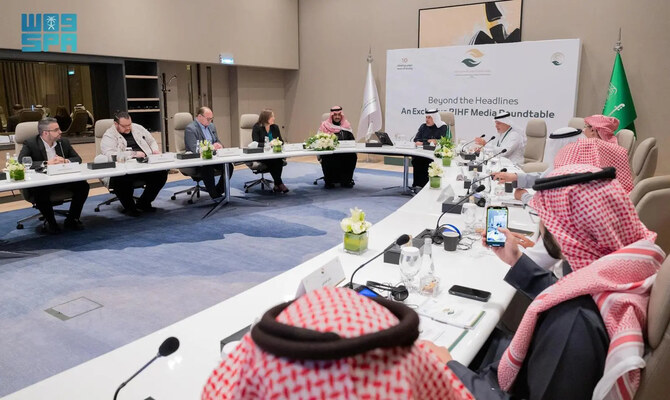
KSrelief Supervisor General Abdullah bin Abdulaziz Al-Rabeeah speaks during a roundtable session with media representatives in Riyadh on February 23, 2025. (SPA)
3 / 7
KSrelief Supervisor General Abdullah bin Abdulaziz Al-Rabeeah speaks during a roundtable session with media representatives in Riyadh on February 23, 2025. (SPA)
4 / 7
KSrelief’s humanitarian efforts have reached 106 countries with an amount exceeding $7.3bn, said Dr. Abdullah Al-Rabeeah at the Riyadh International Humanitarian Forum. (AN Photo/Rashid Hassan)
5 / 7
KSrelief Supervisor General Abdullah bin Abdulaziz Al-Rabeeah speaks during a roundtable session with media representatives in Riyadh on February 23, 2025. (SPA)
6 / 7
KSrelief’s humanitarian efforts have reached 106 countries with an amount exceeding $7.3bn, said Dr. Abdullah Al-Rabeeah at the Riyadh International Humanitarian Forum. (AN Photo/Rashid Hassan)
7 / 7
KSrelief’s humanitarian efforts have reached 106 countries with an amount exceeding $7.3bn, said Dr. Abdullah Al-Rabeeah at the Riyadh International Humanitarian Forum. (AN Photo/Rashid Hassan)
Short Url
Updated 24 February 2025
Follow

KSrelief marks a decade of defining humanitarian aid diplomacy

  • KSrelief’s worldwide aid efforts exceed $7.3 billion
  • King Salman always concerned with humanitarian work, says KSrelief chief

RIYADH: Saudi aid agency KSrelief’s humanitarian efforts have reached 106 countries with an amount exceeding $7.3 billion, its Supervisor-General Dr. Abdullah Al-Rabeeah noted at the Riyadh International Humanitarian Forum on Monday.

The agency has implemented 3,355 relief projects either directly or through its 211 international, national, and local partners.

Speaking at the opening ceremony of the forum which is being held in partnership with the UN, Al-Rabeeah said: “This is a moment worthy of reflection, to draw lessons from the past that will help us to direct our actions towards the future.”

He noted that the forum, which is being attended by experts, officials from the UN and various international organization, is held under the theme “Navigating the Future of Humanitarian Response,” and coincides with the 10th anniversary of the establishment of KSrelief.

“King Salman has always been vitally concerned with humanitarian work, which he underscored 10 years ago with his establishment of the KSrelief to be a leading center in delivering Saudi humanitarian aid to those most in need around the world,” Al-Rabeeah said. “(It is) an approach that combines humanitarian giving, strategic planning, effective and rapid emergency interventions during crises of all kinds.”

He added that as a result of these efforts, the Kingdom’s total charitable contributions over the past five decades have surpassed $133.8 billion. “Additionally, KSrelief is one of the leading international organizations that implement extensive networks of global volunteer missions — 876 thus far across 52 countries,” he said.

KSrelief also actively participates with the UN in supporting a wide range of global humanitarian initiatives, including the Sustainable Development Goals, and contributes to the creation of innovative access mechanisms that achieve significant and comprehensive results.

He explained that the forum is being held within the context of collaborative efforts with the international community “as we share experience and knowledge to improve humanitarian crisis response.”

The event features 21 sessions and 132 speakers and will serve as a starting point for developing innovative initiatives that open new opportunities for humanitarian work.

These initiatives will incorporate creative models inspired by the most up-to-date technologies to improve the operational efficiency of humanitarian responses, ensure the optimal use of resources, and minimize duplication of efforts to better meet the lives of vulnerable groups worldwide.

The forum also provides an opportunity to call on the global donor community and partners from both the public and private sectors to provide the necessary financial support for humanitarian programs, to improve the speed and efficiency of crisis response, and to address urgent humanitarian appeals.

Speaking at the opening ceremony, Saudi Foreign Minister Prince Faisal bin Farhan thanked the diverse participation, saying: “We value the efforts and participation.”

He added: “This is a sign of standing firm and united in commitment to addressing the world's most pressing humanitarian challenges.”

Prince Faisal praised KSrelief for being at the forefront of humanitarian efforts for people in need everywhere including Palestine, Syria, Yemen, Sudan and all over the world.

He commended KSrelief’s extraordinary efforts with the Masam project removing landmines in war hit Yemen, as well as its efforts to champion humanitarian diplomacy in conflict areas.

Saudi moves to enhance dialogue and resolve conflicts have been acknowledged by the world, he said, noting that humanitarian diplomacy is very important in conflict areas, and that KSrelief has been playing a crucial role in preserving values.

Riyadh Gov. Prince Faisal bin Bandar read a message on behalf of King Salman that highlighted the commendable role the KSrelief played over the first decade of its run.

The opening ceremony saw the signing of four agreements: the first memorandum of financial contribution was signed between KSrelief and the World Health Organization with the amount of $300 million for the global polio eradication initiative; the second memorandum was signed between KSrelief and UNICEF with $200 million allocated for the initiative; the third between KSrelief and the Islamic Development Bank with a $100 million contribution to the lives and livelihood fund; and the fourth, a renewal of a joint cooperation program between KSrelief and the World Food Programme which has spanned several decades, during which the Kingdom has supported the dates program with more than 100,000 tonnes donated.

Speaking at the session on “Humanitarian diplomacy in conflicts,” Al-Rabeeah said humanitarian diplomacy is key in paving the way to resolve humanitarian catastrophe in conflict areas.

WHO Director General Tedros Adhanom Ghebreyesus praised Saudi Arabia for its humanitarian diplomacy in conflict areas such as Sudan, Ukraine, Gaza, and Syria.

He underlined that impartiality and neutrality is important for humanitarian diplomacy in conflicts.

International Organization for Migration Director General Amy Pope stressed the importance of access to basic services such as healthcare, water, food and shelter in conflict areas. 

She thanked KSrelief for bringing the organization into this key discussion, saying ensuring the needs of the people on the move remain central to the humanitarian agenda. 

Maciej Popowski, director general of the Directorate General for European Civil Protection and Humanitarian Aid Operations, stressed the importance of the legal aspect of humanitarian diplomacy and called for humanitarian diplomacy according to international humanitarian law, without indulging in politics.

He also mentioned EU sanctions on Syria during the previous regime.

The EU Council, meanwhile, decided on Monday to suspend a number of restrictive measures in view of the improved situation in Syria Arab Republic. This decision is part of the EU’s efforts to support an inclusive political transition in Syria, and its swift economic recovery, reconstruction, and stabilization.

Pierre Krahenbuhl, director general of the International Committee of the Red Cross, praised Saudi Arabia for its important role in Gaza, Lebanon, Syria, Sudan, Ukraine for humanitarian diplomacy in these armed conflicts.

UN Under-Secretary-General for Humanitarian Affairs and Emergency Relief Coordinator Tom Fletcher, in a video message, praised KSrelief’s key role in humanitarian diplomacy in conflict areas.


Surviving the sands: The battle to save Arabian wolves

Updated 34 min 21 sec ago
Follow

Surviving the sands: The battle to save Arabian wolves

  • Exploring the wolf’s role in Arabia’s heritage and ecosystem

RIYADH: Wolves are often portrayed in Western stories and films as dangerous, unpredictable predators. In contrast, Arabic perspectives offer a more nuanced view. 

In Saudi Arabia, wolves are admired for their resilience, intelligence, and role in the natural environment. The Arabian wolf, or Canis lupus arabs, is one of the Peninsula’s iconic native predators. 

For centuries, it shaped both ecological and cultural landscapes across Saudi Arabia. However, its population declined in recent decades. Today, conservation efforts led by the National Center for Wildlife aim to protect and restore this species.

Saudi regulations now make it illegal to display, sell, or transport wolves without authorization. NCW’s initiatives include studying wolf genetics, developing breeding programs to restore wild populations, raising public awareness, and imposing fines of up to SR80,000 ($22,000) for unlicensed hunters.

The Arabian wolf, or Canis lupus arabs, is one of the Arabian Peninsula’s iconic native predators. (SPA)

The Arabian wolf is a symbol of the desert and an important component of the Kingdom’s biodiversity. Historically, it inhabited deserts, mountains, and valleys across Saudi Arabia, Yemen, and Oman. Unlike wolves from colder regions, it evolved to survive extreme heat, scarce water, and fluctuating prey populations.

“Saudi Arabia’s vast and diverse ecosystems have enabled many wildlife species to thrive, including the Arabian wolf,” NCW notes. The wolf historically helped control populations of rodents, small mammals, and weak or diseased animals, maintaining a balanced ecosystem.

However, the shift from nomadic life to urban settlements and agriculture, alongside expanding human activity, put increasing pressure on the species. 

Habitat loss, conflicts with herders, and hunting practices significantly reduced their natural range. NCW records show numerous cases of injured wolves rescued and rehabilitated, highlighting the challenges they face today.

DID YOU KNOW?

• In Saudi Arabia, hunting wolves without a proper license can result in fines of up to SR80,000.

• Mexican wolves, locally known as ‘El Lobo,’ are critically endangered, despite ongoing reintroduction efforts.

• While recent figures for Saudi Arabia’s wolf population are not available, a 2004 report estimated their numbers at 500-600.

Culturally, the Arabian wolf is admired and feared in equal measure. In Bedouin tradition, it symbolizes independence and intelligence, appearing in poetry and oral stories.

“Two cultures in the world share a similar view of the wolf: Native American and Arab cultures,” said Obaid Alouni, a Saudi environmentalist. “They admired wolves and respected wolves. For example, when they see a wolf and someone has a gun, they don’t kill it even though they could,” he added.

Alouni explained that despite being predators, wolves coexisted with humans in the Arabian Peninsula: “There was a kind of coexistence in the Arabian Peninsula.” Yet livestock owners often feared wolves for preying on sheep and goats, creating a tense relationship between humans and wolves.

This dual perception shaped the wolf’s role in cultural metaphors: it was seen as a mirror of the desert itself — tough, resilient, and adaptable. “Arabs have always sought positive qualities in wolves. For example, one of their characteristics is that wolves understand their pack and sacrifice themselves for them. They do not betray their pack and fight for it, in addition to their loyalty to it,” Alouni explained.

Protecting wolves is crucial for maintaining healthy ecosystems. Their presence influences herbivore behavior, supporting a balanced environment. (SPA)

Physically, the Arabian wolf is one of the smallest gray wolf subspecies, adapted to desert life. It weighs 18-25 kilograms and measures 100-110 cm in length. Its large ears reduce heat, a light sandy-gray coat reflects sunlight and camouflages it in the desert, and its diet includes small mammals, birds, and occasionally livestock.

Sadly, the Arabian wolf is classified as endangered due to habitat loss, human conflict, and historical hunting. Alouni noted that hybridization has further reduced the population of purebred Arabian wolves: “Unfortunately, a species is now being circulated that is not the true size of the Arabian wolf. The National Center for Wildlife is currently conducting extensive research to learn more about the Arabian wolf and its true size. The species currently prevalent is shorter in stature.”

Other wolf subspecies include the Gray Wolf, found in North America, Europe, and Asia. It weighs 30–80 kilograms, measures up to 180 cm in length, and is known for its complex social packs. 

Opinion

This section contains relevant reference points, placed in (Opinion field)

The Arctic Wolf, native to Arctic Canada and Greenland, has a thick white coat, short snout and ears, and survives extreme cold, preying on musk oxen, Arctic hares, and caribou. 

The Indian Wolf, scientifically known as Canis lupus pallipes, inhabits South and West Asia, weighs 20-30 kilograms, and forms small, stealthy packs. 

Finally, the Ethiopian wolf is fox-like, inhabits highlands above 3,000 meters, weighs 13–18 kilograms, and has a reddish coat with white markings. It is one of the world’s rarest wolves, with fewer than 500 individuals in the wild.

Protecting wolves is crucial for maintaining healthy ecosystems. As apex predators, they regulate prey populations, prevent overgrazing, maintain plant diversity, and reduce disease spread by feeding on sick or weak animals. Their presence influences herbivore behavior, supporting a balanced environment.

The Arabian wolf is more than a desert predator. It is a cultural symbol, a survivor of harsh landscapes, and a vital component of Saudi Arabia’s ecological identity. The work of the NCW is essential: protecting the Arabian wolf means conserving biodiversity, preserving heritage, and sustaining ecological systems across the Arabian Peninsula.