


VATICAN CITY: While the Vatican has detailed laws and rituals to ensure the transfer of power when a pope dies or resigns, they do not apply if he is sick or even unconscious. And there are no specific norms outlining what happens to the leadership of the Catholic Church if a pope becomes totally incapacitated.
As a result, even though Pope Francis remains hospitalized in critical condition with a complex lung infection, he is still pope and very much in charge.
Still, Francis’ hospital stay is raising obvious questions about what happens if he loses consciousness for a prolonged period, or whether he might follow in Pope Benedict XVI’s footsteps and resign if he becomes unable to lead. On Monday, Francis’ hospital stay will hit the 10-day mark, equaling the length of his 2021 hospital stay for surgery to remove 33 centimeters (13 inches) of his colon.
His age and prolonged illness has revived interest about how papal power is exercised in the Holy See, how it is transferred and under what circumstances. And it points to the legislative loophole that currently exists in what to do if a pope gets so sick that he can’t govern.
The Vatican Curia
Francis may be in charge, but he already delegates the day-to-day running of the Vatican and church to a team of officials who operate whether he is in the Apostolic Palace or not, and whether he is conscious or not.
Chief among them is the secretary of state, Cardinal Pietro Parolin. Other Vatican functions are proceeding normally, including the Vatican’s 2025 Holy Year celebrations.
What happens when a pope gets sick?
Canon law does have provisions for when a bishop gets sick and can’t run his diocese, but none for a pope. Canon 412 says a diocese can be declared “impeded” if its bishop — due to “captivity, banishment, exile, or incapacity” — cannot fulfil his pastoral functions. In such cases, the day-to-day running of the diocese shifts to an auxiliary bishop, a vicar general or someone else.
Even though Francis is the bishop of Rome, no explicit provision exists for the pope if he similarly becomes “impeded.” Canon 335 declares simply that when the Holy See is “vacant or entirely impeded,” nothing can be altered in the governance of the church. But it doesn’t say what it means for the Holy See to be “entirely impeded” or what provisions might come into play if it ever were.
In 2021, a team of canon lawyers set out to propose norms to fill that legislative gap. They created a canonical crowd-sourcing initiative to craft a new church law regulating the office of a retired pope as well as norms to apply when a pope is unable to govern, either temporarily or permanently.
The proposed norms explain that, with medical advancements, it’s entirely likely that at some point a pope will be alive but unable to govern. It argues that the church must provide for the declaration of a “totally impeded see” and the transfer of power for the sake of its own unity.
Under the proposed norms, the governance of the universal church would pass to the College of Cardinals. In the case of a temporary impediment, they would name a commission to govern, with periodical medical checks every six months to determine the status of the pope.
“At first, the promoting group was accused of imprudently choosing topics that were too sensitive and controversial,” said one of the coordinators, canon lawyer Geraldina Boni.
But then, “a widespread consensus formed,” she told The Associated Press. Even Francis’ own canon lawyer, Cardinal Gianfranco Ghirlanda, acknowledged some sort of norms were necessary if the pope “incurably, then irreversibly, lost consciousness or otherwise the ability to perform human acts.”
“The problem is, who declares that the pope is in a situation where he cannot govern?” he told Italian daily Il Giornale in 2022.
Ghirlanda largely backed the crowd-sourcing initiative’s idea, proposing a committee of medical experts to determine if the pope’s condition is irreversible. If they confirm it is, the Rome-based cardinals would be summoned to declare the pope cannot govern, triggering a conclave.

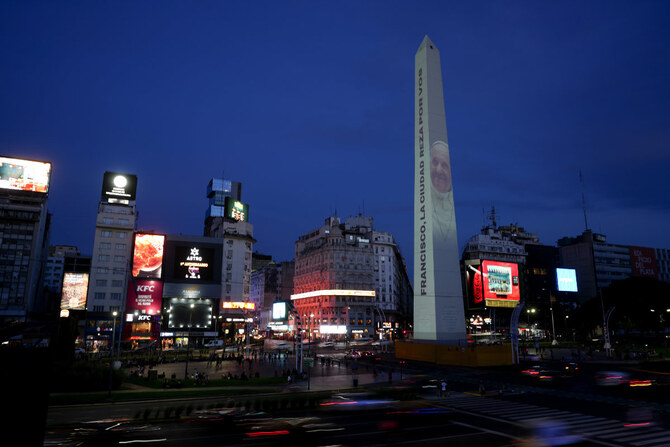
A photo of Pope Francis with a phrase that reads in Spanish: "Francis, the city prays for you" is projected onto the Obelisk in Buenos Aires, Argentina, on Feb. 23, 2025. (AP)
What about the letters?
Francis confirmed in 2022 that shortly after he was elected pope he wrote a letter of resignation, to be invoked if he became medically incapacitated. He said he gave it to the then-secretary of state, Cardinal Tarcisio Bertone, and said he assumed Bertone had delivered it to Parolin’s office when he retired.
The text is not public, and the conditions Francis contemplated for a resignation are unknown. It is also not known if such a letter would be canonically valid. Canon law requires a papal resignation to be “freely and properly manifested” — as was the case when Benedict announced his resignation in 2013.
In 1965, Pope Paul VI wrote letters to the dean of the College of Cardinals hypothesizing that if he were to become seriously ill, the dean and other cardinals should accept his resignation. The letter was never invoked, since Paul lived another 13 years and died on the job.
What happens when a pope dies or resigns?
The only time papal power changes hands is when a pope dies or resigns. At that time, a whole series of rites and rituals comes into play governing the “interregnum” — the period between the end of one pontificate and the election of a new pope.
During that period, known as the “sede vacante,” or “empty See,” the camerlengo, or chamberlain, runs the administration and finances of the Holy See. He certifies the pope’s death, seals the papal apartments and prepares for the pope’s burial before a conclave to elect a new pope. The position is currently held by Cardinal Kevin Farrell, the head of the Vatican’s laity office.
The camerlengo has no role or duties if the pope is merely sick or otherwise incapacitated.
Likewise, the dean of the College of Cardinals, who would preside at a papal funeral and organize the conclave, has no additional role if the pope is merely sick. That position is currently held by Italian Cardinal Giovanni Battista Re, 91.
Earlier this month, Francis decided to keep Re on the job even after his five-year term expired, rather than make way for someone new. He also extended the term of the vice-dean, Argentine Cardinal Leonardo Sandri, 81.


