

Pakistani security forces kill seven militants in separate encounters in volatile northwest

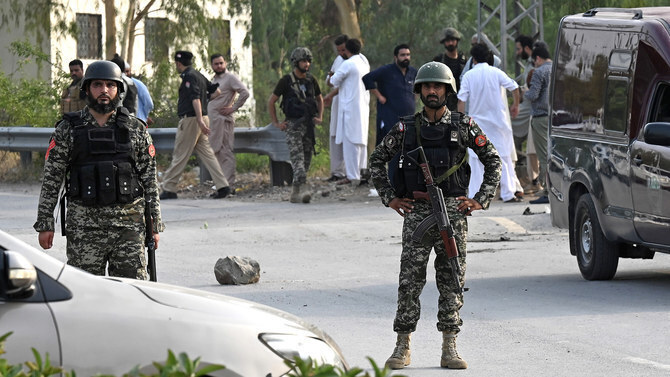
In this file photo, taken on July 18, 2023, Pakistani security personnel stand guard at the Hayatabad area of Peshawar. (AFP/File)
Short Url
Updated 23 February 2025
Follow

Pakistani security forces kill seven militants in separate encounters in volatile northwest

  • The deceased militants belonged to Pakistani Taliban who have stepped up attacks against security forces in recent months
  • Pakistan accuses Afghanistan of sheltering militant groups behind attacks in its western regions, a charge denied by Kabul

ISLAMABAD: Pakistani security forces have killed seven militants in two separate engagements in the northwestern Khyber Pakhtunkhwa (KP) province, the Pakistani military said on Sunday, amid a surge in militant violence in the region that borders Afghanistan.

The first operation was conducted in Daraban area of KP’s Dera Ismail Khan district in which four militants were killed, according to the Inter-Services Public Relations (ISPR), the military’s media wing.

Three other militants were killed in a second encounter in Maddi area of the same district.

“Weapons and ammunition were also recovered from the khwarij [Pakistani Taliban militants], who remained actively involved in numerous terrorist activities in the area,” the ISPR said in a statement.

“Sanitization operations are being conducted to eliminate any other kharji found in the area.”

The South Asian country brands the Pakistani Taliban, or the Tehreek-e-Taliban Pakistan (TTP), fighters as “khwarij,” a historical reference to an extremist sect in early Islam known for rebelling against authority, declaring other Muslims as apostates, and justifying their killing.

Pakistan has seen a surge in militancy in KP since a fragile truce between the Pakistani Taliban and the state broke down in November 2022. The militants have stepped up attacks against police and security forces in recent months, with the military reporting deaths of 383 soldiers and 925 militants in various clashes in the country in 2024.

The latest operations came more than a week after militants killed an army officer and three soldiers in a shootout in KP’s North Waziristan district, according to the military.

Islamabad has frequently blamed the surge in militancy on Afghanistan, accusing it of sheltering and supporting militant groups that launch cross-border attacks. Afghan officials deny involvement and insist that Pakistan’s security issues are an internal matter of Islamabad.


At ECO meeting, Pakistan proposes ‘Regional Innovation Hub’ to curb natural disasters

Updated 21 January 2026
Follow

At ECO meeting, Pakistan proposes ‘Regional Innovation Hub’ to curb natural disasters

  • Pakistan hosts high-level 10th ECO Ministerial Meeting on Disaster Risk Reduction in Islamabad
  • Innovation hub to focus on early warning technologies, risk informed infrastructure planning

ISLAMABAD: Pakistan has proposed to set up a “Regional Innovation Hub on Disaster Risk Reduction” that focuses on early warning technologies and risk informed infrastructure planning, the Press Information Department (PID) said on Wednesday, as Islamabad hosts a high-level meeting of the Economic Cooperation Organization (ECO).

The ECO’s 10th Ministerial Meeting on Disaster Risk Reduction (DRR) is being held from Jan. 21-22 at the headquarters of the National Disaster Management Authority (NDMA) in Pakistan’s capital. 

The high-level regional forum brings together ministers, and senior officials from ECO member states, representatives of the ECO Secretariat and regional and international partner organizations. The event is aimed to strengthen collective efforts toward enhancing disaster resilience across the ECO region, the PID said. 

“Key agenda items include regional cooperation on early warning systems, disaster risk information management, landslide hazard zoning, inclusive disaster preparedness initiatives, and Pakistan’s proposal to establish a Regional Innovation Hub on Disaster Risk Reduction, focusing on early warning technologies, satellite data utilization, and risk-informed infrastructure planning,” the statement said. 

The meeting was attended by delegations from ECO member states including Pakistan, Türkiye, Azerbaijan, Iran, Kyrgyzstan, Tajikistan, Turkmenistan and Uzbekistan. Representatives of regional and international organizations and development partners were also in attendance.

Discussions focused on enhancing regional coordination, harmonizing disaster risk reduction frameworks, and strengthening collective preparedness against transboundary and climate-induced hazards impacting the ECO region, the PID said. 

ECO members states such as Pakistan, Türkiye, Afghanistan and others have faced natural calamities such as floods and earthquakes in recent years that have killed tens of thousands of people. 

Heavy rains triggered catastrophic floods in Pakistan in 2022 and 2025 that killed thousands of people and caused damages to critical infrastructure, inflicting losses worth billions of dollars. 

Islamabad has since then called on regional countries to join hands to cooperate to avert future climate disasters and promote early warning systems to avoid calamities in future.