

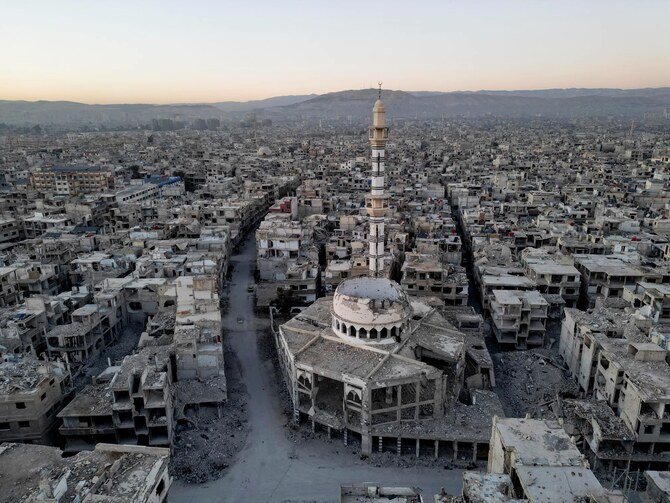

RIYADH: The war-torn economy of the Syrian Arab Republic will take decades to return to pre-conflict levels unless growth accelerates dramatically, according to a report by the UN Development Programme.
While the country’s gross domestic product has contracted to less than half its 2011 value and unemployment has tripled, the report suggests Syria could recover in a decade with a sixfold increase in annual economic growth.
The assessment, titled “The impact of the conflict in Syria: a devastated economy, pervasive poverty, and a challenging road ahead to social and economic recovery,” underscores the extensive economic and social toll of 14 years of war.
“At current growth rates, Syria’s economy will not regain its pre-conflict GDP level before 2080,” the report stated. Achieving recovery within 15 years would require an ambitious tenfold growth increase, bringing GDP to where it would have been without the conflict.
Deepening crisis
Nine out of 10 Syrians now live in poverty, and one in four are unemployed, according to the UNDP. The economy has suffered an estimated $800 billion in cumulative GDP losses since the war began. Public infrastructure has crumbled, exacerbating the crisis and prolonging instability.
The health sector is in collapse, with one-third of health centers damaged and almost half of ambulance services inoperative, the report added. Education has also been hit hard, with 40 percent to 50 percent of children aged 6 to 15 out of school.
Housing and utilities have been heavily damaged, with a third of all units affected, leaving 5.7 million Syrians in need of shelter. Over half of water and sewer systems are damaged or non-functional, affecting nearly 14 million people. Energy production has fallen 80 percent, slashing national grid capacity by over three-quarters.
As a result, Syria’s Human Development Index has fallen from 0.661 in 2010 to 0.557, dropping below its 1990 level when HDI was first recorded.
Recovery path
The UNDP report outlines a roadmap to accelerate economic recovery and restore stability. “Beyond immediate humanitarian aid, Syria’s recovery requires long-term investment in development to build economic and social stability for its people,” said Achim Steiner, UNDP administrator.
“Restoring productivity for jobs and poverty relief, revitalizing agriculture for food security, and rebuilding infrastructure for essential services such as healthcare, education, and energy are key to a self-sustaining future, prosperity, and peace.”
The report stresses the need for a clear national vision, institutional reforms, and improved market access. It calculates that at Syria’s current 1.3 percent annual growth rate, from 2018–2024, it would take 55 years to regain pre-conflict GDP levels. Achieving recovery in 15 years requires at least 5 percent annual growth, while catching up to a no-conflict scenario demands nearly 14 percent annual growth.
“Syria’s future hinges on a robust development recovery approach,” said Abdallah Al-Dardari, UNDP assistant administrator and director of the UNDP Regional Bureau for Arab States.
“This demands a comprehensive strategy addressing governance reform, economic stabilization, sector revitalization, infrastructure rebuilding, and strengthened social services. By implementing these interconnected reforms, we can help Syria regain control over its future, reduce reliance on external aid, and pave the way for a resilient and prosperous future for all in Syria.”
The UNDP assessment is part of a broader effort by the UN Country Team in Syria to shape early recovery and reconstruction initiatives.


