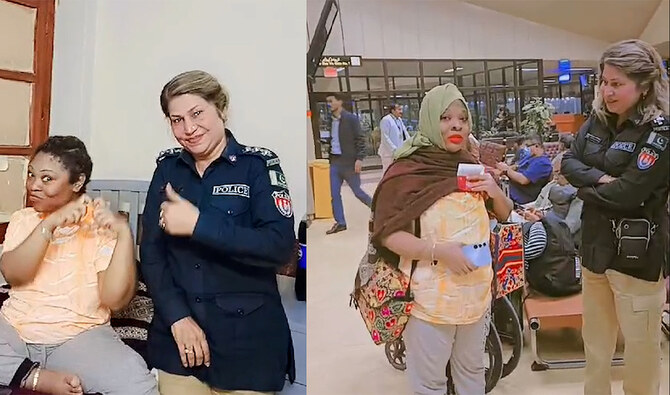
KARACHI: Shabana Jilani, a police officer in the southern Pakistani city of Karachi, emerged as an unlikely Internet star this month amid a media flurry surrounding American woman Onijah Robinson’s months-long stay in Pakistan.
Jilani’s composure and professional yet empathetic interactions with Robinson, who was abandoned by a Pakistani man she befriended online, were captured in viral TikTok videos, highlighting not only her dedication to duty but also the human side of Pakistani law enforcement.
The 33-year-old New Yorker arrived in Pakistan in October last year, hoping to marry her 19-year-old paramour, though their relationship took a dramatic turn when her intended partner abandoned her following family objections.
Left stranded, Robinson spent nearly 30 hours outside the man’s home before being taken to a shelter and later admitted to the psychiatric ward of a local medical facility.
As law enforcers were on their way to take her to the hospital, Jilani received a call from a superior officer asking her to provide security for Robinson. What followed was the making of an unexpected bond between the police officer and Robinson, marked by brief conversations and heartfelt moments that captured the Internet’s attention.
“My first meeting with Madam Onjiah took place at Jinnah Hospital, when she was being admitted,” Jilani told Arab News at her police station in Karachi. “I had a conversation with her there and it was a good experience. We spoke in a good manner.”
She said she was fulfilling her professional responsibility during her interaction with the American woman, though videos of their exchange revealed how they developed a human connection. While Jilani ensured Robinson’s safety, it was her caring attitude — helping the American loosely drape a shawl over her shoulders — that was admired by netizens.
Jilani said that while ensuring the visiting woman’s safety was her job, it was also her moral responsibility to be empathetic toward her.
“We spoke to her with love, respect and kindness, and in return, we received the same,” the police officer said.
Jilani’s husband, Deputy Superintendent of Police Ali Asghar Dahiri, lost his life in an encounter with militants in Karachi’s Landhi area in 2008, but she has continued to serve in the police force despite this personal tragedy and has dedicated about two decades of her life to policing in Karachi.
“When we joined the police department, we were given training that taught us how to face tough situations so that we could handle every challenge and difficulty,” she said.
But her interactions with ordinary people, including Robinson, reveal a softer side of the field-hardened policewoman.
And the online reaction to her videos has been overwhelming.
“I am grateful to everyone for this,” she said. “We fulfilled our professional duty while also showing respect and kindness.”
Jilani expressed her satisfaction with the videos, which have conveyed a positive message about Pakistan’s law enforcement agencies.
“They [social media users abroad] have also seen that Pakistan, its female police officers, and all our law enforcement agencies are doing a great job,” she said.
“So, a positive message has been conveyed to the world, one that highlights good behavior, strong ethics, respect and love.”
But above all, Jilani says, her interactions with Robinson were among the most memorable for her, recalling how she accompanied the American visitor to the airport for her departure on Feb. 7 after spending more than three months in Pakistan.
“She said to me, ‘I miss you so much, Shabana,’” Jilani recalled. “Good memories, good times, and beautiful moments. Just as she remembers them, so do I.”


![]()

Pakistani policewoman’s kindness toward American visitor shoots her to online fame
Short Url
https://arab.news/vt8ew
Pakistani policewoman’s kindness toward American visitor shoots her to online fame
- Shabana Jilani provided security to Onijah Robinson, an American who arrived in Pakistan seeking her online love
- While Robinson’s story made headlines, Jilani’s friendly interactions with her brought the officer online fame


Latest updates





© 2026 SAUDI RESEARCH & PUBLISHING COMPANY, All Rights Reserved And subject to Terms of Use Agreement.