


National Harbor, United States: US President Donald Trump said on Saturday he was trying to get money back for the billions of dollars sent to support Ukraine’s war against Russia.
His comments came as Washington and Kyiv negotiate a mineral resources deal Trump wants as compensation for the wartime aid his predecessor Joe Biden gave Ukraine.
It was the latest twist in a whirlwind first month since he took office, during which he has upended US foreign policy by making diplomatic overtures toward the Kremlin over the heads of Ukraine and Europe.
Trump told delegates at the Conservative Political Action Conference (CPAC) near Washington: “I’m trying to get the money back, or secured.
“I want them to give us something for all of the money that we put up. We’re asking for rare earth and oil, anything we can get.
“We’re going to get our money back because it’s just not fair. And we will see, but I think we’re pretty close to a deal, and we better be close because that has been a horrible situation.”
Hours earlier, a source told AFP that Ukrainian President Volodymyr Zelensky was “not ready” to sign such a deal, despite growing US pressure.
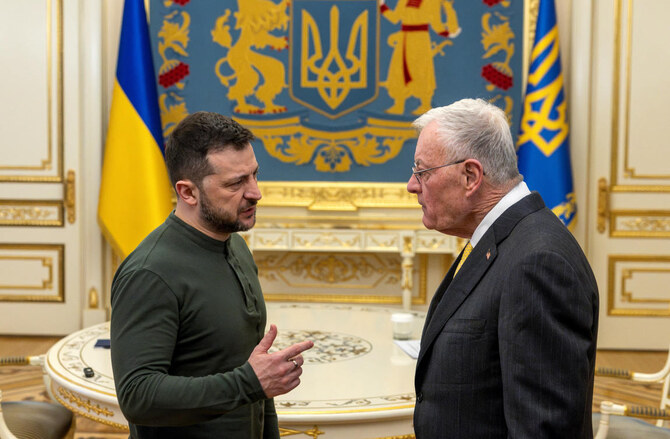
Trump’s special envoy Keith Kellogg, who met Zelensky this week, said the Ukrainian president understood signing a deal with the United States was “critical.”
But the Ukrainian source told AFP that Kyiv needed assurances first.
“In the form in which the draft is now, the president is not ready to accept, we are still trying to make changes and add constructiveness,” the source close to the matter said.
Ukraine wants any agreement signed with the United States to include security guarantees as it battles Russia’s nearly three-year invasion.
The negotiations between the two countries come amid a deepening war of words between Trump and Zelensky that has raised alarm in Kyiv and Europe.
On Wednesday, Trump branded his Ukrainian counterpart a “dictator” and called for him to “move fast” to end the war, a day after Russian and US officials held talks in Saudi Arabia without Kyiv.
Washington has proposed a United Nations resolution on the Ukraine conflict that omitted any mention of Kyiv’s territory occupied by Russia, diplomatic sources told AFP.
MINERALS FOR AID
Trump has asked for “$500 billion worth” of rare earth minerals to make up for aid given to Kyiv — a price tag Ukraine has balked at and which is much higher than published US aid figures.
“There are no American obligations in the agreement regarding guarantees or investments, everything about them is very vague, and they want to extract $500 billion from us,” the Ukrainian source told AFP.
“What kind of partnership is this? And why do we have to give $500 billion, there is no answer,” the source said, adding that Ukraine had proposed changes.
The United States has given Ukraine more than $60 billion in military aid since Russia’s invasion, according to official figures — the largest such contribution among Kyiv’s allies but substantially lower than Trump’s figures.
The Kiel Institute, a German economic research body, said that from 2022 until the end of 2024, the United States gave a total of 114.2 billion euros ($119.8 billion) in financial, humanitarian and military aid.
A senior Ukrainian official told AFP Friday that despite the tensions, talks on a possible agreement were “ongoing.”
The row comes as Ukraine is set to mark the third anniversary of Russia’s invasion on Monday, and as Kyiv’s forces are slowly ceding ground on the front line.
Moscow’s defense ministry earlier on Saturday claimed the capture of Novolyubivka in the eastern Lugansk region, which is now largely under Russian control.
In a call with Zelensky on Saturday, British Prime Minister Keir Starmer pledged the “UK’s ironclad support for Ukraine.”
Zelensky, in response, praised the United Kingdom for showing “leadership” on the war with Russia.
Starmer also said it was in the “interests” of both Britain and the United States to “stand by” Ukraine, which needed a seat at the negotiating table and “strong security guarantees so the peace will last,” writing in a column for The Sun published late Saturday.
Foreign Secretary David Lammy announced that Britain will unveil a significant package of sanctions against Russia on Monday.
In London, thousands of people marched in support of Ukraine on Saturday, and polls in Britain suggest strong support for Kyiv.
France’s Defense Minister Sebastien Lecornu said on Saturday that Paris was looking at increasing the number of its frigates and Rafale fighter jets, and stepping up production of drones.
The measures were being taken to improve France’s defense capabilities because of threats related to the Ukraine conflict, he was quoted as saying in Sunday’s edition of Le Parisien newspaper.
French President Emmanuel Macron is due in Washington for talks with Trump on Monday.
The White House said Saturday that Trump had met with conservative Polish President Andrzej Duda backstage at CPAC, and praised Duda for “Poland’s commitment to increase their defense spending.”
Duda, a vocal admirer of Trump, said he had told Zelensky in a phone call Friday to cooperate with the US president.


