ISLAMABAD: Representatives of Shia and Sunni tribes from Kurram, a district in Pakistan’s northwestern Khyber Pakhtunkhwa (KP) province that has seen sectarian and tribal clashes over the last three months, have assured their support to the government’s efforts to restore peace in the region, the KP information department said on Saturday.
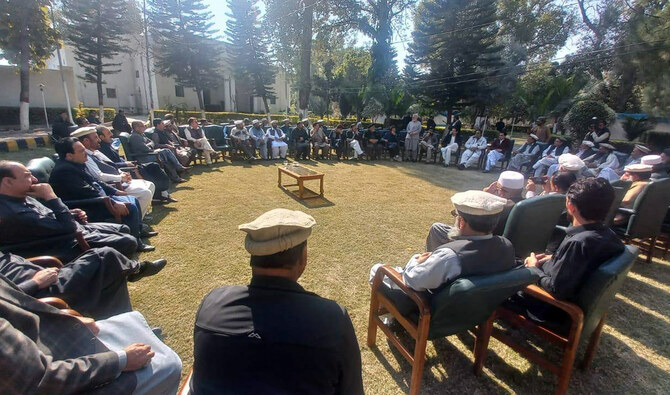
The statement came after separate meetings of delegations of Shia and Sunni tribes, based in Kurram, with KP government spokesman Muhammad Ali Saif at his office in Peshawar, according to the information department. The delegates held a detailed exchange of views with Saif, who is also part of provincial bodies tasked with resolution of the issue, on law-and-order situation in Kurram.
Kurram, a tribal district of around 600,000 where Pakistani federal and provincial authorities have traditionally exerted limited control, has frequently witnessed violence between its Sunni and Shiite communities over land and power. Travelers to and from the area often ride in convoys escorted by security officials.
Fresh feuding began on Nov. 21 when gunmen ambushed a convoy and killed 52 people, mostly Shiites. The assault triggered road closures and other measures that have disrupted people’s access to medicine, food, fuel, education and work and created a humanitarian crisis in the area, where authorities say over 150 people have been killed in nearly three months of clashes.
“Both delegations informed Barrister Dr. Saif of their respective concerns and requested strict action against the miscreants,” the KP information department said in a statement after the meetings.
“The two sides reiterated their commitment to ensure full implementation of the peace agreement and assured full cooperation with the security forces and the government to establish peace.”
The development came days after Pakistani security forces raided several villages in Kurram and arrested at least 30 suspects accused of deadly attacks on aid trucks and security forces convoy, which killed five soldiers and a truck driver this week.
Monday’s ambush was the third such assault in Kurram since January, in which unidentified men attacked vehicles carrying relief goods near Charkhel Ochat, Bagan and Mindori areas when they were en route to Parachinar, the main town of the district, according to Kurram police official Yaqoob Khan.
Shiite Muslims dominate parts of Kurram, although they are a minority in the rest of Pakistan, which is majority Sunni. The warring tribes had reached a peace agreement on Jan. 1, but sporadic violence has continued in Kurram and both sides have occasionally engaged in battles with machine guns and heavy weapons that have isolated the remote, mountainous region from the rest of the country.
The two sides had agreed on the demolition of bunkers, handover of heavy weapons to authorities, and denying space to extremists as part of the peace agreement. The government has so far razed over 150 bunkers in the region and has announced March 23 as the deadline to demolish all such structures.
Authorities have also been airlifting the injured and ailing from Kurram to Peshawar, and airdropping essential supplies in the region via helicopters since last month.
Saif said the provincial government was taking all possible steps to establish permanent peace in the region, according to the KP information department.
“The miscreants are trying to incite sectarian tensions through their nefarious acts,” he said. “We will not allow the miscreants to succeed in their ulterior motives.”

Representatives of warring sects back efforts to restore peace in troubled Pakistani district, government says
https://arab.news/pm739
Representatives of warring sects back efforts to restore peace in troubled Pakistani district, government says
- The delegations held separate meetings with spokesman of Khyber Pakhtunkhwa provincial government and shared their concerns about situation in Kurram district
- The northwestern district has witnessed sectarian clashes as well as attacks on aid convoys and security forces that have killed over 150 people in three months
Pakistan military says 12 soldiers killed in border fighting as Kabul calls for dialogue
- Military says 274 Afghan fighters killed, over 400 injured in ongoing operation
- Afghan authorities earlier said 55 Pakistani soldiers killed in retaliatory strikes
ISLAMABAD: Pakistan’s military said on Friday 12 soldiers had been killed in cross-border fighting with Afghan forces, as it detailed the scale of an ongoing border operation and accused the Kabul government of coordinating with militant groups targeting Pakistan.
The announcement followed days of escalating hostilities triggered by Pakistani airstrikes earlier this week on what Islamabad said were Tehreek-e-Taliban Pakistan (TTP) and Daesh militant camps inside Afghanistan. Since then, both governments have reported retaliatory operations and issued conflicting casualty figures, marking the most serious deterioration in relations between the neighbors in recent months.
The 2,600-kilometer (1,600-mile) shared frontier between the two nations, a key trade and transit corridor, has remained closed to trade and movement since October 2025 amid recurring tensions.
Lt. Gen. Ahmed Sharif Chaudhry, director general of Inter-Services Public Relations (ISPR), told a news conference in Rawalpindi that Pakistani forces had repelled coordinated attacks at 53 locations along the border and responded under what he described as Operation Ghazab lil-Haq.
“While safeguarding Pakistan’s honor and territorial integrity, 12 brave soldiers have embraced martyrdom in the operation so far, while 27 have been injured and one soldier is missing in action,” he said.
Chaudhry said Pakistan had destroyed 274 Taliban posts and positions and more than 400 fighters were injured, describing those figures as conservative estimates. He added that 73 posts were completely destroyed along the border and 18 had been captured.
He said Afghan Taliban forces had launched physical raids “in collusion and in support of an internationally declared terrorist organization” and accused the Taliban administration of acting in coordination with militant groups.
“The Afghan Taliban regime is the master proxy of these terrorist proxies which are operating from Afghanistan,” he said.
Kabul has repeatedly said it does not allow militants to operate in its territory.
Chaudhry said Pakistan had targeted 22 locations across the border, including in Kabul, Kandahar, Paktia, Nangarhar, Khost and Paktika.
“All targets were selected with great care based on intelligence. They were military objectives, and utmost care was taken to avoid any civilian collateral damage,” he said.
He said the Taliban authorities faced a choice.
“Either they choose terrorists and terrorism or side with Pakistan,” he said.
KABUL CALLS FOR DIALOGUE
Separately on Friday afternoon, Afghan Taliban spokesperson Zabihullah Mujahid called for talks to resolve the crisis.
“We have always emphasized peaceful resolution, and now too we want the issue to be resolved through dialogue,” he said.
In a detailed statement earlier in the day, Afghanistan’s Ministry of National Defense said it had carried out airstrikes inside Pakistan in response to what it described as Pakistani “aerial incursions” into Kabul, Kandahar and Paktia.
Afghan officials said 55 Pakistani soldiers were killed and that several posts were captured, claims denied by Islamabad.
None of the casualty figures or battlefield claims from either side could be independently verified.
Pakistan’s Information Minister Attaullah Tarar earlier said militants had attempted to launch drones inside Pakistani territory.
“Fitna al khawarij terrorists have attempted to launch small drones in Abbotabad, Swabi and Nowshera. Anti Drone Systems have brought down all the drones. No damage to life,” Tarar said.
“The incidents have again exposed direct linkages between Afghan Taliban Regime and Terrorism in Pakistan.”
Separately, Prime Minister Shehbaz Sharif on Friday visited General Headquarters (GHQ) in Rawalpindi, where he was briefed by the military leadership on the evolving situation.
According to a statement from the Prime Minister’s Office, Sharif said there would be “zero tolerance” toward what he described as collusion between the Afghan Taliban regime and militant elements.
“Pakistan knows very well how to defend itself against any aggression,” the statement quoted him as saying, adding that the armed forces were ready to safeguard the country.
Regional concern
Cross-border violence has intensified in recent weeks, with Pakistan blaming a surge in suicide bombings and militant attacks on insurgents it says are based in Afghanistan. Kabul denies providing safe havens and says Pakistan’s security challenges are an internal matter.
The latest clashes mark the third major escalation between the neighbors in less than a year. Similar strikes last year triggered weeklong fighting before Qatar, Türkiye and other regional actors mediated a ceasefire in October.
Several countries, including China, Russia, Saudi Arabia and Iran, have expressed concern and urged restraint.
Operations on both sides were ongoing as of Friday evening.


