JERUSALEM: Hamas freed six hostages from Gaza on Saturday, the last living Israeli captives slated for release under the first phase of a fragile ceasefire accord, in exchange for hundreds of Palestinian prisoners and detainees.
Eliya Cohen, 27, Omer Shem Tov, 22, and Omer Wenkert, 23, all seized from the site of the Nova music festival in Hamas’ October 7, 2023 attack on southern Israel, were handed over to the Red Cross in Nuseirat, central Gaza, to be transported to Israeli forces.
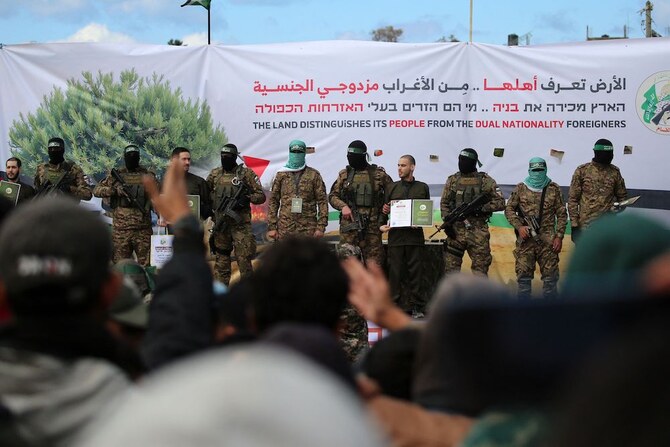
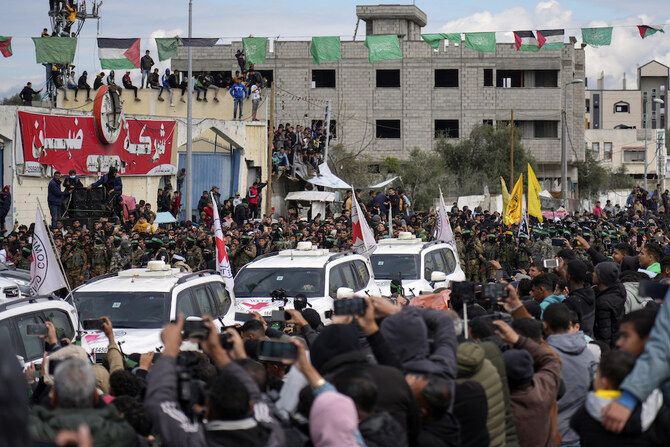
Dozens of militants stood guard in a crowd that had gathered to watch the handover, as masked Hamas men armed with automatic rifles stood on each side of the three men, who appeared thin and pale, as they were made to wave from the stage.
Tal Shoham, 40 and Avera Mengistu, 39, were earlier released in Rafah in southern Gaza.
The Hamas-directed releases, which have included public ceremonies in which captives are taken on stage and some made to speak, have faced mounting criticism, including from the United Nations, which denounced the “parading of hostages.”
Hamas rejected the criticism on Saturday, describing the events as a solemn show of Palestinian unity. It later handed over a sixth hostage, Hisham Al-Sayed, 36, to the Red Cross in Gaza City with no public ceremony.
Al-Sayed and Mengistu have been held by Hamas since they entered Gaza of their own accord around a decade ago. Shoham was abducted from Kibbutz Be’eri along with his wife and two children, who were freed in a brief truce in November 2023.
The six are the last living hostages from a group of 33 due to be freed in the first stage of the three-phase ceasefire deal between Israel and Hamas that took effect on January 19. Sixty-three more captives, less than half of whom are believed to be alive, remain in Gaza.
Shem Tov embraced his parents tightly, laughing and crying, “How I dreamt of this,” he said, in a video distributed by the Israeli military.
Shoham smiled, waved and gave a thumbs up to his friends who had gathered outside the hospital where he was taken.
“We’ve been waiting for Tal every day since October 7th,” said Yael Avner, 50, one of Shoham’s friends. “It’s a great relief just to see him there, himself just coming back home.”
Hundreds of Israelis gathered in the rain in what has become known as Hostages Square in Tel Aviv. Some lit candles under photos of the Bibas family, whose bodies were returned this week.
In return for the hostages, Israel is expected to release 602 Palestinian prisoners and detainees held in its jails.
They will include 445 Gazans rounded up by Israeli forces during the war, as well as dozens of convicts serving lengthy or life terms for attacks that killed dozens of Israelis in the Palestinian uprising two decades ago.
The fragile truce in the war between Israel and Hamas militants had been threatened by the misidentification of a body released on Thursday as that of Shiri Bibas, who was kidnapped with her two young sons and her husband in the Hamas 2023 attack.
However, late on Friday, Hamas handed over another body, which her family said had been confirmed to be hers.
“Last night, our Shiri was returned home,” her family said in a statement, which said she had been identified by Israel’s Institute of Forensic Medicine.
The Bibas family has been an emblem of the trauma suffered by Israel on that day. Her husband Yarden, seized and held separately from his family, was freed on February 1.
The Israeli military said intelligence assessments and forensic analysis of the bodies of 10-month-old Kfir Bibas and his four-year-old brother Ariel showed both had been killed deliberately by their captors, “in cold blood.”
Israel’s Army Radio, citing the forensic conclusions, said Bibas was likely slain with her children.
Hamas says the Bibas family was killed by an Israeli airstrike. A group called the Mujahideen Brigades said it was holding the family, which was confirmed by the Israeli military.
The ceasefire has brought a pause in the fighting, but prospects of a definitive end to the war remain unclear. Hamas has been at pains to demonstrate that it remains in control in Gaza despite heavy losses in the war.
The militant group triggered the conflict by its attack on Israeli communities that killed 1,200 and took 251 hostages, according to Israel.
The Israeli campaign has killed at least 48,000 people, the Palestinian health authorities say, and reduced much of the enclave to rubble, leaving some hundreds of thousands in makeshift shelters and dependent on aid trucks.
Both sides have said they intend to start talks on a second stage, which mediators say aims to agree the return of all remaining hostages and the full withdrawal of Israeli troops.


![]()
![]()
![]()

Hamas frees six hostages in Gaza in exchange for Palestinian detainees

Short Url
https://arab.news/gu7e6
Hamas frees six hostages in Gaza in exchange for Palestinian detainees
- Releases came under first phase of a ceasefire deal which began on January 19


Latest updates






© 2026 SAUDI RESEARCH & PUBLISHING COMPANY, All Rights Reserved And subject to Terms of Use Agreement.