

Andreeva downs Rybakina in Dubai to become youngest WTA 1000 finalist

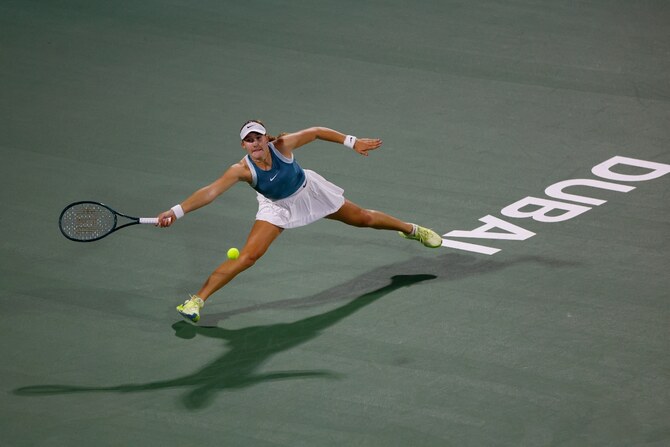
Russia's Mirra Andreeva in action during her semifinal match against Kazakhstan's Elena Rybakina at the Dubai Championships Friday. (Reuters)
Short Url
Updated 22 February 2025
Follow

Andreeva downs Rybakina in Dubai to become youngest WTA 1000 finalist

  • Andreeva is the youngest player to beat multiple Grand Slam champions at a tournament of this level, having ousted Iga Swiatek, Marketa Vondrousova, and now Rybakina, en route to the final
  • She will face Clara Tauson in Saturday’s final after the Danish world No. 38 moved past Karolina Muchova 6-4, 6-7 (4/7), 6-3 in a two-hour 52-minute tussle

DUBAI: Teenager Mirra Andreeva toppled another seed at the Dubai Championships, upsetting Elena Rybakina on Friday to become the youngest player to reach the final of a WTA 1000 tournament.

The Russian 17-year-old fought back from 1-3 down in the deciding set to beat sixth-seeded Rybakina 6-4, 4-6, 6-3 and move into the first WTA 1000 final of her career.

Andreeva is the youngest player to beat multiple Grand Slam champions at a tournament of this level, having ousted Iga Swiatek, Marketa Vondrousova, and now Rybakina, en route to the final.

She will face Clara Tauson in Saturday’s final after the Danish world No. 38 moved past Karolina Muchova 6-4, 6-7 (4/7), 6-3 in a two-hour 52-minute tussle.

“Honestly, it’s crazy because at first I was not very positive before coming to Dubai. I was like, ‘Okay, well, I’m just going to play’,” said Andreeva.

“As always, when you don’t think about how you’re going to play, you just play your best tennis. In the end, it’s one of your best tournaments.”

Tauson, 22, is enjoying a banner week that saw her knock out world number one Aryna Sabalenka. She is now through to the biggest final of her career, and fifth overall.

Tauson has collected a tour-leading 15 victories so far this season, one more than Swiatek and Australian Open champion Madison Keys, who each have 14.

“Muchova is such a great player. I don’t know what to say, I don’t know how I won today. I tried to keep my cool and play some good tennis,” said Tauson, who was on the receiving end of a stunning tweener lob winner struck by Muchova midway through the deciding set.

In the first semifinal of the day, a punishing backhand return from Andreeva earned her the first break of the match in game five and despite Rybakina’s immediate response, the young Russian got back in front and closed out the opening set on the 46-minute mark.

Having already saved six match points in her win over Paula Badosa in the round of 16, Rybakina looked ready to put up a fight against Andreeva and the second set was a tight affair.

The pair remained neck and neck until Rybakina found an opening when Andreeva double-faulted to face two set points at 4-5. Andreeva bounced the ball off the ground in frustration and received a code violation warning for ball abuse.

Moments later, former Wimbledon champion Rybakina took the match into a decider on a long defensive forehand from her opponent, as Andreeva dropped her first set of the tournament.

Rybakina made the first move in the third, breaking for a 3-1 advantage but Andreeva reacted and swept the next five games to wrap up the win in two hours and 15 minutes.

Andreeva will rise to a career-high No. 11 in the world by virtue of reaching the final and could become the first 17-year-old to break the top 10 since Nicole Vaidisova achieved that feat in 2007 if she lifts the trophy on Saturday.

She made her tour debut less than two years ago but has quickly positioned herself as a star in the making with a great deal of pressure on her shoulders.

“Now I have some kind of pressure that people are expecting some things from me. People are saying, ‘She’s going to be No. 1, she’s going to win the Slams. She’s going to be great’,” explained Andreeva.

She says she’s been working with her psychologist to adopt the right mentality when dealing with such pressure.

“It’s easier for me to think these people are saying this because probably they are afraid of the way I play,” added Andreeva.

“It helps me to go on the court with kind of anger, not to prove to everyone that I really can do it, but to prove myself that I’m strong enough to handle the pressure and to really win these high-quality matches.”


From Jeddah to the world stage: Bader Idrees and Saudi Arabia’s tennis rise

Updated 25 December 2025
Follow

From Jeddah to the world stage: Bader Idrees and Saudi Arabia’s tennis rise

RIYADH: As tennis continues to gain momentum throughout Saudi Arabia, several local players are beginning to emerge on the national and international scene. One of them is Saudi national team player Bader Idrees, whose journey mirrors the Kingdom’s evolving relationship with the sport.

Idrees’ first exposure to tennis came at a time when the local game was still developing. His interest began in early 2010 after watching his older sister train regularly.

“I was five years old when I used to watch my older sister playing tennis every day,” he told Arab News. “One of her coaches recommended that I try it out, and from the first hit, I fell in love with the sport.”

Now 20 years old, Idrees finds himself progressing alongside a country that is investing heavily in tennis. Over the past three months alone, Saudi Arabia has hosted the Six Kings Slam, the WTA Finals, and the Next Gen ATP Finals, an indication of its growing ambitions on the global tennis stage.

A defining moment in Idrees’ development came at the 2025 WTA Finals, where he reached a personal milestone in his role as a hitting partner for some of the world’s best players.

“It was one of the best experiences I’ve had so far,” he said. “To actually see the players and train with them was an eye-opening experience for me.”

The exposure offered by hosting elite tournaments has had a direct impact on aspiring Saudi athletes, providing valuable insight into the professional game.

“Seeing how players prepare for matches — from how they behave off the court to actually practicing on the court — was an amazing experience,” he said.

Beyond individual growth, Idrees believes the broader sporting ecosystem benefits from welcoming international events to the Kingdom.

“Hosting these events motivates every Saudi athlete,” Idrees said. “Foreign players get to know the country and the players who represent it, and it pushes us to perform better knowing that the world is watching.”

That motivation has translated into concrete goals. Idrees is planning a busy start to the year, with four international tournaments scheduled for January.

“I feel very positive about what I’ve accomplished so far, so hopefully I can kick off with a strong start in 2026.”

Despite recent progress, Idrees credits his early development at home as the foundation of his success.

“I don’t think I would be at this level if I weren’t in Saudi Arabia, and if I didn’t meet my coach Wajih there, who played a big role in my journey,” Idrees said.

To further advance his career, he later relocated to Cairo, where increased competition and exposure helped accelerate his development.

“That experience, combined with my coach’s motivation, made me believe I could truly go pro,” he said.

The journey was not without challenges. Idrees reflected on the limitations that once existed in the local tennis landscape.

“Tennis has grown massively in Saudi Arabia over the last few years,” he said. “But before that, we didn’t always have the best facilities or infrastructure. That’s why seeing the progress now makes me happy.”

Today, that transformation is happening at a rapid pace — something Idrees notices each time he returns home from international competition.

“Month by month,” as he puts it.

Whether in Riyadh, Jeddah, or Dammam, the changes are increasingly visible. Looking ahead, Idrees is optimistic about the next generation of Saudi players.

“I wouldn’t be surprised to see the kids playing at the under-10 and under-12 level find themselves in the top 500 or 300 within the next 10 years,” he said. “I see the discipline and motivation in them, and it truly is something special.”

He is also realistic about his own development compared with today’s young talents.

“I wasn’t at this level at 10, 12 years old,” he admitted. “Training with kids at that age now, I’m genuinely impressed. It’s why I’m feeling very positive about their future.”

With growing infrastructure, elite-level exposure, and rising ambition, Idrees’ story represents more than personal achievement. It highlights how Saudi Arabia’s expanding role as a host of global sporting events is reshaping its tennis landscape — and how a new generation of players may be poised to make an impact on the world stage in the years ahead.
