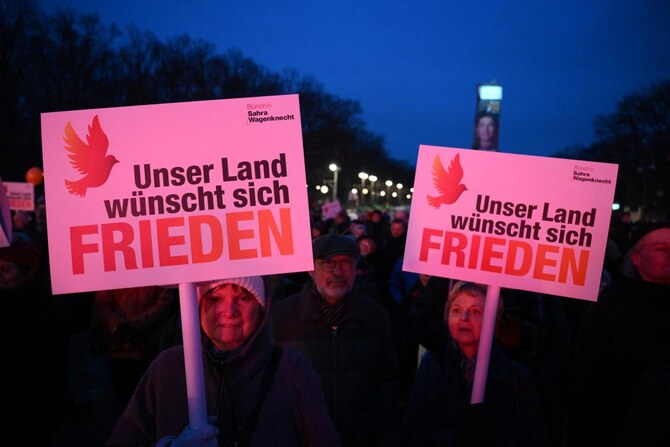
BERLIN: More than half a million newly naturalized citizens will have the opportunity to vote in a German national election for the first time this weekend.
Almost a third of the new Germans are originally from Syria. Most of them left their home countries in the last decade, fleeing war, political instability and economic hardship. In 2015-2016 alone, more than 1 million migrants came to Germany, most from Syria, but also from Afghanistan and Iraq.
Since the last national election in 2021, the number of naturalizations in Germany has risen sharply: More than 500,000 people were naturalized between 2021 and 2023, according to the country’s Federal Statistical Office.
While the numbers for 2024 are not yet available, experts estimate that more than 250,000 people were naturalized in Germany last year.
Many of the new citizens who will vote for the first time in Germany on Sunday have expressed a mix of excitement, hope for change, and a feeling of empowerment about their voting rights. Some worry about the rise of the far-right, anti-immigrant Alternative for Germany, or AfD, party.
For the new Germans originally from Syria, the election is weighted with extra significance. Many of them fled their country because of the civil war that followed former president Bashar Assad’s crackdown on protests calling for greater democratic freedom. He was toppled in November, but whether Syria will now become a democracy remains unclear. In the meantime, they are able to vote in multi-party elections in their new home.
Here’s what five of the newcomers say about voting in Germany:
Logeen Faour Shahna, 24, wants to give other migrants a voice
Originally from Idlib in Syria, Faour Shahna arrived in 2015 and is now studying mathematics at Berlin’s Technical University. She says her new German passport gives her a sense of security as she is now no longer afraid of being deported. She wants to go vote on Sunday, “because every vote counts.”
“It may be that others still see me as a foreigner, but I also want to pass on the voices of foreigners (and show) that not everyone is the same. You should not see us as foreigners, but as human beings, and you should see what we will do for the German state in the future.
“I am clearly against AfD. ... I think there are also many others who are against AfD, whether they were born as foreigners or whether they are German. I don’t think they’ll ever rule Germany. Otherwise we would be back in the 1930s.”
Syamend Al Othman, 31, hopes the next government will boost the economy
Al Othman, a Syrian Kurd, came to Germany in 2014. He currently works in online marketing but dreams of opening his own coffee place in Berlin. He says he and his wife are just like other Germans, working, paying their taxes, not committing any crimes, and visiting family on weekends. He hopes that the next government can make sure that ” Germany’s economy will get better again.”
“This is my first national election after becoming a German. Of course it has a lot of meaning for me that my wife and I have an influence on German elections, that we also decide who governs us.
“I talked to my father (in Syria) the other day. My father has never voted. And that’s why we think it’s so important. It’s nice that we can vote and that we also have democracy here in Germany. There is still not much real democracy in Syria and no elections yet, because Assad has only been gone for a few weeks and we still need time to get democracy in Syria.”
Ketevan Asatiani-Hermann, 35, says voting is more important than ever as democracy is under threat
Asatiani-Hermann came to Germany from Georgia, in the Caucasus, in 2011 and was naturalized in October. She is married to a German and lives in Magdeburg, where she has a job as a social worker helping migrant teenagers integrate in society. She voiced concern that discrimination of migrants may further grow after a deadly attack by a Saudi physician on a Christmas market in Magdeburg that killed six and injured more than 200.
“I have never felt before that democracy is under such threat. This is a very good time for me to perhaps contribute with my vote to ensure that people vote for democracy and that hate and racism are not promoted. ... It also gives me a sense of affirmation and that I’m allowed to have a say ... I’m very pleased that I’ll have that opportunity this year.
“I very much hope that the next government will ensure that there is more cohesion in our society again. That it’s not so much about them and us anymore and that people who are different for whatever reasons won’t get excluded.”
Sedra Hanina, 23, wants Germany to provide more security especially for women wearing hijab
Hanina came from Damascus in 2016, when she was 15 years old. She’s married, has one daughter, and studies chemistry in Berlin. The young woman hopes that the next government will provide more security, especially for women like herself who wear the hijab, as she often feels badly treated. But most of all she is excited to vote for the first time in her life.
“It’s a big challenge that you have to find out which party, which advantages, which disadvantages, what the goals of the respective party are. And I’m actually really looking forward to seeing what happens after the elections and which party wins.
“I hope there will be more of a focus on social justice, integration, and freedom of people ... that everyone is treated the same as everyone else, no matter where you come from, how you look, and how you act. The main thing is that everyone is treated equally.”
Hassan Salameh, 40, says German passport, right to vote are a reward for his efforts to integrate
The pharmacist and father of two small children is originally from Aleppo. Since his arrival in Germany in 2014, he studied German until he was fluent, worked to get his pharmacy degree recognized, found a job and waited for more than three years until his application for German citizenship was approved.
” I see the German passport as a reward after such a long time of efforts, difficulties, hope and stress — we’ve put so much effort into making sure that we make a future for ourselves as a small family.
“For me, the moment when I go to vote for the first time is very, very special. ... It is a responsibility for us and for society to make the right decision this time to ensure our future, security and wellbeing, and that Germany continues to lead in Europe.”


![]()

Five newly naturalized Germans will head to the polls
Short Url
https://arab.news/m7rcm
Five newly naturalized Germans will head to the polls
- For the new Germans originally from Syria, the election is weighted with extra significance
- Many of them fled their country because of the civil war that followed former president Bashar Assad’s crackdown on protests calling for greater democratic freedom


Latest updates




© 2026 SAUDI RESEARCH & PUBLISHING COMPANY, All Rights Reserved And subject to Terms of Use Agreement.