In rare development, ex-PM Khan aides hold meeting with Pakistan chief justice

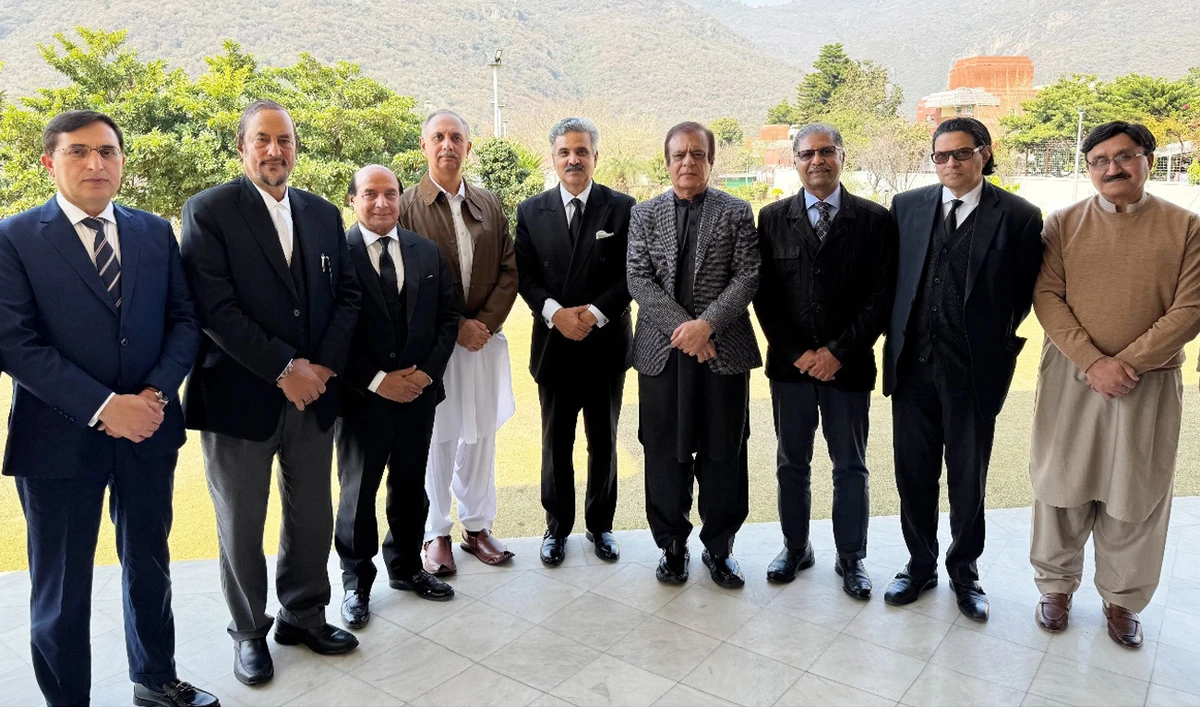
In this handout photo, taken and released by the Supreme Court of Pakistan on February 21, 2025, Pakistan Chief Justice Yahya Afridi (5R) gestures for a group photograph with the Pakistan Tehreek-e-Insaf and opposition leaders following a meeting at the Chief Justice House in Islamabad. (Photo courtesy: Handout/SCP)
Short Url
Updated 21 February 2025
Follow

In rare development, ex-PM Khan aides hold meeting with Pakistan chief justice

  • Imran Khan’s aides say top judge asked for their input on draft National Judicial Policy
  • Supreme Court says judicial reform should be ‘minimum common national agenda’

ISLAMABAD: Jailed former prime minister Imran Khan’s top aides said on Friday they had held a meeting with Pakistan Chief Justice Yahya Afridi, in a rare development to discuss drafting a National Judicial Policy.
The move comes days after Prime Minister Shehbaz Sharif met Afridi at his residence, with the top judge sharing the agenda of an upcoming meeting of the National Judicial Policy Making Committee and seeking the input of the government on the draft, according to the Supreme Court. The chief justice’s reforms agenda aims to reduce the pendency of cases and provide speedy justice to litigants.
Afridi had informed PM Sharif during their meeting that he would also be taking the opposition’s input and wanted bi-partisan support for his reforms.
Speaking at a press conference in Islamabad, Gohar Khan, the chairman of Imran Khan’s Pakistan Tehreek-e-Insaf, said the party had met the chief justice on his request to discuss the new National Judicial Policy.
“The chief justice of Pakistan had shared an agenda with us regarding National Judicial Policy and asked for our inputs on ten points,” Gohar said.
Last year, ex-PM Khan had written a letter to then Chief Justice Qazi Faez Isa, who retired in October, seeking judicial intervention into alleged rigging in the Feb. 8, 2024 national election and the subsequent allocation of reserved seats in the national and provincial assemblies, which the PTI says were unfairly allocated to their opponents.
After the election, the Election Commission of Pakistan had denied the PTI its share of 70 reserved seats in parliament, contending that Khan-backed independent candidates could not claim them. PTI candidates contested the polls independently after the party lost its election symbol in the run-up to election for not holding intra-party elections.
The Supreme Court later struck down the Election Commission of Pakistan’s decision on the reserved seats, calling it “unconstitutional” and ordering that reserved seats be allocated to the PTI.
“We also told him [Chief Justice Afridi] that no one regards SC order as a court order these days. SC orders are not being implemented be it senate elections or reserved seats,” Gohar said.
The PTI chairman added that the chief justice had assured the party of taking “certain measures” to address its issues.
The Supreme Court issued a statement later in the day, corroborating the information shared by PTI leaders about their discussion with the chief justice regarding the situation faced by their party colleagues and supporters.
The statement emphasized the need to make judicial reform a “Minimum Common National Agenda” with comprehensive political support.
Pakistan, currently bolstered by a $7 billion IMF facility granted in September, is navigating an economic recovery path even as it faces prolonged political crisis.
Imran Khan, arguably the country’s most popular politician, has been behind bars since August 2023 in a slew of cases he says are politically motivated. His party has been leading a movement, including through street protests and sit-ins, to demand his release.
Pakistan’s Punjab to hold Basant kite festival from Feb. 6-8 after 25-year ban

Updated 7 sec ago
Follow

Pakistan’s Punjab to hold Basant kite festival from Feb. 6-8 after 25-year ban

  • Province to start safety antenna installation campaign on all motorbikes from tomorrow
  • Basant ban began in the mid-2000s after fatal incidents involving metal-coated kite strings

ISLAMABAD: Pakistan’s most populous Punjab province will hold the iconic spring kite-flying Basant festival from Feb. 6-8 next year after the provincial government lifted its long-running 25-year ban earlier this month, a senior minister said on Wednesday.

The ban due to fatal kite-string accidents was lifted after the provincial administration passed the Punjab Kite Flying Ordinance 2025, marking a cautious comeback for a festival that once symbolized the arrival of spring in the region.

Basant, one of Punjab’s most celebrated cultural festivals, used to draw thousands to rooftops across Lahore and other cities. However, from 2005 onward, it was repeatedly banned after dozens of people were killed or injured by dangerous metal and chemically coated kite strings that could slash motorcyclists and pedestrians, many of them children.

Courts and provincial administrations upheld these prohibitions for years, making the revival of Basant one of Punjab’s most politically sensitive cultural decisions.

“[Chief Minister] Punjab Maryam Nawaz Sharif has approved the revival of our beloved Heritage Basant Festival on February 6th, 7th and 8th celebrated across Lahore after 25 years, a tradition rooted in history and admired worldwide,” Punjab Senior Minister Marriyum Aurangzeb said in a post on X.

“The Basant Ordinance 2025 will be fully enforced and implemented. Every kite string and seller registered, QR coded and monitored. Basant belongs to the people, its success is our collective responsibility.”

Aurangzeb added that a citywide campaign to install safety antennas on all motorbikes will begin tomorrow.

“Every motorbike in Lahore will have Antenna for safety before and during Basant Inshallah,” Aurangzeb added. “Safety is CM Punjab’s priority. Let every kite soar and every ride be safe together, we’ll make Lahore happy historic and secure!“

Under new regulations, the government has made it mandatory for anyone making or selling kites to register. Each kite must carry a QR code linking to the seller’s identity.

The rules also prohibit children under the age of 18 from flying kites, making their guardians responsible for any violations. Fines for minors are set at Rs 50,000 ($179) for a first offense and Rs 100,000 ($358) for a second offense. Kite flying will only be allowed with formal authorization.

In Punjab, kite flying will require permission from the deputy commissioners, and kites may only be purchased from registered vendors.

The ordinance introduces strict penalties for adults as well, including three to five years in prison and a fine of Rs 2 million ($7,160) for violations.

The government has said the new regulatory framework was intended to revive the Basant festival in a controlled and safe manner, balancing public enthusiasm for the celebration with longstanding concerns over fatal injuries caused by unsafe kite strings.

Officials say that the ordinance also aims to formalize the small but extensive economy surrounding Basant, which includes kite manufacturing, string production, dyes, paper supply, bamboo cutting, wholesalers and thousands of seasonal vendors.

For decades, this value chain has operated informally, with no licensing, safety regulations, or tax registration, generating minimal direct revenue for the provincial government.

By bringing manufacturers and sellers into a documented system through mandatory registration and QR-coded products, officials argue that the government can expand its tax base, ensure safer production standards and create more predictable business opportunities for cottage-industry workshops that rely on the Basant season for income.