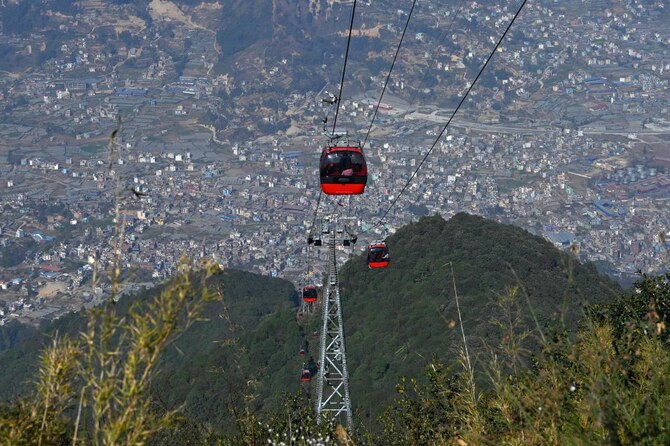
TAPLEJUNG, Nepal: They appear tranquil soaring above Himalayan forests, but a string of cable car projects in Nepal have sparked violent protests, with locals saying environmental protection should trump tourism development.
In Nepal’s eastern district of Taplejung, the community has been torn apart by a $22-million government-backed project many say will destroy livelihoods and damage ancient forests they hold as sacred.
Across Nepal, five cable car projects have opened in the past two years – and 10 more are under development, according to government figures.
Critics accuse the government of failing to assess the environmental impact properly.
In January, protests at Taplejung escalated into battles with armed police, with four activists wounded by gunfire and 21 officers injured.
The protests calmed after promises construction would be suspended, but erupted again this week, with 14 people wounded on Thursday – 11 of them members of the security forces.
“We were in a peaceful protest but hired thugs showed us kukris (large knives) and attacked us – and we countered them,” protest committee leader Shree Linkhim Limbu said after the latest clashes.
He vowed to continue demonstrations until the project is scrapped.
Around 300,000 Hindu devotees trek for hours to Taplejung’s mountaintop Pathibhara temple every year – a site also deeply sacred to the local Limbu people’s separate beliefs.
In 2018, Chandra Prasad Dhakal, a businessman with powerful political ties who is also president of Nepal’s Chamber of Commerce and Industry, announced the construction of a 2.5-kilometer-long (1.5-mile) cable car to the temple.
The government calls it a project of “national pride.”
Dhakal’s IME Group is also building other cable cars, including the 6.4-kilometer-long Sikles line in the Annapurna Conservation Area, which the Supreme Court upheld.
The government deemed the project a “national priority,” thereby exempting it from strict planning restrictions in protected areas.
The Supreme Court scrapped that controversial exemption last month, a move celebrated by environmentalists.
But activists fear the project may still go ahead.
Taplejung is deeply sacred to local Mukkumlung beliefs, and residents say that the clearance of around 3,000 rhododendron trees – with 10,00 more on the chopping block – to build pylons is an attack on their religion.
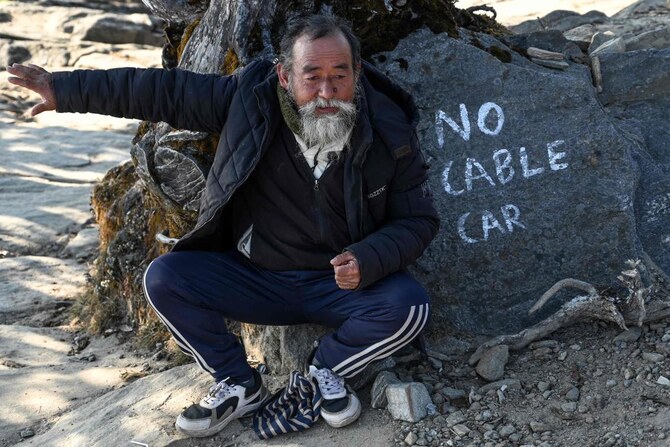
“It is a brutal act,” said protest chief Limbu. “How can this be a national pride project when the state is only serving business interests?”
Saroj Kangliba Yakthung, 26, said locals would rather efforts and funding were directed to “preserve the religious, cultural and ecological importance” of the forests.
The wider forests are home to endangered species including the red panda, black bear and snow leopard.
“We worship trees, stone and all living beings, but they are butchering our faith,” said Anil Subba, director of the Katmandu-based play “Mukkumlung,” which was staged for a month as part of the protest.
The hundreds of porters and dozens of tea stall workers that support trekking pilgrims fear for their livelihoods.
“If they fly over us in a cable car, how will we survive?” said 38-year-old porter Chandra Tamang.
The government says the cable car will encourage more pilgrims by making it easy to visit, boosting the wider economy in a country where unemployment hovers around 10 percent, and GDP per capita at just $1,377, according to the World Bank.
“This will bring development,” said resident Kamala Devi Thapa, 45, adding that the new route will aid “elderly pilgrims.”
The cable cars symbolize Nepal’s breakneck bid to cash in on tourism, making up more than six percent of the country’s GDP in 2023, according to the World Travel and Tourism Council (WTTC).
Beyond the Pathibhara project, the government’s environmental policy is in question – in a country where 45 percent is forest.
More than 255,000 trees have been cut down for infrastructure projects in the past four years, according to the environment ministry.
“Nepal has witnessed massive deforestation in the name of infrastructure,” said Rajesh Rai, professor of forestry at Tribhuvan University. “This will have severe long-term consequences.”
Unperturbed, the cable car builder assures his project will create 1,000 jobs and brushes aside criticism.
“It won’t disturb the ecology or local culture,” Dhakal said. “If people can fly there in helicopters, why not a cable car?”
The argument leaves Kendra Singh Limbu, 79, unmoved.
“We are fighting to save our heritage,” he said.
It has split the community, local journalist Anand Gautam said.
“It has turned fathers and sons against each other,” Gautam said. “Some see it as progress, others as destruction.”


![]()
![]()
![]()

Nepal community fights to save sacred forests from cable cars

Short Url
https://arab.news/26ztd
Nepal community fights to save sacred forests from cable cars
- Across Nepal, five cable car projects have opened in the past two years – and 10 more are under development
- Critics accuse the Nepalese government of failing to assess the environmental impact properly


Latest updates


© 2026 SAUDI RESEARCH & PUBLISHING COMPANY, All Rights Reserved And subject to Terms of Use Agreement.