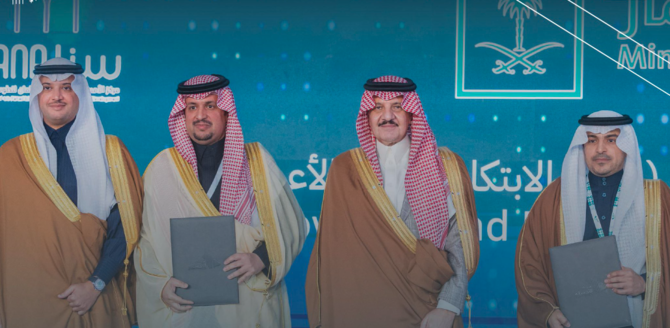
Saudi investment ministry inks deal with Sana to boost entrepreneurial ecosystem in Al-Ahsa

The agreement was signed at the Al-Ahsa Forum 2025 in Al-Ahsa. X/@MISA
Short Url
Updated 20 February 2025
Follow

Saudi investment ministry inks deal with Sana to boost entrepreneurial ecosystem in Al-Ahsa

RIYADH: A new cooperation agreement between the Ministry of Investment and Prince Ahmed bin Fahd bin Salman Center will see Saudi Arabia enhance its entrepreneurial ecosystem in the Al-Ahsa region.

The deal signed with the center, also known as Sana, focuses on attracting pioneering companies and innovators while fostering a business-friendly environment.

The Kingdom is increasingly being recognized for its growing enteprise-friendly landscape, securing third position in the 2023-2024 Global Entrepreneurship Monitor report.

The latest initiative, inked at the Al-Ahsa Forum 2025 in Al-Ahsa, also seeks to foster greater engagement with creative thinkers and business leaders through investment meetings and events, and will support the issuance of entrepreneurial licenses and provide access to essential services.

Moreover, the Sana agreement seeks to explore investment opportunities, encourage strategic partnerships, and promote investment alliances that enhance the competitiveness of the entrepreneurship sector in Saudi Arabia.

The new deal comes against a backdrop of venture capital pouring into the Kingdom, with the country retaining its position as the leading destination for such funds in the MENA region in 2024, raising $750 million, according to a report from regional venture platform MAGNiTT.

This marked the second consecutive year the Kingdom has led regional VC rankings. Saudi Arabia accounted for 40 percent of the total amount deployed in MENA, closing 178 deals, the most of any nation in the region.

Speaking to Arab News at at the LEAP 2025 Tech Conference held in February, Mohammed Al-Zubi —founder of Saudi venture capital firm Nama Ventures — explained that the nation is rapidly becoming a key player in the regional technology ecosystem and is emerging as the “center of gravity” for Middle East startups.

Al-Zubi believes Saudi Arabia’s support for the startup ecosystem is unmatched globally. Having spent time in Silicon Valley, London, and the Middle East, he argued that the Kingdom’s government-led initiatives are unparalleled.

According to the international policy advisory and research organization Startup Genome, Riyadh ranked among the top five startup ecosystems in the Middle East and North Africa in June, in collaboration with the Global Entrepreneurship Network.


Education spending surges 251% as students return from autumn break: SAMA

Updated 12 December 2025
Follow

Education spending surges 251% as students return from autumn break: SAMA

RIYADH: Education spending in Saudi Arabia surged 251.3 percent in the week ending Dec. 6, reflecting the sharp uptick in purchases as students returned from the autumn break.

According to the latest data from the Saudi Central Bank, expenditure in the sector reached SR218.73 million ($58.2 million), with the number of transactions increasing by 61 percent to 233,000.

Despite this surge, overall point-of-sale spending fell 4.3 percent to SR14.45 billion, while the number of transactions dipped 1.7 percent to 236.18 million week on week.

The week saw mixed changes between the sectors. Spending on freight transport, postal and courier services saw the second-biggest uptick at 33.3 percent to SR60.93 million, followed by medical services, which saw an 8.1 percent increase to SR505.35 million.

Expenditure on apparel and clothing saw a decrease of 16.3 percent, followed by a 2 percent reduction in spending on telecommunication.

Jewelry outlays witnessed an 8.1 percent decline to reach SR325.90 million. Data revealed decreases across many other sectors, led by hotels, which saw the largest dip at 24.5 percent to reach SR335.98 million. 

Spending on car rentals in the Kingdom fell by 12.6 percent, while airlines saw a 3.7 percent increase to SR46.28 million.

Expenditure on food and beverages saw a 1.7 percent increase to SR2.35 billion, claiming the largest share of the POS. Restaurants and cafes retained the second position despite a 12.6 percent dip to SR1.66 billion.

Saudi Arabia’s key urban centers mirrored the national decline. Riyadh, which accounted for the largest share of total POS spending, saw a 3.9 percent dip to SR4.89 billion, down from SR5.08 billion the previous week.

The number of transactions in the capital settled at 74.16 million, down 1.4 percent week on week.

In Jeddah, transaction values decreased by 5.9 percent to SR1.91 billion, while Dammam reported a 0.8 percent surge to SR713.71 million.

POS data, tracked weekly by SAMA, provides an indicator of consumer spending trends and the ongoing growth of digital payments in Saudi Arabia. 

The data also highlights the expanding reach of POS infrastructure, extending beyond major retail hubs to smaller cities and service sectors, supporting broader digital inclusion initiatives. 

The growth of digital payment technologies aligns with the Kingdom’s Vision 2030 objectives, promoting electronic transactions and contributing to the nation’s broader digital economy.