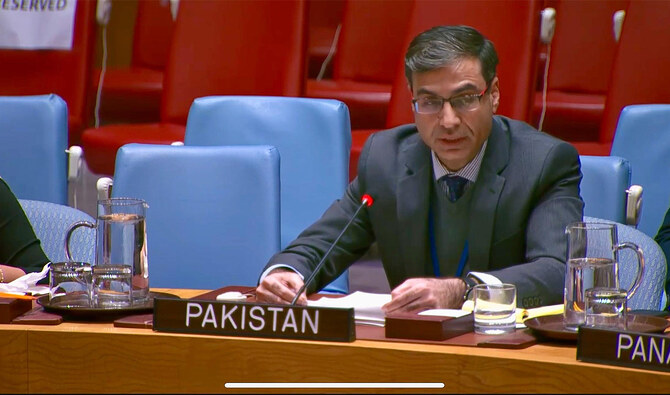
ISLAMABAD: Pakistan accused India of employing militant groups as proxies to target Pakistan citizens and security forces at the United Nations Security Council on Wednesday, as it said New Delhi was conducting “demographic engineering” in the disputed Himalayan region of Kashmir under its control.
The statement by Pakistani diplomat Asif Khan came amid a surge in militant violence within Pakistan, particularly in the western provinces of Khyber Pakhtunkhwa and Balochistan. These regions, bordering Afghanistan, have experienced increased attacks from groups such as Tehreek-e-Taliban Pakistan (TTP) and separatist factions like the Baloch Liberation Army (BLA).
Pakistan has frequently accused Afghanistan’s interim administration of sheltering these armed factions and facilitating their attacks, allegations that Kabul has consistently denied. However, the recent accusation against India was articulated by Khan during his right of reply, following remarks from an Indian delegate concerning Kashmir and militancy.
“We heard the Indian delegate raising the bogey of terrorism to divert attention and for diplomatic point-scoring,” the Pakistani diplomat said. “It is most ironic that India, which is committing the worst form of state terrorism in Occupied Jammu and Kashmir, is portraying itself as the victim.”
“It is India which supports and finances terrorism against Pakistan by using its proxies such as Tehreek-i-Taliban Pakistan (TTP), Majeed Brigade and Baloch Liberation Army (BLA),” he added. “The country is insensitive to the tragic human dimension of terrorism.”
He accused India of insensitivity to the tragic human dimension of terrorism and described the country as running a “global terrorism syndicate,” saying it had gone from regional to global and even reached North American shores.
Addressing the Kashmir issue, Khan said India was undertaking demographic engineering since August 5, 2019, when it unilaterally revoked the region’s special constitutional status and decided to integrate it with the rest of the Indian union.
India and Pakistan have fought three wars, two of them over Kashmir, which they both claim in full but rule in part since their independence.


Pakistan tells UN India using militant proxies amid surge in violence
https://arab.news/g3rkh
Pakistan tells UN India using militant proxies amid surge in violence

- Pakistani diplomat accused New Delhi of running a ‘global terrorism syndicate’ reaching North American shores
- He says Indian administration is conducting ‘demographic engineering’ in the part of Kashmir under its control

Pakistan awards 11 onshore oil and gas blocks to boost domestic production
- Pakistan has faced a widening energy gap due to rising demand, limited domestic output, forcing it to import costly fuels
- Successful joint venture partners include state-run enterprises as well as local and international explorations companies
KARACHI: Pakistan has awarded 11 onshore oil and gas blocks for exploration to state-owned and private firms to boost domestic production and reduce reliance on costly energy imports, the Pakistani information ministry said on Thursday.
Pakistan has faced a widening energy gap due to rising demand and limited domestic output, forcing it to import costly fuels and expose the economy to global price swings. Its petroleum, oil, and lubricants import bill fell 4.39 percent to $9.046 billion in July 2025-January 2026.
On Thursday, the Petroleum Division signed petroleum concession agreements (PCAs) and exploration licenses (ELs) to award 11 onshore blocks for exploration, marking a significant step forward in advancing oil and gas exploration activities across the South Asian country.
The successful joint venture partners include the state-run Oil and Gas Development Company Limited (OGDCL), Pakistan Petroleum Limited (PPL), Mari Energies Limited (MariEnergies), Pakistan Oilfields Limited (POL) and Prime Global Energies (Prime).
“Signing of agreements demonstrate strong investor confidence in Pakistan’s upstream potential,” Petroleum Minister Ali Pervaiz Malik said, adding it aimed to boost domestic exploration, attract investment and reduce reliance on imported energy.
MariEnergies will serve as operator for six blocks. The company has secured 100 percent working interest in five blocks, including Padag, Chagai, Dalbandin, Merui, and Merui West, and will lead the Ahmad Wal block as operator with a 60 percent working interest, alongside the
Oil and Gas Development Company Limited (OGDCL) that will be holding 40 percent.
OGDCL will operate three blocks, including Kalat North with 100 percent working interest. It will also lead two joint venture blocks: Naing Sharif (OGDCL 70 percent as operator, Prime 30 percent) and Khiu-II (OGDCL 60 percent as operator, MariEnergies 40 percent).
PPL emerged as the highest bidder for the Kalat South block and will operate it with a 40 percent working interest, in partnership with OGDCL (30 percent) and MariEnergies (30 percent). POL secured the Jherruk block with 100 percent working interest.
“The minimum committed investment by the successful bidders exceeds USD31 million (approximately Rs8.66 billion) over the next three years,” the information ministry said. “In addition, more than Rs276 million ($987,133) has been committed toward social welfare initiatives in the respective areas.”
In the event of commercial hydrocarbon discoveries, substantial additional investments amounting to millions of dollars are anticipated for field development and production activities, according to the ministry.
Pakistan has announced new oil and gas discoveries in recent months. Islamabad this month announced a discovery at an exploratory well that produced 225 barrels of oil per day (BOPD) and 1.01 million standard cubic feet per day (MMSCFD) of gas.
In January, a discovery regarding an exploratory well, flowing at the rate of 4,100 barrels of oil per day (BOPD) and 10.5 million standard cubic feet per day (MMSCFD) of gas, was made in Kohat. In September 2025, Pakistan Petroleum Limited announced a discovery in Attock district, while Mari Energies reported a new gas find in North Waziristan.
“Recent discoveries would lead to further investments in development and production, create employment opportunities, stimulate economic activity in the regions and will contribute meaningfully to reducing reliance on imported energy,” Malik added.


