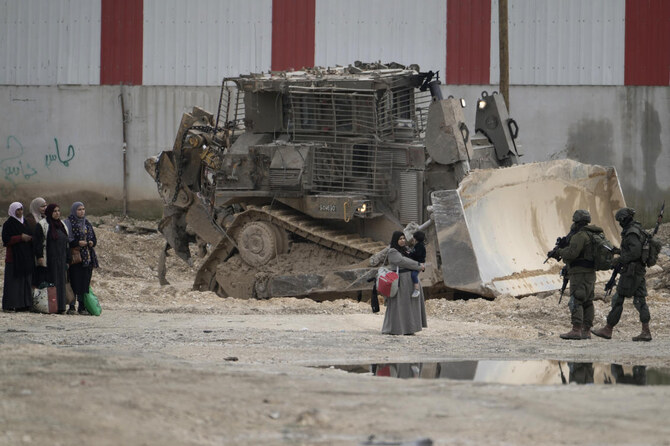
FAR’A REFUGEE CAMP, West Bank: By car and on foot, through muddy olive groves and snipers’ sight lines, tens of thousands of Palestinians in recent weeks have fled Israeli military operations across the northern West Bank — the largest displacement in the occupied territory since the 1967 Mideast war.
After announcing a widespread crackdown against West Bank militants on Jan. 21 — just two days after its ceasefire deal with Hamas in Gaza — Israeli forces descended on the restive city of Jenin, as they have dozens of times since Hamas’ Oct. 7, 2023, attack on Israel.
But unlike past operations, Israeli forces then pushed deeper and more forcefully into several other nearby towns, including Tulkarem, Far’a and Nur Shams, scattering families and stirring bitter memories of the 1948 war over Israel’s creation.
During that war, 700,000 Palestinians fled or were forced from their homes in what is now Israel. That Nakba, or “catastrophe,” as Palestinians call it, gave rise to the crowded West Bank towns now under assault and still known as refugee camps.
“This is our nakba,” said Abed Sabagh, 53, who bundled his seven children into the car on Feb. 9 as sound bombs blared in Nur Shams camp, where he was born to parents who fled the 1948 war.
Tactics from Gaza
Humanitarian officials say they haven’t seen such displacement in the West Bank since the 1967 Mideast war, when Israel captured the territory west of the Jordan River, along with east Jerusalem and the Gaza Strip, displacing another 300,000 Palestinians.
“This is unprecedented. When you add to this the destruction of infrastructure, we’re reaching a point where the camps are becoming uninhabitable,” said Roland Friedrich, director of West Bank affairs for the UN Palestinian refugee agency. More than 40,100 Palestinians have fled their homes in the ongoing military operation, according to the agency.
Experts say that Israel’s tactics in the West Bank are becoming almost indistinguishable from those deployed in Gaza. Already, President Donald Trump’s plan for the mass transfer of Palestinians out of Gaza has emboldened Israel’s far-right to renew calls for annexation of the West Bank.
“The idea of ‘cleansing’ the land of Palestinians is more popular today than ever before,” said Yagil Levy, head of the Institute for the Study of Civil-Military Relations at Britain’s Open University.
The Israeli army denies issuing evacuation orders in the West Bank. It said troops secure passages for those wanting to leave on their own accord.
Seven minutes to leave home
Over a dozen displaced Palestinians interviewed in the last week said they did not flee their homes out of fear, but on the orders of Israeli security forces. Associated Press journalists in the Nur Shams camp also heard Israeli soldiers shouting through mosque megaphones, ordering people to leave.
Some displaced families said soldiers were polite, knocking on doors and assuring them they could return when the army left. Others said they were ruthless, ransacking rooms, waving rifles and hustling residents out of their homes despite pleas for more time.
“I was sobbing, asking them, ‘Why do you want me to leave my house?’ My baby is upstairs, just let me get my baby please,’” Ayat Abdullah, 30, recalled from a shelter for displaced people in the village of Kafr Al-Labd. “They gave us seven minutes. I brought my children, thank God. Nothing else.”
Told to make their own way, Abdullah trudged 10 kilometers (six miles) on a path lighted only by the glow from her phone as rain turned the ground to mud. She said she clutched her children tight, braving possible snipers that had killed a 23-year-old pregnant woman just hours earlier on Feb. 9.
Her 5-year-old son, Nidal, interrupted her story, pursing his lips together to make a loud buzzing sound.
“You’re right, my love,” she replied. “That’s the sound the drones made when we left home.”
Hospitality, for now
In the nearby town of Anabta, volunteers moved in and out of mosques and government buildings that have become makeshift shelters — delivering donated blankets, serving bitter coffee, distributing boiled eggs for breakfast and whipping up vats of rice and chicken for dinner.
Residents have opened their homes to families fleeing Nur Shams and Tulkarem.
“This is our duty in the current security situation,” said Thabet A’mar, the mayor of Anabta.
But he stressed that the town’s welcoming hand should not be mistaken for anything more.
“We insist that their displacement is temporary,” he said.
Staying put
When the invasion started on Feb. 2, Israeli bulldozers ruptured underground pipes. Taps ran dry. Sewage gushed. Internet service was shut off. Schools closed. Food supplies dwindled. Explosions echoed.
Ahmad Sobuh could understand how his neighbors chose to flee the Far’a refugee camp during Israel’s 10-day incursion. But he scavenged rainwater to drink and hunkered down in his home, swearing to himself, his family and the Israeli soldiers knocking at his door that he would stay.
The soldiers advised against that, informing Sobuh’s family on Feb. 11 that, because a room had raised suspicion for containing security cameras and an object resembling a weapon, they would blow up the second floor.
The surveillance cameras, which Israeli soldiers argued could be exploited by Palestinian militants, were not unusual in the volatile neighborhood, Sobuh said, as families can observe street battles and Israeli army operations from inside.
But the second claim sent him clambering upstairs, where he found his nephew’s water pipe, shaped like a rifle.
Hours later, the explosion left his nephew’s room naked to the wind and shattered most others. It was too dangerous to stay.
“They are doing everything they can to push us out,” he said of Israel’s military, which, according to the UN agency for refugees, has demolished hundreds of homes across the four camps this year.
The Israeli army has described its ongoing campaign as a crucial counterterrorism effort to prevent attacks like Oct. 7, and said steps were taken to mitigate the impact on civilians.
A chilling return
The first thing Doha Abu Dgheish noticed about her family’s five-story home 10 days after Israeli troops forced them to leave, she said, was the smell.
Venturing inside as Israeli troops withdrew from Far’a camp, she found rotten food and toilets piled with excrement. Pet parakeets had vanished from their cages. Pages of the Qur’an had been defaced with graphic drawings. Israeli forces had apparently used explosives to blow every door off its hinges, even though none had been locked.
Rama, her 11-year-old daughter with Down syndrome, screamed upon finding her doll’s skirt torn and its face covered with more graphic drawings.
AP journalists visited the Abu Dgheish home on Feb. 12, hours after their return.
Nearly two dozen Palestinians interviewed across the four West Bank refugee camps this month described army units taking over civilian homes to use as a dormitories, storerooms or lookout points. The Abu Dgheish family accused Israeli soldiers of vandalizing their home, as did multiple families in Far’a.
The Israeli army blamed militants for embedding themselves in civilian infrastructure. Soldiers may be “required to operate from civilian homes for varying periods,” it said, adding that the destruction of civilian property was a violation of the military’s rules and does not conform to its values.
It said “any exceptional incidents that raise concerns regarding a deviation from these orders” are “thoroughly addressed,” without elaborating.
For Abu Dgheish, the mess was emblematic of the emotional whiplash of return. No one knows when they’ll have to flee again.
“It’s like they want us to feel that we’re never safe,” she said. ”That we have no control.”


![]()
![]()

Thousands of Palestinian families flee West Bank homes as Israel confronts militants

Short Url
https://arab.news/b6r3f
Thousands of Palestinian families flee West Bank homes as Israel confronts militants
- “This is our nakba,” said Abed Sabagh, 53, who bundled his seven children into the car on Feb. 9 as sound bombs blared in Nur Shams camp
- Ahmad Sobuh could understand how his neighbors chose to flee the Far’a refugee camp during Israel’s 10-day incursion


Latest updates


© 2026 SAUDI RESEARCH & PUBLISHING COMPANY, All Rights Reserved And subject to Terms of Use Agreement.