At UNSC, Pakistan calls for permanent ceasefire in Gaza, urgent humanitarian support to Palestinians

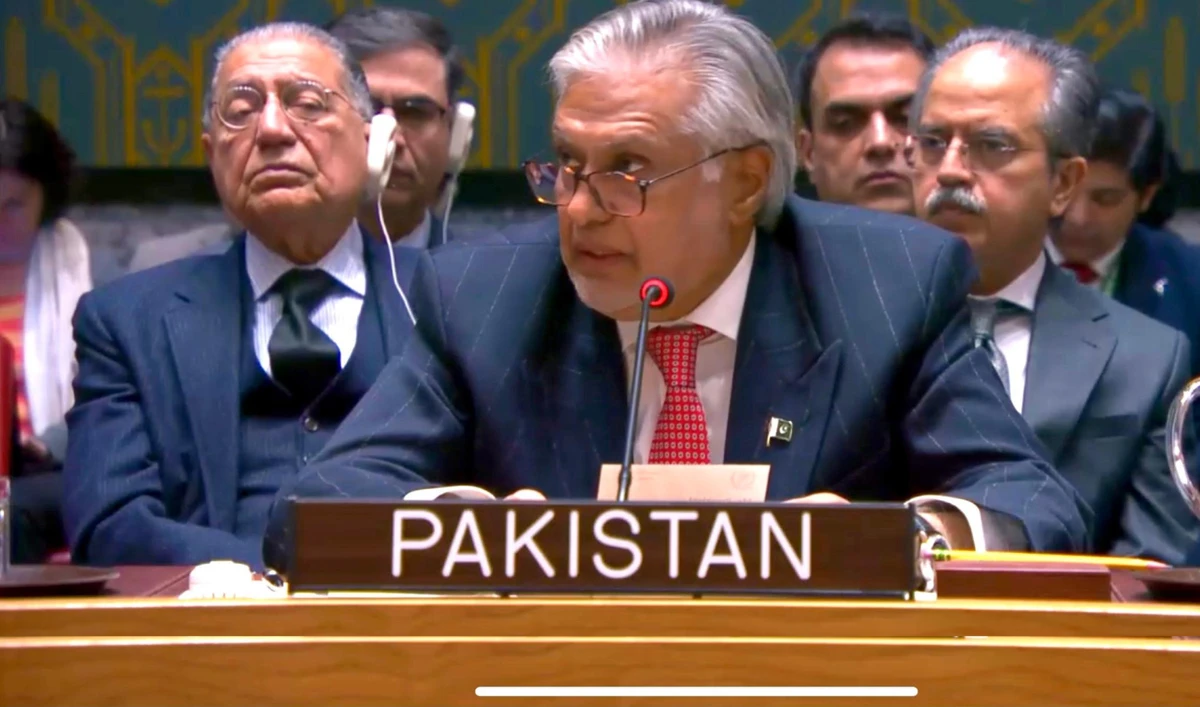
Pakistan’s Deputy Prime Minister Ishaq Dar addresses the United Nations Security Council (UNSC) on February 18, 2025. (Ministry of Foreign Affairs)
Short Url
Updated 18 February 2025
Follow

At UNSC, Pakistan calls for permanent ceasefire in Gaza, urgent humanitarian support to Palestinians

  • The statement comes amid a six-week truce between Hamas and Israel that ended 15-month war, which has killed over 48,000 Palestinians
  • Pakistan Deputy PM Ishaq Dar rejects any displacement of the Palestinian people, urges revival of a process to achieve two-state solution

ISLAMABAD: Pakistan’s Deputy Prime Minister Ishaq Dar on Tuesday called for a permanent ceasefire in Gaza and urgent delivery of humanitarian aid to people affected by Israel’s war as he addressed a high-level debate at United Nations Security Council (UNSC).
Dar was addressing the debate, titled “Practicing Multilateralism: Reforming and Improving Global Governance,” which was convened by China. The session was presided over by Chinese Foreign Minister Wang Yi.
The statement came amid a six-week truce announced on Jan. 19 between Hamas and Israel that ended 15 months of war, involving the gradual withdrawal of Israeli forces from central Gaza and the return of displaced Palestinians to the north.
Addressing the session, Dar emphasized the need for international commitment to multilateralism to address emerging global challenges, calling for upholding principles of the UN Charter, including self-determination, the non-use of force, respect for sovereignty, and the peaceful resolution of disputes.
“He called for the full implementation of the agreement to secure a permanent ceasefire in the Gaza and the urgent humanitarian support to the Palestinian people and the revival of a political process to achieve the two-state solution,” the Pakistani foreign office said.
Israel’s war on Gaza, which began after the Oct. 7, 2023 attacks by Hamas, has killed more than 48,000 Palestinians and displaced almost all of Gaza’s 2 million population by laying waste to swathes of neighborhoods, schools and hospitals.
The deputy prime minister condemned the massive loss of civilian lives and the persistent Israeli violations of the international law.
“He rejected any displacement of the Palestinian people from their homeland,” the foreign office added.
The statement followed remarks by United States (US) President Donald Trump and Israeli PM Benjamin Netanyahu about the relocation of Palestinians to Egypt, Jordan or other countries, which have been rejected by Saudi Arabia, Egypt, Jordan, Pakistan and other nations apart from being condemned by international rights groups.
Palestinian territory – encompassing the Gaza Strip and West Bank, including East Jerusalem – has been occupied by Israel since 1967. Pakistan does not recognize Israel and has consistently called for an independent Palestinian state based on “internationally agreed parameters
In his address, the Pakistan deputy premier also proposed the adoption of a roadmap for strengthening multilateralism and reforming the global governance.
“He emphasized the need for a more inclusive, democratic, and accountable Security Council, reforming the international financial architecture and strengthening international cooperation to address emerging challenges, particularly the regulation of transformative technologies like artificial intelligence,” the foreign office added.

Islamabad facilitating thousands of stranded Pakistanis in Gulf amid Iran conflict, FM says

Updated 4 sec ago
Follow

Islamabad facilitating thousands of stranded Pakistanis in Gulf amid Iran conflict, FM says

  • Pakistani religious pilgrims, visitors are being evacuated via land routes due to airspace shutdowns
  • Foreign Minister Ishaq Dar says ‘our consistent message is de-escalation, restraint and return to dialogue’

ISLAMABAD: Pakistan’s Foreign Minister Ishaq Dar on Tuesday said that Islamabad was working round the clock to assist thousands of Pakistanis stranded in Arab Gulf countries, reiterating his country’s readiness to facilitate diplomatic efforts to de-escalate tensions in the Middle East.

Tensions in the region heightened on Saturday following coordinated strikes by the US and Israel against Iran, diminishing prospects of a peaceful settlement of Tehran’s long-running dispute with Western countries and Tel Aviv over its nuclear program.

Tehran subsequently targeted American bases in Gulf states, including the UAE, Bahrain, Qatar, Kuwait and Jordan, prompting their governments to issue condemnations. The Saudi foreign ministry on Tuesday condemned Iran’s drone attack on the US embassy building in Riyadh.

Describing the Gulf situation as “very fluid,” Dar said regional airspace shutdowns had forced Pakistani religious pilgrims and visitors in Gulf states, also home to 4.5 million Pakistani expatriates, to mostly rely on land routes for their exit.

“The safety of Pakistanis abroad and the sovereignty of Pakistan remain our foremost priorities... Our crisis management unit is operational 24 hours to facilitate the stranded Pakistanis,” he said at a media briefing in Islamabad on Tuesday, adding that Pakistani missions in Tehran, Zahedan, Mashhad, Riyadh, Jeddah, Abu Dhabi, Dubai, Doha, Kuwait City and Manama were actively assisting nationals.

“If someone’s visa is expiring, as a visitor, they’re are getting fully cooperated. Similarly, if people are transiting from Saudi Arabia to other countries by road, then the other Gulf countries are also facilitating and helping them.”

Around 35,000 Pakistanis were currently in Iran and evacuation through Azerbaijan remained another viable option for those in northern Iran. So far, 64 Pakistanis have crossed into Azerbaijan, with dozens already flown onward, including 42 who reached Lahore on March 2, according to Dar.

Flights between Pakistan and Azerbaijan remain operational and Baku is providing visa-on-arrival and logistical support to stranded Pakistani nationals.

Dar said 4,543 Pakistani visitors were stranded in the UAE and around 1,400 in Qatar due to the conflict and airspace disruptions, adding that Saudi Arabia, home to more than 2 million Pakistani expatriates, remained relatively stable, with partial air operations continuing via Oman.

Land corridors between Saudi Arabia, Bahrain, UAE and Qatar were being widely used and travelers were being allowed to transit by road, he said, thanking authorities in these countries for facilitating Pakistani nationals.

ISLAMABAD’S DIPLOMATIC EFFORTS FOR PEACE

The foreign minister said he had been in contact with foreign ministers from Turkiye, Iran, Saudi Arabia, Qatar, UAE and Oman as well as European Union representatives over the past three days to help de-escalate the tensions.

“Our consistent message is de-escalation, restraint and return to dialogue,” he said.

Prime Minister Shehbaz Sharif is personally overseeing the situation and has convened Pakistani parliamentary leaders from all parties for a detailed briefing, he added.

In discussions involving US Secretary of State Marco Rubio prior to the US-Israeli strikes, Dar said, both Oman and Islamabad had been considered potential venues for US-Iran talks and Pakistan had conveyed that it was “fully ready” to host negotiations.

“Islamabad is available for any mediation or facilitation,” he said, adding that Pakistan’s policy did not support a regime change in Iran and focused solely on dialogue and regional stability.