

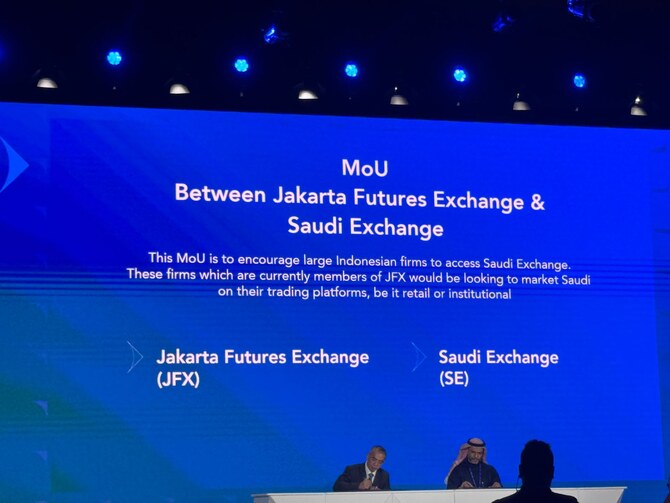
Saudi Exchange targets Indonesian firms with Jakarta Futures MoU 

The agreement was signed during the fifth Capital Market Forum. AN
Short Url
Updated 18 February 2025
Follow

Saudi Exchange targets Indonesian firms with Jakarta Futures MoU 

RIYADH: Saudi Arabia’s stock market is set to attract Indonesian firms following a new memorandum of understanding with the Jakarta Futures Exchange. 

Signed during the fifth Capital Market Forum, the agreement will see JFX members promoting the Kingdom’s trading platforms to both retail and institutional investors, strengthening financial ties between the two markets. 

In another step to bolster Saudi Arabia’s financial infrastructure, Fidelity Information Services Global inked an MoU with Muqassa, a subsidiary of the Saudi Tadawul Group, to enhance the Kingdom’s derivatives market. The partnership aims to integrate advanced technologies that improve market efficiency and liquidity. 

These deals were among eight agreements signed during the conference, underscoring Saudi Arabia’s continued push for financial sector expansion and technological advancement. 

The Financial Academy and Saudi Tadawul Group also joined forces to launch specialized training programs tailored for the financial industry. 

The initiative, developed in collaboration with leading universities, will introduce the Sustainability Specialist in the Financial Sector certification and host workshops to deepen industry expertise. 

Awqaf Investment has signed two key agreements. The first, with SNB Capital, is aimed at serving the SR8 billion ($2.1 billion) Awqaf market, with a focus on developing improved investment products that cater to the sector’s needs. 

The second, an investment advisory agreement with Ehsan, will see Awqaf Investment Co. providing strategic advisory services for the Ehsan Waqf Fund, further strengthening the Kingdom’s philanthropic investment landscape. 

Saudi Arabia’s real estate market is also set to benefit from a new collaboration between Aljazira Capital and Target, as the two entities launch the Wahat Alnakheel Real Estate Fund — a major initiative with a fund size exceeding SR1 billion. 

Meanwhile, Dalipal Holdings Limited has partnered with Saudi investment firm BMG Financial Group to strengthen Dalipal’s presence in the Kingdom’s energy sector. The MoU leverages BMG’s regulatory expertise and investor network with Dalipal’s specialization in high-end energy pipes and seamless steel products. The collaboration could pave the way for a potential Dalipal listing on the Saudi Exchange. 

A significant trilateral partnership was also unveiled, with Wamid, Google Cloud, and Deloitte teaming up to develop and launch new capital market data products. The initiative positions Saudi Tadawul Group as a leader in financial innovation and digital transformation. 

Additionally, the Saudi Securities Depository Center Co., known as Edaa, has launched EDAA CONNECT, a centralized platform for mutual fund investments across the Saudi capital market. 

The initiative, developed in partnership with 11 financial firms — including Albilad Capital, AlRajhi Capital, and Rassanah Capital, as well as Saudi Awwal Bank Invest, and SNB Capital — aims to streamline fund access and enhance investment efficiency. 

Saudi Tadawul Group and its subsidiaries announced a series of strategic initiatives aimed at advancing the Saudi financial market.

The group unveiled the launch of the STG App, an integrated platform designed to unify all group services, streamline processes for investors, companies, and market participants, and simplify market access.


Arab food and beverage sector draws $22bn in foreign investment over 2 decades: Dhaman 

Updated 28 December 2025
Follow

Arab food and beverage sector draws $22bn in foreign investment over 2 decades: Dhaman 

JEDDAH: Foreign investors committed about $22 billion to the Arab region’s food and beverage sector over the past two decades, backing 516 projects that generated roughly 93,000 jobs, according to a new sectoral report. 

In its third food and beverage industry study for 2025, the Arab Investment and Export Credit Guarantee Corp., known as Dhaman, said the bulk of investment flowed to a handful of markets. Egypt, Saudi Arabia, the UAE, Morocco and Qatar attracted 421 projects — about 82 percent of the total — with capital expenditure exceeding $17 billion, or nearly four-fifths of overall investment. 

Projects in those five countries accounted for around 71,000 jobs, representing 76 percent of total employment created by foreign direct investment in the sector over the 2003–2024 period, the report said, according to figures carried by the Kuwait News Agency. 

“The US has been the region's top food and beverage investor over the past 22 years with 74 projects or 14 projects of the total, and Capex of approximately $4 billion or 18 percent of the total, creating more than 14,000 jobs,” KUNA reported. 

Investment was also concentrated among a small group of multinational players. The sector’s top 10 foreign investors accounted for roughly 15 percent of projects, 32 percent of capital expenditure and 29 percent of newly created jobs.  

Swiss food group Nestlé led in project count with 14 initiatives, while Ukrainian agribusiness firm NIBULON topped capital spending and job creation, investing $2 billion and generating around 6,000 jobs. 

At the inter-Arab investment level, the report noted that 12 Arab countries invested in 108 projects, accounting for about 21 percent of total FDI projects in the sector over the past 22 years. These initiatives, carried out by 65 companies, involved $6.5 billion in capital expenditure, representing 30 percent of total FDI, and generated nearly 28,000 jobs. 

The UAE led inter-Arab investments, accounting for 45 percent of total projects and 58 percent of total capital expenditure, the report added, according to KUNA. 

The report also noted that the UAE, Saudi Arabia, Egypt, and Qatar topped the Arab ranking as the most attractive countries for investment in the sector in 2024, followed by Oman, Bahrain, Algeria, Morocco, and Kuwait. 

Looking ahead, Dhaman expects consumer demand to continue rising. Food and non-alcoholic beverage sales across 16 Arab countries are projected to increase 8.6 percent to more than $430 billion by the end of 2025, equivalent to 4.2 percent of global sales, before exceeding $560 billion by 2029. 

Sales are expected to remain highly concentrated geographically, with Egypt, Saudi Arabia, Algeria, the UAE and Iraq accounting for about 77 percent of the regional total. By product category, meat and poultry are forecast to lead with sales of about $106 billion, followed by cereals, pasta and baked goods at roughly $63 billion. 

Average annual per capita spending on food and non-alcoholic beverages in the region is projected to rise 7.2 percent to more than $1,845 by the end of 2025, approaching the global average, and to reach about $2,255 by 2029. Household spending on these products is expected to represent 25.8 percent of total expenditure in 13 Arab countries, above the global average of 24.2 percent. 

Arab external trade in food and beverages grew more than 15 percent in 2024 to $195 billion, with exports rising 18 percent to $56 billion and imports increasing 14 percent to $139 billion. Brazil was the largest foreign supplier to the region, exporting $16.5 billion worth of products, while Saudi Arabia ranked as the top Arab exporter at $6.6 billion.