

Calls mount for lifting of Western sanctions on Syria

Hiba Zayadin, HRW’s senior Syria researcher, said the country “is in desperate need of reconstruction and Syrians are struggling to survive.” (AFP)
Short Url
Updated 18 February 2025
Follow

Calls mount for lifting of Western sanctions on Syria

  • Human Rights Watch: Country ‘in desperate need of reconstruction and Syrians are struggling to survive’
  • Current sanctions were imposed on regime of Bashar Assad who was deposed in December

LONDON: Sanctions imposed on the regime of former Syrian President Bashar Assad by the West are harming the country’s recovery, Human Rights Watch said on Tuesday.

Sanctions put in place by the US, the UK, the EU and others are “hindering reconstruction efforts and exacerbating the suffering of millions of Syrians,” and have no clear removal mechanism, HRW added.

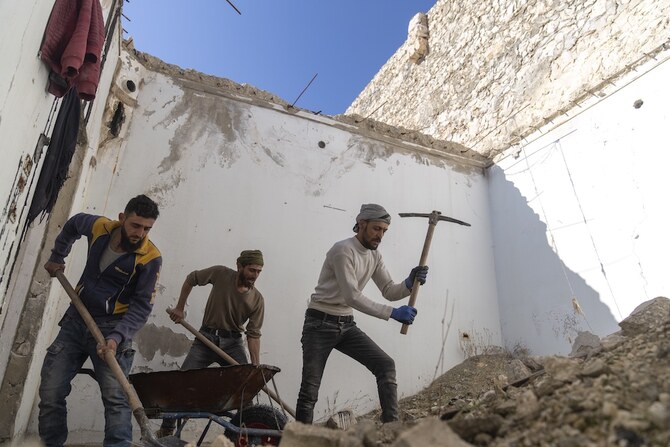
Hiba Zayadin, HRW’s senior Syria researcher, said the country “is in desperate need of reconstruction and Syrians are struggling to survive. With the collapse of the former government, broad sanctions now stand as a major obstacle to restoring essential services such as health care, water, electricity, and education.”

HRW said the country’s long-running civil war has left its economy and infrastructure devastated, with millions of people having fled and 90 percent of the remaining population living in poverty.

Around 13 million are unable to access sufficient food, and 16.5 million are reliant on humanitarian aid.

The organization said sanctions, some of which have been in place for almost half a century but which were ramped up by the West in 2011 after the outbreak of the conflict, are making it harder to alleviate this suffering and to deliver aid despite humanitarian exemptions.

HRW said sanctions should be lifted to allow “access to basic rights,” including “restoring Syria’s access to global financial systems, ending trade restrictions on essential goods, addressing energy sanctions to ensure access to fuel and electricity, and providing clear legal assurances to financial institutions and businesses to mitigate the chilling effect of overcompliance.”

US sanctions hinder nearly all trade and financial transactions with Syria, while the Caesar Act sanctions foreign companies doing business with the government, “particularly in oil and gas, construction, and engineering,” HRW said.

EU and UK sanctions focus largely on Syrian crude oil exports, investments, and the activities of Syrian banks.

Western powers have proposed changes to the sanctions regime since Assad’s ouster in December, but the head of the Syrian Arab Republic’s Investment Agency, Ayman Hamawiye, said earlier this year that the only concrete changes — tweaks to US sanctions affecting energy remittance payments — were “inadequate” so far. 

“Rather than using broad sectoral sanctions as leverage for shifting political objectives, Western governments should recognize their direct harm to civilians and take meaningful steps to lift restrictions that impede access to basic rights,” Zayadin said.

“A piecemeal approach of temporary exemptions and limited waivers is not enough. Sanctions that harm civilians should immediately be lifted, not refined.”

HRW said Syria requires at least $250 billion to begin its reconstruction, focusing on essential infrastructure.

It highlighted the crumbling water network and overwhelmed healthcare system as two examples in desperate need of financial help, as well as the education sector, with around 2 million Syrian children out of fulltime school.

HRW said sanctions should not “have a disproportionately negative impact on human rights or create unnecessary suffering,” and “should not be punitive, but should instead be designed to deter and correct human rights abuses.”

It added: “To be effective, sanctions must be tied to clear, measurable, and attainable conditions for their removal, with regular monitoring to assess progress.

“The Caesar Act in the United States was designed to punish the Assad government, but in a post-Assad world, its broad and indefinite restrictions risk harming civilians without advancing clear human rights objectives.”


Israeli troops kill Palestinians for crossing a vague ceasefire line that’s sometimes unmarked

Updated 57 min 52 sec ago
Follow

Israeli troops kill Palestinians for crossing a vague ceasefire line that’s sometimes unmarked

  • Israeli soldiers direct near-daily fire at anyone who crosses or even lingers near it
  • The ‘yellow line’ is still unmarked in certain places

CAIRO: A dividing line, at times invisible, can mean life or death for Palestinians in Gaza.
Those sheltering near the territory’s “yellow line” that the Israeli military withdrew to as part of the October ceasefire say they live in fear as Israeli soldiers direct near-daily fire at anyone who crosses or even lingers near it.
Of the 447 Palestinians killed between the ceasefire taking effect and Tuesday, at least 77 were killed by Israeli gunfire near the line, including 62 who crossed it, according to the Gaza Health Ministry. Among them were teenagers and young children, The Associated Press found.
And although the military has placed some yellow barrels and concrete barriers delineating the limits of the Palestinian zone, the line is still unmarked in certain places and in others was laid nearly half a kilometer deeper than what was agreed to in the ceasefire deal, expanding the part of Gaza that Israel controls, according to Palestinians and mapping experts.
“We stay away from the barrels. No one dares to get close” said Gaza City resident Ahmed Abu Jahal, noting that the markers are less than 100 meters from his house — instead of the roughly 500 meters outlined in a map put out by the Israeli military.
As of Tuesday, the military had acknowledged killing 57 people around the yellow line, saying most were militants. It said its troops are complying with the rules of engagement in order to counter militant groups, and are informing Palestinians of the line’s location and marking it on the ground to “reduce friction and prevent misunderstandings.”
Easy to get lost
Under the ceasefire, Israel withdrew its troops to a buffer zone that is up to 7 kilometers deep and includes most of Gaza’s arable land, its elevated points and all of its border crossings. That hems more than 2 million Palestinians into a strip along the coastline and central Gaza.
People of all ages, some already dead, have been showing up almost daily at the emergency room of Gaza City’s Al-Ahli hospital with bullet wounds from straying near the line, said hospital director Fadel Naeem.
Amid the vast destruction in Gaza, the demarcation line often isn’t easy to detect, Naeem said. He recounted picking his way through undamaged paths during a recent visit to the southern city of Khan Younis. He didn’t notice he was almost across the line until locals shouted at him to turn back, he said.
The Israeli military said most of the people it has killed crossing the line posed a threat to its troops. According to a military official who spoke on the condition of anonymity in line with military rules, troops issue audible warnings and then fire warning shots whenever someone crosses the line. Many civilians retreat when warning shots are fired, though some have been killed, the official acknowledged.
Killed while playing near the line
Zaher Shamia, 17, lived with his grandfather in a tent 300 meters from the line in northern Gaza’s Jabaliya refugee camp. On Dec. 10, he was playing with his cousin and some friends near the line, according to video he took before his death.
Suddenly, shots rang out and the video stopped. Soldiers approaching the line with an armored bulldozer had fired on the teens, hitting Zaher, said a witness.
A neighbor eventually found Zaher’s body, which had been crushed by the bulldozer, said Zaher’s grandfather, Kamal Al-Beih: “We only recognized him from his head.”
Two doctors, Mohamed Abu Selmiya and Rami Mhanna, confirmed that the teen had been killed by gunshots and then run over by a bulldozer. The military official said he was aware that Shamia was a civilian and that the military was looking into it.
Maram Atta said that on Dec. 7, her 3-year-old daughter, Ahed Al-Bayouk, was playing with siblings outside of their tent, which was near the yellow line along Gaza’s southern coast. Atta was preparing lentils when she heard aircraft overhead, then shots.
A stray projectile whizzed close to her and struck Ahed, who was dead before they reached the clinic.
“I lost my daughter to what they keep calling a ‘ceasefire’” said Atta, crying. “What ceasefire are they talking about?”
A military official denied the killing.
Deadly ambiguity
The line’s exact location is ambiguous, differing on maps put out by the Israeli military and the White House.
Neither matches the line troops appear to be marking on the ground, according to Palestinians and geolocation specialists.
Chris Osiek, an open source intelligence analyst and consultant, has geolocated a number of yellow blocks based on social media videos. He found at least four urban areas where troops set the blocks several hundred meters deeper into Gaza than the military map-specified yellow line.
“This is basically what you get when you simply let Trump make an image and post it on Truth Social and let the IDF make their own,” he said, using the acronym for the military. “If it’s not a proper system, with coordinates that make it easy for people to navigate where it is, then you leave the ambiguity free for the IDF to interpret the yellow line how they basically want.”
The military official dismissed such criticism, saying any deviations from the map amount to just a few meters. But to Palestinians hemmed in by widespread destruction and displacement, every few meters lost is another house that can’t be sheltered in — another they doubt will ever be returned.
‘The line is getting very close’
Under the ceasefire, Israeli forces are only supposed to remain at the yellow line until a fuller withdrawal, though the agreement doesn’t give a timeline for that. With the next steps in the deal lagging and troops digging into positions on the Israeli side, though, Palestinians wonder if they are witnessing a permanent land takeover.
In December, Israel’s defense minister described the yellow line as “a new border line — serving as a forward defensive line for our communities and a line of operational activity.”
The military has continued leveling buildings inside the Israeli-held zone, turning already damaged neighborhoods to moonscapes. Almost all of the city of Rafah, on Gaza’s border with Egypt, has been razed over the past year. The army says this is necessary to destroy tunnels and prepare the area for reconstruction.
In some places, demolitions since the ceasefire have encroached beyond the official yellow line. Since November, troops have leveled a swath of Gaza City’s Tuffah neighborhood extending some 300 meters outside the Israeli-held zone, according to Oct. 14 and Dec. 18 satellite photos provided by Planet Labs.
Abu Jahal moved back to his damaged house in Tuffah at the ceasefire’s start. He said he frequently saw new yellow barrels appear and the military forcing out anyone living on its side of the markers.
On Jan. 7, Israeli fire hit a house near him, and the residents had to evacuate, he said. Abu Jahal said his family — including his wife, their child, and seven other relatives — may also have to leave soon.
“The line is getting very close,” he said.