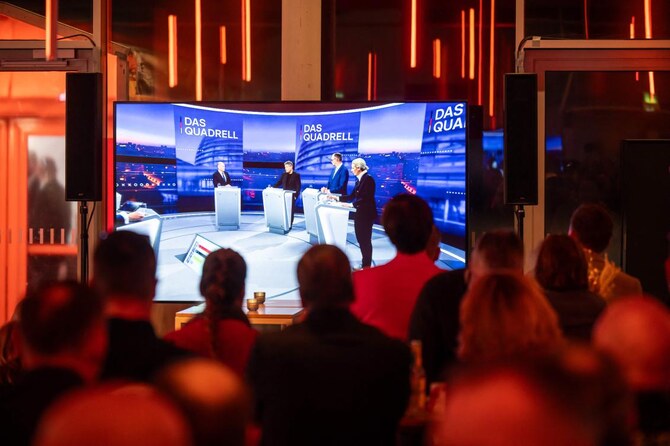
BERLIN: Four candidates are bidding to be Germany’s next leader in Sunday’s election. The would-be chancellors are the incumbent, the opposition leader, the current vice chancellor and — for the first time — a leader of a far-right party.
Olaf Scholz
The 66-year-old has been Germany’s chancellor since December 2021. The center-left Social Democrat has a wealth of government experience, having previously served as Hamburg’s mayor and as German labor and finance minister. As chancellor, he quickly found himself dealing with unexpected crises. He launched an effort to modernize Germany’s military after Russia’s invasion of Ukraine and made Germany Ukraine’s second-biggest weapons supplier. His government prevented an energy crunch and tried to counter high inflation. But his three-party coalition became notorious for infighting and collapsed in November as it argued over how to revitalize the economy — Europe’s biggest, which has shrunk for the past two years.
Friedrich Merz
Germany’s 69-year-old opposition leader has been the front-runner in the election campaign, with his center-right Union bloc leading polls. He became the leader of his Christian Democratic Union party after longtime Chancellor Angela Merkel — a former rival — stepped down in 2021. Merz has taken his party in a more conservative direction. In the election campaign, he has made curbing irregular migration a central issue. Merz lacks experience in government. He joined the European Parliament in 1989 before becoming a lawmaker in Germany five years later. He took a break from active politics for several years after 2009, practicing as a lawyer and heading the supervisory board of investment manager BlackRock’s German branch.
Robert Habeck
The 55-year-old is the candidate of the environmentalist Greens. He’s also Germany’s current vice chancellor and the economy and climate minister, with responsibility for energy issues. As co-leader of the Greens from 2018 to 2022, he presided over a rise in the party’s popularity, but in 2021 he stepped aside to let Annalena Baerbock — now Germany’s foreign minister — make her first run for the chancellor’s job. Habeck’s record as a minister has drawn mixed reviews, particularly a plan his ministry drew up to replace fossil-fuel heating systems with greener alternatives that deepened divisions in the government.
Alice Weidel
The 46-year-old is making the first bid of the far-right, anti-immigration Alternative for Germany, or AfD, for the country’s top job. An economist by training, Weidel joined the party shortly after it was founded in 2013. She has been co-leader of her party’s parliamentary group since the party first won seats in the national legislature in 2017. She has been a co-leader of the party itself since 2022, along with Tino Chrupalla. In December, she was nominated as the candidate for chancellor — though other parties say they won’t work with the AfD, so she has no realistic path to the top job at present.


![]()

4 candidates want to be Germany’s next chancellor. Who are they?
Short Url
https://arab.news/yfk36
4 candidates want to be Germany’s next chancellor. Who are they?
- The country has the largest population - 84 million - and the biggest economy in Europe with a GDP of $4.5trn
- Ahead of the German election, the far-right Alternative for Germany (AfD) is in second place in opinion polls
Latest updates


Recommended


© 2026 SAUDI RESEARCH & PUBLISHING COMPANY, All Rights Reserved And subject to Terms of Use Agreement.