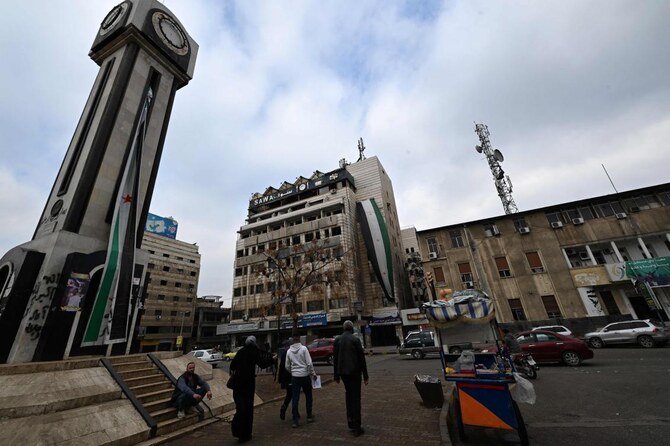
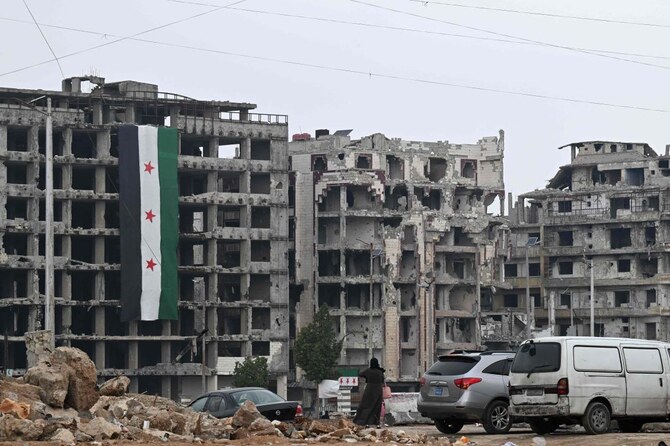
HOMS, Syria: Once dubbed the capital of the revolution against Bashar Assad, Homs saw some of the fiercest fighting in Syria’s civil war. Now, displaced people are returning to their neighborhoods, only to find them in ruins.
It was in Homs that rebels first took up arms to fight Assad’s crackdown on protests in 2011.
The military responded by besieging and bombarding rebel areas such as Baba Amr, where US journalist Marie Colvin and French journalist Remi Ochlik were killed in a bombing in 2012.
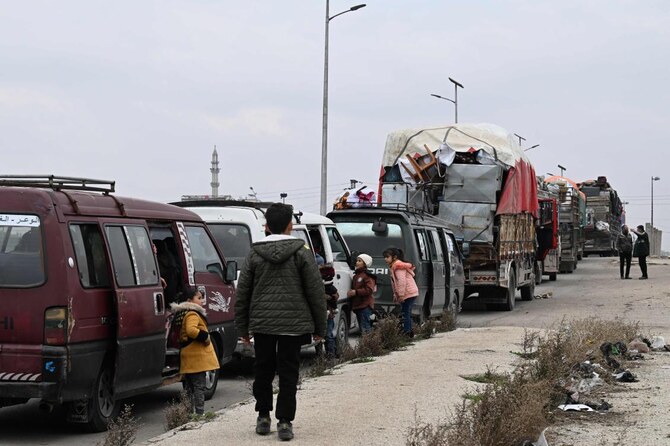
Since Assad’s ouster, people have started returning to neighborhoods they fled following successive evacuation agreements that saw Assad take back control.
“The house is burned down, there are no windows, no electricity,” said Duaa Turki at her dilapidated home in Khaldiyeh neighborhood.
“We removed the rubble, lay a carpet” and moved in, said the 30-year-old mother of four.
“Despite the destruction, we’re happy to be back. This is our neighborhood and our land.”
Her husband spends his days looking for a job, she said, while they hope humanitarian workers begin distributing aid to help the family survive.
The siege of Homs lasted two years and killed around 2,200 people, according to the Syrian Observatory for Human Rights.
During the siege, thousands of civilians and rebels were left with nothing to eat but dried foods and grass.
In May 2014, under an evacuation deal negotiated with the former government, most of those trapped in the siege were evacuated, and two years later, Assad seized the last rebel district of Waer.
“We were besieged... without food or water, under air raids, and barrel bombings,” before being evacuated to the rebel-held north, Turki said.
AFP journalists saw dozens of families returning to Homs from northern Syria, many of them tearful as they stepped out of the buses organized by local activists.
Among them was Adnan Abu Al-Ezz, 50, whose son was wounded by shelling during the siege and who later died because soldiers at a checkpoint barred him from taking him to hospital.
“They refused to let me pass, they were mocking me,” he said with tears in his eyes.
“I knew my house was nearly destroyed, but I came back to the precious soil of Homs,” he said.
While protests and fighting spread across Syria over the course of the 13-year war, Homs’s story of rebellion holds profound symbolism for the demonstrators.
It was there that Abdel Basset Al-Sarout, a football goalkeeper in the national youth team, joined the protests and eventually took up arms.
He became something of a folk hero to many before he joined an Islamist armed group and was eventually killed in fighting.
In 2013, his story became the focus of a documentary by Syrian filmmaker Talal Derki named “The Return to Homs,” which won international accolades.
Homs returnee Abu Al-Moatasim, who remembers Sarout, recounted being detained for joining a protest.
When he saw security personnel approaching in a car, he prayed for “God to drop rocket on us so I die” before reaching the detention center, one of a network dotted around the country that were known for torture.
His father bribed an officer in exchange for his release a few days later, he said.
In Baba Amr, for a time early in the war a bastion of the rebel Free Syrian Army, there was rubble everywhere.
The army recaptured the district in March 2012, following a siege and an intense bombardment campaign.
It was there that Colvin and Ochlik were killed in a bombing of an opposition press center.
In 2019, a US court found Assad’s government culpable in Colvin’s death, ordering a $302.5 million judgment for what it called an “unconscionable” attack that targeted journalists.
Touring the building that housed the press center, Abdel Qader Al-Anjari, 40, said he was an activist helping foreign journalists at that time.
“Here we installed the first Internet router to communicate with the outside world,” he said.
“Marie Colvin was martyred here, targeted by the regime because they did not want (anyone) to document what was happening,” he said.
He described her as a “friend” who defied the “regime blackout imposed on journalists” and others documenting the war.
After leaving Homs, Anjari himself became a rebel fighter, and years later took part in the offensive that ousted Assad on December 8, 2024.
“Words cannot describe what I felt when I reached the outskirts of Homs,” he said.
Now, he has decided to lay down his arms.
“This phase does not call for fighters, it calls for people to build a state,” he said.


![]()
![]()
![]()
![]()

Syrians return to Homs, ‘capital of the revolution’

Short Url
https://arab.news/956fy
Syrians return to Homs, ‘capital of the revolution’
- It was in Homs that rebels first took up arms to fight Assad’s crackdown on protests in 2011
- Since Assad’s ouster, people have started returning to neighborhoods they fled


Latest updates


Recommended


© 2026 SAUDI RESEARCH & PUBLISHING COMPANY, All Rights Reserved And subject to Terms of Use Agreement.