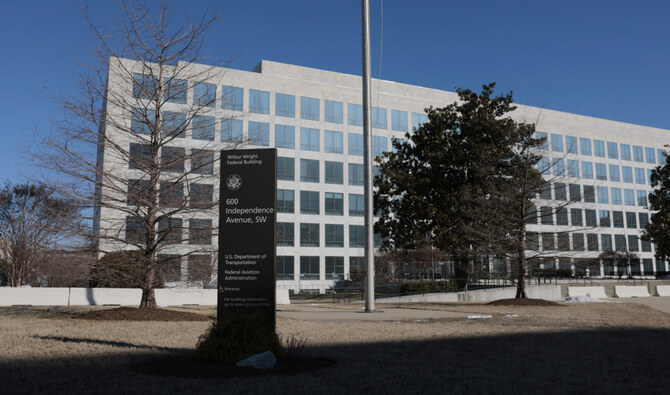
WASHINGTON: The Trump administration has begun firing several hundred Federal Aviation Administration employees, upending staff on a busy air travel weekend and just weeks after a January fatal midair collision at Ronald Reagan Washington National Airport.
Probationary workers were targeted in late-night emails Friday notifying them they had been fired, David Spero, president of the Professional Aviation Safety Specialists union, said in a statement.
The impacted workers include personnel hired for FAA radar, landing and navigational aid maintenance, one air traffic controller told The Associated Press. The air traffic controller was not authorized to talk to the media and spoke on condition of anonymity.
A Transportation Department official told the AP late Monday that no air traffic controllers were affected by the cuts, and that the agency has “retained employees who perform critical safety functions.” In a follow-up query the agency said they would have to look into whether the radar, landing and navigational aid workers affected were considered to handle critical safety functions.
The National Air Traffic Controllers Association said in a brief statement Monday it was “analyzing the effect of the reported federal employee terminations on aviation safety, the national airspace system and our members.”
Other FAA employees who were fired were working on an urgent and classified early warning radar system the Air Force had announced in 2023 for Hawaii to detect incoming cruise missiles, through a program that was in part funded by the Defense Department. It’s one of several programs that the FAA’s National Defense Program manages that involve radars providing longer-range detection around the country’s borders.
Due to the nature of their work, staff in that office typically provide an extensive knowledge transfer before retiring to make sure no institutional knowledge is lost, said Charles Spitzer-Stadtlander, one of the employees in that branch who was terminated.
The Hawaii radar and the FAA National Defense Program office working on it are “about protecting national security,” Spitzer-Stadtlander said. “I don’t think they even knew what NDP does, they just thought, oh no big deal, he just works for the FAA.”
“This is about protecting national security, and I’m scared to death,” Spitzer-Stadtlander said. “And the American public should be scared too.”
Spero said messages began arriving after 7 p.m. Friday and continued late into the night. More might be notified over the long weekend or barred from entering FAA buildings Tuesday, he said.
The employees were fired “without cause nor based on performance or conduct,” Spero said, and the emails were “from an ‘exec order’ Microsoft email address” — not a government email address. A copy of the termination email that was provided to the AP shows the sending address “[email protected].”
The firings hit the FAA as it is facing a shortfall in controllers. Federal officials have been raising concerns about an overtaxed and understaffed air traffic control system for years, especially after a series of close calls between planes at US airports. Among the reasons they have cited for staffing shortages are uncompetitive pay, long shifts, intensive training and mandatory retirements.
In the Jan. 29 fatal crash between a US Army Black Hawk helicopter and American Airlines passenger jet, which is still under investigation, one controller was handing both commercial airline and helicopter traffic at the busy airport.
Just days before the collision, President Donald Trump had already fired all the members of the Aviation Security Advisory Committee, a panel mandated by Congress after the 1988 PanAm 103 bombing over Lockerbie, Scotland. The committee is charged with examining safety issues at airlines and airports.
Spitzer-Stadtlander suggested he was targeted for firing for his views on Tesla and X, formerly Twitter, not as part of a general probationary-level sweep. Both companies are owned by Elon Musk, whose Department of Government Efficiency is leading Trump’s effort to cut the federal government.
Spitzer-Stadtlander is Jewish and was angered by Musk’s straight-arm gesture at Trump’s inauguration. On his personal Facebook page he urged friends to get rid of their Teslas and X accounts in response.
Spitzer-Stadtlander said that post drew the attention of a Facebook account labeled “Department of Government Efficiency,” which reacted with a laughing emoji. Soon after, he saw the same account reacting to much older posts through his personal Facebook feed.
There are at least a half-dozen Facebook accounts labeled “Department of Government Efficiency,” and it’s unclear who operates any of them. White House spokesperson Karoline Leavitt wrote Monday on X, “DOGE doesn’t even have a Facebook page.”
Spitzer-Stadtlander said he was supposed to be exempted from the probationary firings because the FAA office he worked in focused on national security threats such as attacks on the national airspace by drones.
“Less than a week later, I was fired, despite my position allegedly being exempted due to national security,” Spitzer-Stadtlander wrote in a post over the weekend on LinkedIn.
He added, “When DOGE fired me, they turned off my computer and wiped all of my files without warning.”
DOGE did not immediately respond to a request for comment. The firings were first reported by CNN.


![]()

Trump begins firings of FAA staff just weeks after fatal DC plane crash
Short Url
https://arab.news/yrkfg
Trump begins firings of FAA staff just weeks after fatal DC plane crash


Latest updates


© 2026 SAUDI RESEARCH & PUBLISHING COMPANY, All Rights Reserved And subject to Terms of Use Agreement.