TORONTO: All but two of the passengers injured on a Delta Air Lines jet that crashed upon landing in Toronto have been released, the airport CEO said Tuesday.
Miraculously, all 80 people on board the flight from Minneapolis to Toronto’s Pearson International Airport survived the crash Monday afternoon. Most of them walked away with minor injuries, the airport’s chief executive said.
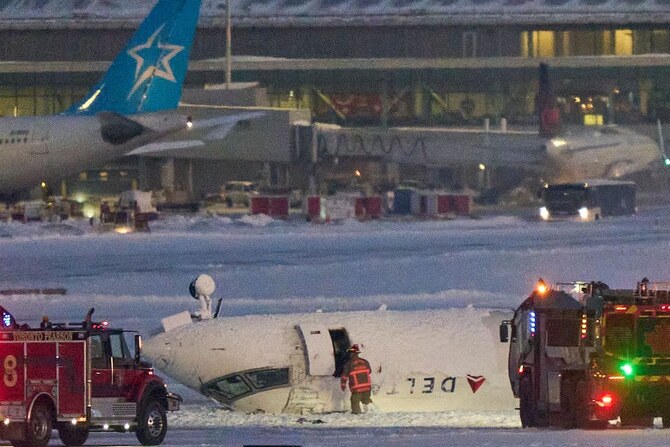
The aircraft came down fast, landing so hard that it lost its right wing, then burst into flames on the runway. The aircraft slid to a stop, upside down, leaving a trail of black smoke in its wake.
Deborah Flint, CEO of Greater Toronto Airports Authority, said 19 of the 21 people who were hurt have been released but did not provided any details on the two who remain hospitalized.
Authorities said the cause of the crash remains under investigation. Communications between the tower and pilot were normal on approach and it’s not clear what went wrong when the plane touched down.
At the time of the flight’s arrival, Pearson was experiencing blowing snow and winds of 32 mph (51 kph) gusting to 40 mph (65 kph), according to the Meteorological Service of Canada. The temperature was about 16.5 degrees Fahrenheit (minus 8.6 degrees Celsius).
Peter Carlson, a passenger traveling to Toronto for a paramedics conference, said the landing was “very forceful.”
“All the sudden everything just kind of went sideways and the next thing I know, it’s kind of a blink and I’m upside down still strapped in,” he told CBC News.
Canadian authorities held two brief news conferences Monday but provided few details. The aircraft was a Mitsubishi CRJ-900 made by the Canadian company Bombardier.
“We are very grateful there was no loss of life and relatively minor injuries,” Deborah Flint, CEO of Greater Toronto Airports Authority, told reporters.
Delta CEO Ed Bastian said in a statement that “the hearts of the entire global Delta family are with those affected.”
The crash was the fourth major aviation accident in North America in recent weeks. A commercial jetliner and an Army helicopter collided near Reagan National Airport in Washington, D.C., on Jan. 29, killing 67 people. A medical transportation plane crashed in Philadelphia on Jan. 31, killing the six people on board and another person on the ground. And on Feb. 6, 10 people were killed in a plane crash in Alaska.
The last major crash at Pearson was on Aug. 2, 2005, when an Airbus A340 from Paris skidded off the runway and burst into flames in stormy weather. All 309 passengers and crew aboard Air France Flight 358 survived.
The Delta flight was cleared to land at about 2:10 p.m. Audio recordings show the control tower warned the pilots of a possible air flow “bump” on approach.
“It was windy, but the airplanes are designed and certified to handle that,” said John Cox, CEO of aviation safety consulting firm Safety Operating Systems in St. Petersburg, Florida. “The pilots are trained and experienced to handle that.”
The plane came to a rest at the intersection of Runways 23 and 15L.
Carlson said when he took off his seat belt he crashed onto the ceiling, which had become the floor. He smelled gas, saw aviation fuel cascading down the cabin windows and knew he needed to get out, but his paramedic skills kicked in and he looked for those he could help.
Carlson and another man assisted a mother and her young son out of the plane and then Carlson dropped onto the tarmac. He said snow was blowing but “I didn’t care how cold it was, didn’t care how far I had to walk, how long I had to stand — all of us just wanted to be out of the aircraft.”
Cox, who flew for US Air for 25 years and has worked on US National Transportation Safety Board investigations, said the CRJ-900 has been in service for decades and does a good job of handling inclement weather, but that it’s unusual for any plane to end up on its roof.
“We’ve seen a couple of cases of takeoffs where airplanes have ended up inverted, but it’s pretty rare,” Cox said.
Among the questions that need to be answered, Cox said, is why the crashed plane was missing its right wing. He said the flight data recorder and cockpit voice recorder will be imperative to understanding what actually occurred.
The US Federal Aviation Administration said in a statement that the Transportation Safety Board of Canada would head up the investigation and provide any updates. The NTSB in the US said it was sending a team to assist.
Endeavor Air, based in Minneapolis, is a subsidiary of Delta Air Lines and the world’s largest operator of CRJ-900 aircraft. The airline operates 130 regional jets on 700 daily flights to over 126 cities in the US, Canada and the Caribbean, according to the company’s website.


![]()

Toronto airport CEO says all but 2 of 21 people hurt in Delta crash have left hospitals
Short Url
https://arab.news/5r63n
Toronto airport CEO says all but 2 of 21 people hurt in Delta crash have left hospitals
- Deborah Flint, CEO of Greater Toronto Airports Authority, said 19 of the 21 people who were hurt have been released
- Authorities said the cause of the crash remains under investigation


Latest updates


© 2026 SAUDI RESEARCH & PUBLISHING COMPANY, All Rights Reserved And subject to Terms of Use Agreement.