Crashed Azerbaijani plane was riddled with holes after incident over Russia, report says

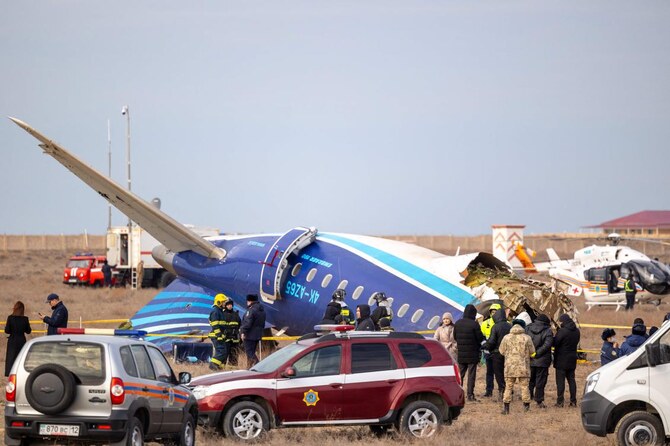
A Russia-bound Azerbaijani jet which crashed in Kazakhstan in December had probably been damaged by “external objects” before it hit the ground, an investigation said on Feb. 4, 2025. (AFP)
Short Url
Updated 04 February 2025
Follow

Crashed Azerbaijani plane was riddled with holes after incident over Russia, report says

  • A senior Azerbaijani government official told Reuters that the external impact referred to in the report was from a Russian surface-to-air missile
  • “The Azerbaijani side possesses a fragment of a Pantsir-S missile, which was extracted from the aircraft and identified through international expertise“

ASTANA: An Azerbaijani passenger plane that crashed in December after being diverted from Russia to Kazakhstan had suffered external damage and was riddled with holes in its fuselage, according to a report published on a Kazakh government website on Tuesday.
Thirty-eight people were killed when the Azerbaijan Airlines passenger plane crashed on Dec. 25 near the city of Aktau in Kazakhstan after re-routing across the Caspian Sea from southern Russia.
Azerbaijan’s President Ilham Aliyev said in December the plane had been damaged by accidental shooting from the ground in Russia. Moscow has not confirmed this.
Following the crash, Russian President Vladimir Putin issued a rare apology to Aliyev for the “tragic incident” in Russian airspace, but the Kremlin did not say Russia had fired at the plane, only noting that a criminal case had been opened.
The preliminary report was issued under global aviation rules designed to draw lessons to prevent future accidents, rather than assigning blame or liability.
It was cautiously worded and did not say what had caused the extensive damage to the plane, including its stabilizers, hydraulics and trim systems.
But it included photographs showing the port side of the tail section was punctured with numerous holes. Also pictured were fragments that it described as “foreign metal objects” removed from the left stabilizer and hydraulic system.
A senior Azerbaijani government official told Reuters that the external impact referred to in the report was from a Russian surface-to-air missile.
“The Azerbaijani side possesses a fragment of a Pantsir-S missile, which was extracted from the aircraft and identified through international expertise,” the source said.
It was the first time that a Baku government source has claimed to have physical proof that Russia shot down the plane, a Brazilian-manufactured Embraer E190. No comment was immediately available from Russian officials late on Tuesday evening.
Russia says it has assigned its own investigation to the most experienced experts and that actions are being taken to establish the cause and circumstances of the incident.

’PASSENGERS ARE LOSING CONSCIOUSNESS’
The plane had been flying from Baku to Grozny in southern Russia, where the Kremlin said Ukrainian drones had been attacking several cities at the time.
Twenty-nine people survived the crash-landing in Kazakhstan. Aliyev has hailed the pilots, who died, as national heroes. The Azerbaijani leader has said that blame lies with Russian individuals, and that Baku demands justice.
The report said that at the start of the incident, the cockpit voice recorder identified the sound of two impacts in the space of 25 seconds. Two minutes later, the pilot reported to air traffic control that he thought the plane had suffered a bird strike.
After a further five minutes, he said the aircraft was losing control.
Several other airports were discussed as possible landing sites for the stricken plane before the crew decided to head to Aktau in Kazakhstan, which required them to fly east across the Caspian Sea.
“So, we have this situation, oxygen is running out in the passenger cabin, which means an oxygen tank exploded there, I think,” the pilot reported. “So there is a smell of fuel, some passengers are losing consciousness, give us permission to go at a lower altitude.”
The plane transmitted a distress signal while approaching Aktau. It collided with the ground there an hour and 12 minutes after the pilots first reported a problem.
Azerbaijan’s transport ministry, commenting on the report, said the plane had been fully airworthy but was damaged due to the impact of “external objects.”
It highlighted the report’s finding that it was not until eight minutes after the initial impacts that Russian air traffic controllers initiated a protocol that bans aircraft from flying in areas which are being subjected to drone attacks.



Nowhere to pray as logs choke flood-hit Indonesian mosque

Updated 9 sec ago
Follow

Nowhere to pray as logs choke flood-hit Indonesian mosque

  • Before the disaster, the mosque bustled with worshippers — locals and students alike — attending daily and Friday prayers
  • Indonesia consistently ranks among the countries with the highest annual deforestation rates

ACEH TAMIANG, Indonesia: Almost two weeks on from devastating floods, Muslim worshippers in Indonesia’s Sumatra who gathered at their local mosque on Friday for prayers were blocked from entering by a huge pile of thousands of uprooted trees.
The deadly torrential rains had inundated vast tracts of rainforest nearby, leaving residents of the Darul Mukhlisin mosque and Islamic boarding school to search elsewhere for places of worship that had been less damaged.
“We have no idea where all this wood came from,” said Angga, 37, from the nearby village of Tanjung Karang.
Before the disaster, the mosque bustled with worshippers — locals and students alike — attending daily and Friday prayers.
“Now it’s impossible to use. The mosque used to stand near a river,” said Angga. “But the river is gone — it’s turned into dead land.”
Village residents told AFP the structure likely absorbed much of the impact of trees and logs carried by the torrents, preventing even greater destruction downstream.
When AFP visited the site, the mosque was still encircled by a massive heap of timber — a mix of uprooted trees and felled logs, likely from nearby forests.
By Friday, the death toll from one of northern Sumatra’s worst recent disasters — including in Aceh, where a tsunami wreaked havoc in 2004 — had reached 995 people, with 226 still missing and almost 890,000 displaced, according to the National Disaster Mitigation Agency.

- Uncontrolled logging -

Authorities have blamed the scale of devastation partly on uncontrolled logging.
Environmentalists say widespread forest loss has worsened floods and landslides, stripping the land of tree cover that normally stabilizes soil and absorbs rainfall.
Indonesia consistently ranks among the countries with the highest annual deforestation rates.
President Prabowo Subianto, visiting Aceh Tamiang district on Friday, assured victims the government was working to restore normalcy.
“We know conditions are difficult, but we will overcome them together,” he said, urging residents to “stay alert and be careful.”
“I apologize for any shortcomings (but) we are working hard,” he said.
Addressing environmental concerns, Prabowo called for better forest protection.
“Trees must not be cut down indiscriminately,” he said.
“I ask local governments to stay vigilant, to monitor and safeguard our nature as best as possible.”
But frustrations were growing, with flood victims complaining about the pace of relief efforts.
Costs to rebuild after the disaster could run up to 51.82 trillion rupiah ($3.1 billion) and the Indonesian government has so far shrugged off suggestions that it call for international assistance.
Back in nearby Babo Village, Khairi Ramadhan, 37, said he planned to seek out another mosque for prayers.
“I’ll find one that wasn’t hit by the flood,” he said. “Maybe some have already been cleaned. I don’t want to dwell on sorrow anymore.”