SINGAPORE: Singapore’s opposition leader was fined on Monday for lying to parliament while helping a fellow party member cover up a false witness account, but narrowly avoided being barred from contesting upcoming national elections.
Pritam Singh, 48, secretary-general of the Workers’ Party, was found guilty on two counts of lying to a parliamentary committee probing a fellow MP.
The conviction comes as the Southeast Asian nation’s struggling political opposition is seeking to challenge the overwhelming dominance of the ruling People’s Action Party (PAP) in elections expected within months.
The PAP has ruled the wealthy city-state since 1959.
District court judge Luke Tan said that contrary to what Singh told the committee, he had not done enough to get rookie MP Raeesah Khan to admit to her lie in parliament.
The judge also gave credence to Khan’s testimony that Singh had told her during a meeting to “take the lie to the grave.”
Singh, who said he would appeal the court’s decision, was fined S$7,000 ($5,200) for each charge.
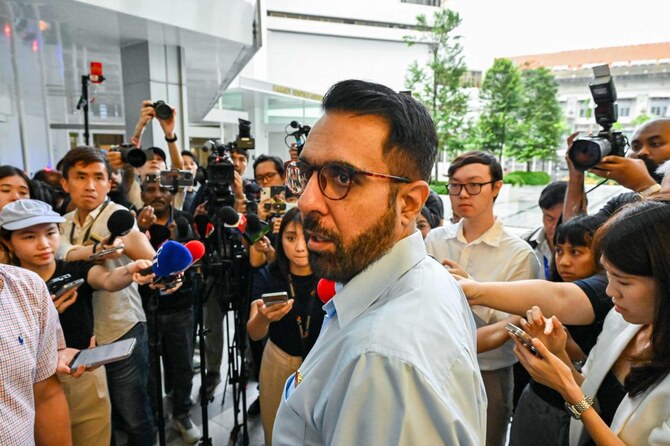
“It’s not going to be an easy election... we’ll have to fight hard, and that’s what we will do,” Singh told reporters outside the court.
“The path of choosing opposition politics is not for the faint hearted.”
Under the constitution, a person fined a minimum of Sg$10,000 or jailed for at least one year, is disqualified from running for election or holding a parliamentary seat for five years.
“He will not be disqualified as the threshold of $10,000 fine per charge is not crossed. You can’t stack up the fines,” Eugene Tan, who teaches constitutional law at Singapore Management University, said.
The Elections Department later confirmed this via a statement on Facebook.
Khan, who resigned from the legislature following the scandal, had admitted to making up a story she told in parliament about a female rape victim she accompanied to make a police report.
The former MP confessed that she lied when telling parliament in 2021 that a police officer supposedly made “insensitive comments” about the way the alleged victim was dressed and that she had drunk alcohol.
But Home Affairs Minister K. Shanmugam had said there was no record in the police files of such an incident and Khan eventually admitted to lying.
Singh was then accused of lying to the parliamentary committee investigating Khan.
He allegedly told the committee that he was not aware that Khan had made up the story about the rape victim, in an apparent attempt to downplay his responsibility as party leader, court documents said.
But the judge tore through Singh’s credibility as a witness.
In the 2020 general elections, the PAP won 83 of the 93 seats at stake to retain its dominance.
The main opposition Workers’ Party captured 10 seats – four more than previously held – in its strongest performance since independence in 1965.
Its leaders have said they hope to further increase the party’s numbers in parliament in the upcoming elections, which will be new premier Lawrence Wong’s first major political test.


![]()

Singapore opposition leader fined for lying to parliament
Short Url
https://arab.news/nuhvq
Singapore opposition leader fined for lying to parliament
- Pritam Singh, secretary-general of the Workers’ Party, was found guilty on two counts of lying
- Singh, who said he would appeal the court’s decision, was fined S$7,000 ($5,200) for each charge


Latest updates


© 2026 SAUDI RESEARCH & PUBLISHING COMPANY, All Rights Reserved And subject to Terms of Use Agreement.