SINGAPORE: Singapore’s government has used a controversial online misinformation law to order an opposition party to correct a social media post, days after campaigning got underway for an election next week.
Under the law, ministers can order social media sites to put warnings next to posts the government considers false and order pages be blocked, but critics fear it is being used to suppress dissent.
On Thursday the government ordered Peoples Voice to correct a video posted on Facebook and YouTube and the opposition party complied, putting up banners saying it contains inaccurate information.
In the video, party chief Lim Tean said the government spends a quarter of a billion Singapore dollars ($180 million) “providing free education for foreigners every year.”
A government website aimed at debunking untrue information said the video contained “a false and misleading statement,” as a significant majority of such students have to pay fees higher than local students.
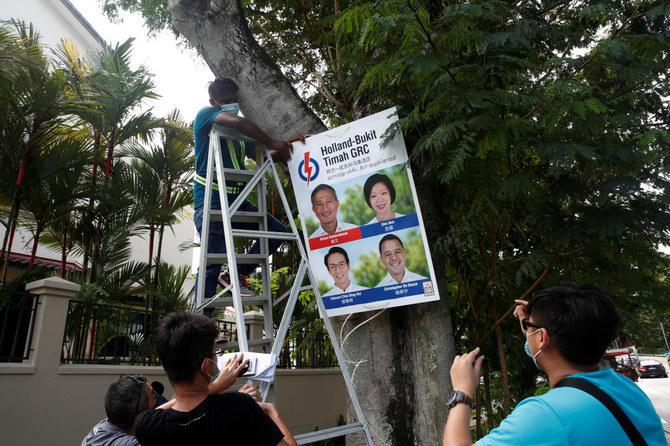
The large number of foreigners in the city-state has become a hot-button issue ahead of the election, with the opposition pressing the government to put Singaporeans first when it comes to job opportunities.
People’s Voice is among a handful of small opposition groups taking on the long-ruling People’s Action Party (PAP) at the July 10 vote.
While the PAP is expected to remain in power, the opposition hopes to win more seats in parliament.
Since the misinformation law came into force last year, several opposition figures and activists have been ordered to correct posts while Facebook has been forced to block pages on several occasions.
The tech giant said last month the use of the law is “severe” and risks stifling free speech, while Google and Twitter have also expressed concerns.
But authorities insist the measure is necessary to stop falsehoods from circulating online that could sow divisions in the multi-ethnic, multi-faith country of 5.7 million.


![]()

Singapore opposition hit with misinformation law before polls
Short Url
https://arab.news/g9jds
Singapore opposition hit with misinformation law before polls
- Ministers can order social media sites to put warnings next to posts the government considers false and order pages be blocked


Latest updates


Recommended


© 2026 SAUDI RESEARCH & PUBLISHING COMPANY, All Rights Reserved And subject to Terms of Use Agreement.