

Pakistan’s top commerce body launches EU business forum

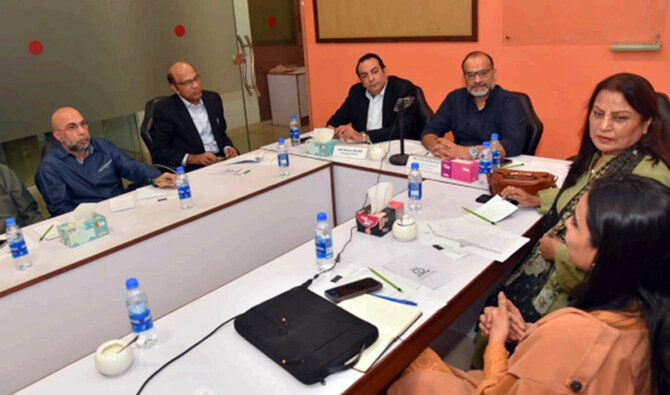
President of the Federation of Pakistan Chambers of Commerce & Industry (FPCCI) Atif Ikram Sheikh (center), and Zubair Baweja (third right), chairman of the Pak-EU Business Forum, attend the first meeting of Pak–EU Business Forum in Karachi on February 16, 2025. (Photo Courtesy: FPCCI)
Short Url
Updated 17 February 2025
Follow

Pakistan’s top commerce body launches EU business forum

  • Forum aims to explore “untapped” trade, investment, economic and industrial collaboration potential, FPCCI president says 
  • Pakistan’s major exports to EU, including textiles and garments, agricultural products, leather goods, aree valued at $10 billion annually

ISLAMABAD: The Federation of Pakistan Chambers of Commerce & Industry (FPCCI) has set up the Pak-EU Business Forum to explore “untapped” trade, investment, economic and industrial collaboration potential between the South Asian nation and the regional economic alliance, FPCCI said in a statement this month.

Pakistan has become the largest beneficiary of the EU’s GSP+ preferential trade scheme in recent years, with its businesses increasing their exports to the EU market by 108 percent since the launch of the trade scheme in 2014. The EU is also Pakistan’s second most important trading partner after China, accounting for over 14 percent of Pakistan’s total trade and absorbing 28 percent of Pakistan’s total exports. Pakistan’s major exports to the EU – including textiles and garments, agricultural products and leather goods – are valued at $10 billion annually.

“Cracking the EU market in a substantive manner can transform the entire economy of Pakistan – as geographical contiguity and regulatory uniformity offers a huge market for Pakistani products in a number of industries, sectors and verticals,” FPCCI President Atif Ikram Sheikh said in a statement, calling on the need to diversify Pakistan’s export portfolio.

Zubair Baweja, the chairman of the Pak-EU Business Forum, said the main aim of setting up the platform was to “diversify, enrich, expand and value-add” Pakistan’s export-basket to the EU member states.

“It was decided to make working groups on different sectors and product categories for a focused and result-oriented facilitation to the trade and industry,” the statement quoted Baweja as saying.

Last month, the European Union’s mission in Islamabad reminded Pakistan that the trade benefits it received under the GSP+ scheme depended on progress the country made on addressing a list of issues, including human rights, saying “tangible” efforts remained essential. 

The statement came after a visit to Pakistan by Ambassador Olof Skoog, EU Special Representative for Human Rights (EUSR), to engage the country on human and labor rights issues and to discuss Pakistan’s plans to address them, including in view of the ongoing assessment under the GSP+ trade scheme.

The GSP+ scheme grants beneficiary countries’ exports duty-free access to the European market in exchange for voluntarily agreeing to implement 27 international core conventions, including on human and civil rights.

Multiple developments on the human rights front have raised concerns over Pakistan’s GSP+ status in recent weeks. The EU has openly criticized Pakistan for sentencing over 80 civilians in army courts after charging them for anti-government riots in May 2023 in which military installations were attacked, saying it was “inconsistent” with Pakistan’s international obligations. 

The country’s GSP+ status was once more in the spotlight last month after parliament passed a controversial cybercrime law that journalists and digital rights activists have widely said aims to crackdown against dissent on social media platforms. The government denies this.


UN torture expert decries Pakistan ex-PM Khan’s detention

Updated 12 December 2025
Follow

UN torture expert decries Pakistan ex-PM Khan’s detention

  • Khan’s party alleges government is holding him in solitary confinement, barring prison visits
  • Pakistan’s government rejects allegations former premier is being denied basic rights in prison

GENEVA: Pakistan’s former prime minister Imran Khan is being held in conditions that could amount to torture and other inhuman or degrading treatment, the United Nations’ special rapporteur on torture warned Friday.

Alice Jill Edwards urged Pakistan to take immediate and effective action to address reports of the 73-year-old’s inhumane and undignified detention conditions.

“I call on Pakistani authorities to ensure that Khan’s conditions of detention fully comply with international norms and standards,” Edwards said in a statement.

“Since his transfer to Adiala Jail in Rawalpindi on September 26, 2023, Imran Khan has reportedly been held for excessive periods in solitary confinement, confined for 23 hours a day in his cell, and with highly restricted access to the outside world,” she said.

“His cell is reportedly under constant camera surveillance.”

Khan an all-rounder who captained Pakistan to victory in the 1992 Cricket World Cup, upended Pakistani politics by becoming the prime minister in 2018.

Edwards said prolonged or indefinite solitary confinement is prohibited under international human rights law and constitutes a form of psychological torture when it lasts longer than 15 days.

“Khan’s solitary confinement should be lifted without delay. Not only is it an unlawful measure, extended isolation can bring about very harmful consequences for his physical and mental health,” she said.

UN special rapporteurs are independent experts mandated by the Human Rights Council. They do not, therefore, speak for the United Nations itself.

Initially a strong backer of the country’s powerful military leadership, Khan was ousted in a no-confidence vote in 2022, and has since been jailed on a slew of corruption charges that he denies.

He has accused the military of orchestrating his downfall and pursuing his Tehreek-e-Insaf (PTI) party and its allies.

Khan’s supporters say he is being denied prison visits from lawyers and family after a fiery social media post this month accusing army leader Field Marshal Asim Munir of persecuting him.

According to information Edwards has received, visits from Khan’s lawyers and relatives are frequently interrupted or ended prematurely, while he is held in a small cell lacking natural light and adequate ventilation.

“Anyone deprived of liberty must be treated with humanity and dignity,” the UN expert said.

“Detention conditions must reflect the individual’s age and health situation, including appropriate sleeping arrangements, climatic protection, adequate space, lighting, heating, and ventilation.”

Edwards has raised Khan’s situation with the Pakistani government.