


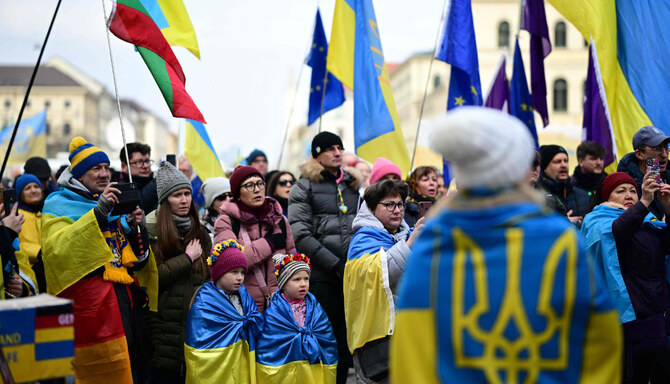

WASHINGTON: President Donald Trump’s approach to ending Russia’s war against Ukraine has left European allies and Ukrainian officials worried they are being largely sidelined by the new US administration as Washington and Moscow plan direct negotiations.
With the three-year war grinding on, Trump is sending Secretary of State Marco Rubio, national security adviser Mike Waltz and special envoy Steve Witkoff to Saudi Arabia for talks with Russian counterparts, according to a US official who was not authorized to publicly discuss the upcoming diplomatic efforts and spoke on condition of anonymity.
It is unclear whether Ukraine or European officials will be represented in discussions expected to take place in Riyadh in the coming days. The official said the United States sees negotiations as early-stage and fluid, and who ultimately ends up at the table could change.
The outreach comes after comments by top Trump advisers this past week, including Vice President JD Vance, raised new concerns in Kyiv and other European capitals that the Republican administration is intent on quick resolution to the conflict with minimum input from Europe.
“Decades of the old relationship between Europe and America are ending,” Ukrainian President Volodymyr Zelenskyin an address Saturday at the Munich Security Conference. “From now on, things will be different, and Europe needs to adjust to that.”
White House officials on Sunday pushed back against the notion that Europe has been left out of the conversation. Trump spoke by phone in recent days with French President Emmanuel Macron and is expected to consult with British Prime Minister Keir Starmer this week.
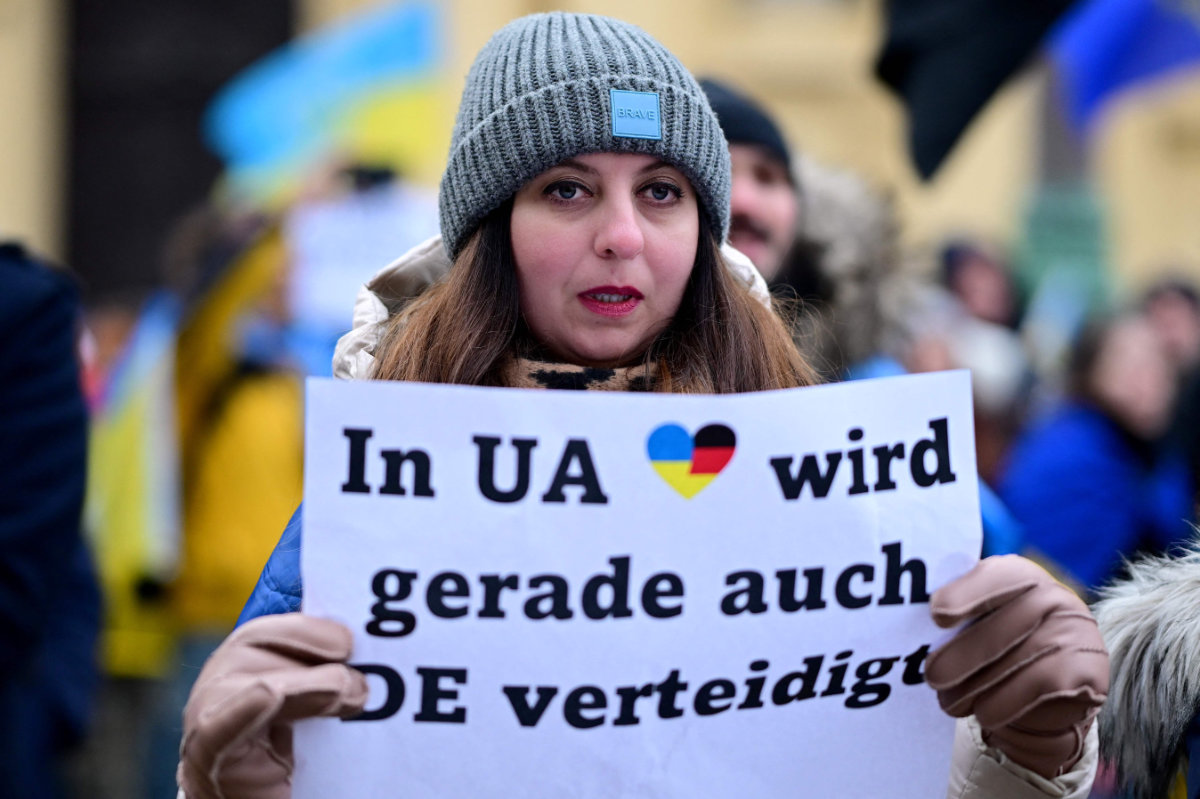
A protester holds a poster reading "Germany is also being defended in Ukraine right now" during a demonstration supporting Ukraine in Munich on February 15, 2025. (AFP)
During his visit to Munich and Paris, Vance held talks with Macron, British Foreign Secretary David Lammy, German President Frank-Walter Steinmeier, NATO Secretary-General Mark Rutte as well as Zelensky.
“Now they may not like some of this sequencing that is going on in these negotiations but I have to push back on this ... notion that they aren’t being consulted,” Waltz told “Fox News Sunday.”
“They absolutely are and at the end of the day, though, this is going to be under President Trump’s leadership that we get this war to an end,’’ Waltz said.
Rubio, who was in Israel on Sunday before heading to Saudi Arabia, said the US is taking a careful approach as it reengages with Moscow after the Biden administration’s clampdown on contacts with the Kremlin following the February 2022 invasion.
Trump spoke by phone with Russian President Vladimir Putin last week and the two leaders agreed to begin high-level talks on ending the war. They were initially presented as two-way, but Trump later affirmed that Ukraine would have a seat — though he did not say at what stage.
It was not immediately clear whether any Ukrainians would take part in the upcoming Riyadh talks. A Ukrainian delegation was in Saudi Arabia on Sunday to pave the way for a possible visit by Zelensky, according to Ukraine’s economy minister.
“I think President Trump will know very quickly whether this is a real thing or whether this is an effort to buy time. But I don’t want to prejudge that,” Rubio said told CBS’ “Face the Nation.”
“I don’t want to foreclose the opportunity to end a conflict that’s already cost the lives of hundreds of thousands and continues every single day to be increasingly a war of attrition on both sides,” he said.
Heather Conley, a deputy assistant secretary of state for Central Europe during Republican President George W. Bush’s administration, said that with Trump’s current approach to Moscow, the US appears to be “seeking to create a new international approach based on a modern-day concert of great powers.”
“As in the 19th and early 20th centuries, it is only for the great powers to decide the fate of nations and to take — either by purchase or force — that which strengthens the great powers’ economic and security interests,” Conley said. “Each of these powers posit claims or coerce countries in their respective regional spheres of influence.”
There is some debate inside the administration about its developing approach to Moscow, with some more in favor of a rapid rapprochement and others wary that Putin is looking to fray the Euro-Atlantic alliance as he aims to reclaim Russian status and wield greater influence on the continent, according to the US official who spoke on condition of anonymity.
Trump said last week that he would like to see Russia rejoin what is now the Group of Seven major economies. Russia was suspended from the G8 after Moscow’s 2014 annexation of Ukraine’s Crimea region.
“I’d like to have them back. I think it was a mistake to throw them out. Look, it’s not a question of liking Russia or not liking Russia,” Trump told reporters. “I think Putin would love to be back.”
The anticipated Saudi talks also come amid tension over Trump’s push to get the Ukrainians to agree to give the US access to Ukraine’s deposits of rare earth minerals in exchange for some $66 billion in military aid that Washington has provided Kyiv since the start of the war, as well as future defense assistance.
Zelensky, who met on Friday with Vance and other senior US officials in Munich, said he had directed Ukraine’s minister to not sign off, at least for now.
Zelensky said in an interview the deal as presented by the US was too focused on American interests and did not include security guarantees for Ukraine.
The White House called Zelensky’s decision “short-sighted,” and argued that a rare-earth’s deal would tie Ukraine closer to the United States — something that Moscow doesn’t want to see.
European officials were also left unsettled by some of Vance’s remarks during his five-day visit to Paris and Munich last week in which he lectured them on free speech and illegal migration on the continent. He warned that they risk losing public support if they don’t quickly change course.
Vance also met while in Munich with Alice Weidel, the co-leader and candidate for chancellor of the far-right and anti-immigrant Alternative for Germany party in this month’s election.
Throughout Europe, officials are now looking to recalibrate their approach in the face of the Trump administration’s unfolding Ukraine strategy.
Macron will convene top European countries in Paris on Monday for an emergency “working meeting” to discuss next steps for Ukraine, French Foreign Minister Jean-Noël Barrot said Sunday.
“A wind of unity is blowing over Europe, as we perhaps have not felt since the COVID period,” Barrot told public broadcaster France-Info.


