

Saudi Arabia, IMF host roundtable on supporting conflict-affected Middle East economies

1 / 3
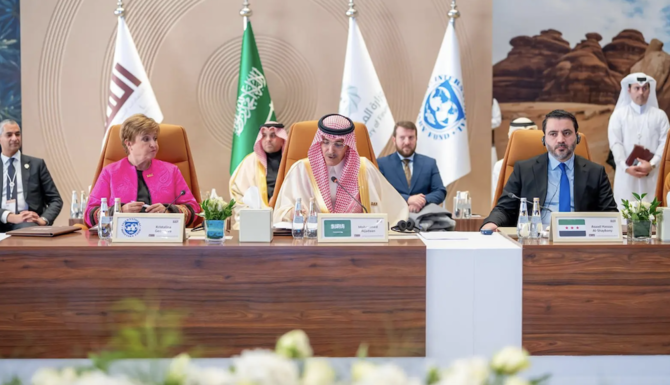
Saudi Arabia’s Finance Ministry and the International Monetary Fund co-hosted on Sunday a high-level roundtable aimed at addressing economic recovery in conflict-affected countries in the Middle East, with a particular focus on the Syrian Arab Republic. (SPA)
2 / 3
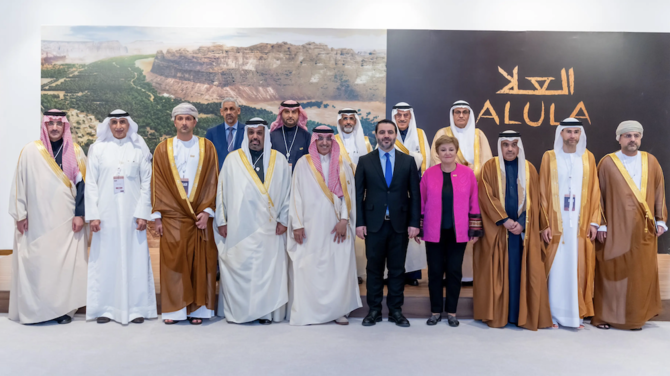
Saudi Arabia’s Finance Ministry and the International Monetary Fund co-hosted on Sunday a high-level roundtable aimed at addressing economic recovery in conflict-affected countries in the Middle East, with a particular focus on the Syrian Arab Republic. (SPA)
3 / 3
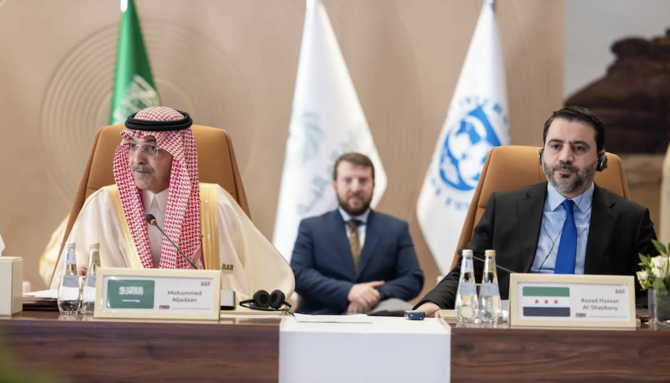
Saudi Arabia’s Finance Ministry and the International Monetary Fund co-hosted on Sunday a high-level roundtable aimed at addressing economic recovery in conflict-affected countries in the Middle East, with a particular focus on the Syrian Arab Republic. (SPA)
Short Url
Updated 17 February 2025
Follow

Saudi Arabia, IMF host roundtable on supporting conflict-affected Middle East economies

  • Focus on Syria as meeting calls for international cooperation in supporting devastated populations
  • Finance leaders highlight wider regional consequences of prolonged instability

ALULA: Saudi Arabia’s Finance Ministry and the International Monetary Fund co-hosted on Sunday a high-level roundtable aimed at addressing economic recovery in conflict-affected countries in the Middle East, with a particular focus on the Syrian Arab Republic. 

The meeting, held on the sidelines of the inaugural AlUla Conference for Emerging Market Economies, brought together regional finance ministers, the Syrian foreign minister, the managing director of operations at the World Bank Group, and representatives from international financial institutions and the Arab Coordination Group.

Following the discussion, IMF Managing Director Kristalina Georgieva and Saudi Finance Minister Mohammed Al-Jadaan issued a joint statement emphasizing the significance of international cooperation in rebuilding economies devastated by conflict, the Saudi Press Agency reported.

They stressed the urgency of addressing humanitarian needs and facilitating a durable recovery, underscoring the commitment of participating nations and institutions to pool their expertise and resources to support affected populations, SPA added.

Participants highlighted the wider regional consequences of prolonged instability, reinforcing the need for coordinated recovery efforts. Syria remained a focal point of the discussions.

As part of a collective strategy, attendees identified three priorities for supporting conflict-affected economies.

First, they agreed on the necessity of a continuous diagnostic process to assess each country’s unique challenges, humanitarian requirements, and reconstruction needs. This would include evaluating gaps in institutional frameworks, economic policies, and financial resources.

Second, they underscored the importance of enhanced capacity development, with an emphasis on scaling up IMF and World Bank initiatives to strengthen key institutions, particularly in fiscal, monetary, and banking sectors.

Lastly, they emphasized the mobilization of financial assistance from the global community, stressing the importance of securing coordinated support from international and regional development partners for reconstruction and humanitarian programs.

The IMF, World Bank, and Arab Coordination Group reaffirmed their commitment to working together within their respective mandates to facilitate economic recovery efforts in the region.

To enhance these efforts, they agreed to establish an informal coordination group that will oversee ongoing initiatives. Further discussions are scheduled to take place at the upcoming IMF/World Bank Spring Meetings, set to be held in Washington, from April 25-27.

The meeting saw participation from regional governments, international financial institutions, and high-level Syrian representatives, marking a significant step toward a collaborative and sustained approach to economic recovery in the Middle East.


Saudi POS stays above $4bn as Ramadan spending lifts home goods

Updated 16 sec ago
Follow

Saudi POS stays above $4bn as Ramadan spending lifts home goods

RIYADH: Saudi point-of-sale transactions remained above $4 billion in the week ending Feb. 14, with spending on furniture and home supplies rising ahead of Ramadan, central bank data showed. 

Overall POS activity totaled SR15.34 billion ($4.09 billion), representing a 4.8 percent week-on-week decrease, while the number of transactions dipped 1.6 percent to 252 million, according to the Saudi Central Bank. 

Spending on furniture and home supplies rose 5.9 percent to SR697.35 million, marking the strongest weekly increase among major retail categories. 

Expenditure on electronics increased 2.9 percent, while spending on construction and building materials rose 1.1 percent.

Sectors that saw declines includes freight transport and courier services, which posted a drop of 5 percent to SR64.86 million.

Pharmacy and medical supplies spending fell 8.2 percent to SR223.81 million, but outlays on medical services rose 5.7 percent to SR539.68 million. 

Food and beverage expenditure decreased 4.3 percent, but the total spend of SR2.57 billion meant it retained the largest share of POS activity.

Restaurants and cafes followed with SR1.73 billion, despite a 4.7 percent decline. Apparel and clothing outlays represented the third-largest share of POS spending during the monitored week, up 0.5 percent to SR1.38 billion.

The Kingdom’s major urban centers mirrored the mixed national changes. Riyadh, which accounted for the largest share of total POS spending, saw a 3.4 percent drop to SR5.32 billion. The number of transactions in the capital reached 80.7 million, down 0.8 percent week on week. 

In Jeddah, transaction values decreased 4.4 percent to SR2.12 billion, while Dammam reported a 3.3 percent decrease to SR746.29 million. 

POS data, tracked weekly by SAMA, provides an indicator of consumer spending trends and the ongoing growth of digital payments in Saudi Arabia.  

The data also highlights the expanding reach of POS infrastructure, extending beyond major retail hubs to smaller cities and service sectors, supporting broader digital inclusion initiatives.  

The growth of digital payment technologies aligns with Saudi Arabia’s Vision 2030 objectives, promoting electronic transactions and contributing to the Kingdom’s broader digital economy.