

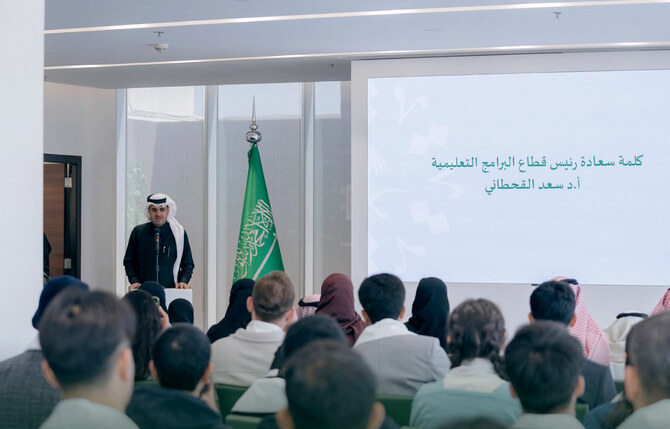
King Salman academy launches third Arabic program for non-native speakers

The program, which follows an advanced academic methodology, will accept applications until March 15, with in-person study starting on Sept. 1. (File/@KSGAFAL)
Short Url
Updated 16 February 2025
Follow

King Salman academy launches third Arabic program for non-native speakers

  • Initiative aims to provide students with strong foundations in reading, writing, listening and spoken Arabic

RIYADH: The King Salman Global Academy for the Arabic Language has begun accepting applications for its third study program for non-native speakers at the Abjad Center in Riyadh.

The program, which follows an advanced academic methodology, will accept applications until March 15, with in-person study starting on Sept. 1, according to the Saudi Press Agency.

The center offers a comprehensive educational experience aligned with the Common European Framework of Reference for Languages.

The program has four levels, each lasting two months, for a total of eight months and 160 instructional hours per level, averaging 20 hours per week, the SPA reported.

It focuses on core language skills — reading, writing, listening, and speaking — while incorporating cultural activities to enhance learning and immerse students in the Arabic-speaking environment.

The first edition attracted more than 16,140 applicants from 162 nationalities, with more than 130 students from 34 nationalities accepted.

The second edition received even more interest, with 16,472 applications from 126 nationalities and more than 150 students from about 40 nationalities admitted.


Wrapping up Year of Handicrafts at AlUla’s Winter at Tantora

Updated 30 December 2025
Follow

Wrapping up Year of Handicrafts at AlUla’s Winter at Tantora

  • Annual festival takes place until Jan. 10

ALULA: AlUla’s Old Town has sprung into life with Winter at Tantora — the annual festival which runs until Jan. 10 — as cooler temperatures settle over the region.

The three-week event contains workshops, concerts and gastronomic experiences which have transformed the historic landscape into a vibrant cultural gathering point, catering to locals and visitors alike.

Winter at Tantora takes its name from the traditional sundial, or the tantora, once used to mark the agricultural calendar.

The actual tantora is still perched atop what is now Dar Tantora The House Hotel, which was named as one of Time magazine’s “World’s Greatest Places” in 2024.

One of the festival’s most atmospheric offerings is Shorfat Tantora, where live music fills Al-Jadidah Arts District as musicians perform from balconies, blending traditional rhythms with contemporary beats.

The open-air experience invites audiences to gather and witness music’s unifying power on Thursday and Friday nights between 8:30 p.m. and 10:30 p.m. It ends on Jan. 2.

Since this year’s festival also highlights Saudi Arabia’s rich artisanal heritage — in line with the Ministry of Culture’s designation of 2025 as the Year of Handicrafts — there are plenty of crafts to be seen.

The festival spirit was also reflected this week at the outdoor Thanaya venue, a short drive from Old Town, where Emirati superstar Ahlam Al-Shamsi, who is known as Ahlam, took to the stage.

Her name, which means “dream” in Arabic, felt particularly fitting as the audience was immersed in her craft on the crisp, cool night with AlUla’s ancient rock formations as a backdrop. With wind billowing over the sky, she was perhaps the brightest star of the night.

Ahlam told the crowd: “In the Year of Handicrafts we celebrate human creativity through the hands that craft and the spirit that creates.

“The weather has been chilly over the last two days, but you (the audience) radiate warmth.”

With craft stations and food trucks nearby, Ahlam represented a modern twist weaved into the ongoing oral storytelling tradition.

Back in Old Town, people enjoyed the Art Walk tour and snaked through the labyrinth of painted mudbrick homes, murals and traditions while being guided by a local storyteller.

The Old Town Culinary Voyage merges storytelling and tasting. It spotlights traditional flavors and culture through aromas, spices and tastings.

Walking through the dusty, uneven rocky ground, visitors come across the ancient “Incense Road,” a well-known trade route central to pre-Islamic history and a main stage for global exchange.

A key stop in a network of ancient caravan routes, the road connected southern parts of Arabia, where frankincense and myrrh were produced, to the Mediterranean world.

These routes made incense one of the most valuable commodities of the ancient world. Parts of the route are now UNESCO World Heritage Sites.