

Egypt’s El-Sisi discusses Mideast peace with World Jewish Congress chief

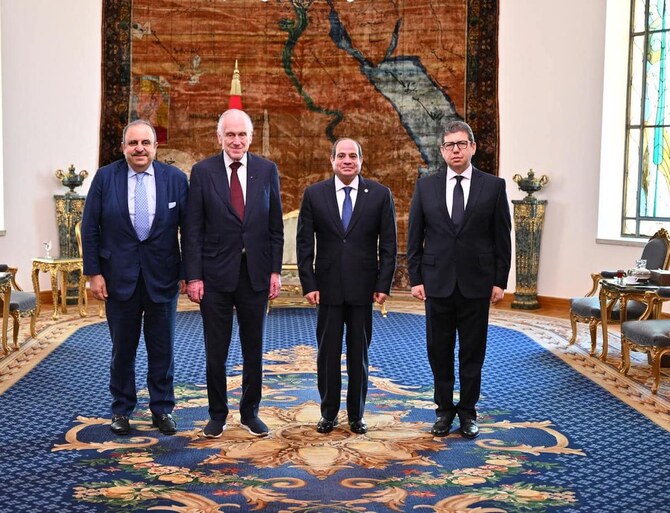
Egyptian President Abdel Fattah El-Sisi meets with the head of the World Jewish Congress Ronald Lauder (2L) on Sunday. (Spokesman for the Egyptian Presidency)
Short Url
Updated 16 February 2025
Follow

Egypt’s El-Sisi discusses Mideast peace with World Jewish Congress chief

  • During his meeting with Lauder in Cairo on Sunday, El-Sisi called for starting the reconstruction of Gaza “without displacing its residents from their land”

CAIRO: Egyptian President Abdel Fattah El-Sisi told the head of the World Jewish Congress Ronald Lauder on Sunday that the establishment of a Palestinian state is “the only guarantee” for lasting peace in the Middle East.
During his meeting with Lauder in Cairo on Sunday, El-Sisi called for starting the reconstruction of war-battered Gaza “without displacing its residents from their land,” according to a statement from his office.
The Egyptian leader’s remarks come as Arab countries are scrambling to come up with an alternative to a controversial plan floated by US President Donald Trump to take over Gaza, redevelop the coastal territory and turn it into the “Riviera of the Middle East.”


Trump’s proposal envisages permanently resettling Gaza’s Palestinian residents elsewhere, including Egypt and Jordan, drawing widespread condemnation from Arab and world leaders.
“The establishment of a Palestinian state... is the only guarantee to achieve lasting peace,” El-Sisi told Lauder on Sunday.
According to the Egyptian presidency statement, Lauder praised Egypt’s “wise efforts” to restore stability in the region.
The leaders of Egypt, Jordan, Qatar and the United Arab Emirates are set to met in Riyadh on Thursday to discuss Trump’s proposal, ahead of an emergency Arab League summit in Cairo a week later to discuss the same issue.


Turkiye’s Kurdish party says Syria deal leaves Ankara ‘no excuses’ on peace process

Updated 2 sec ago
Follow

Turkiye’s Kurdish party says Syria deal leaves Ankara ‘no excuses’ on peace process

ANKARA: Turkiye’s pro-Kurdish DEM Party said on Monday that the Turkish government had no more “excuses” to delay a peace process with the Kurdistan Workers Party (PKK) now that a landmark integration deal was achieved in neighboring Syria.
On Sunday in Syria, the Kurdish-led Syrian Democratic Forces (SDF) agreed to come under the control of authorities in Damascus — a move that Ankara had long sought as integral to ‌its own peace ‌effort with the PKK. “For more than a ‌year, ⁠the ​government ‌has presented the SDF’s integration with Damascus as the biggest obstacle to the process,” Tuncer Bakirhan, co-leader of the DEM Party, told Reuters, in some of the party’s first public comments on the deal in Syria.
“The government will no longer have any excuses left. Now it is the government’s turn to take concrete steps.” Bakirhan cautioned President Tayyip Erdogan’s ⁠government against concluding that the rolling back Kurdish territorial gains in Syria negated the need ‌for a peace process in Turkiye. “If the ‍government calculates that ‘we have weakened ‍the Kurds in Syria, so there is no longer a ‍need for a process in Turkiye,’ it would be making a historic mistake,” he said in the interview.
Turkish officials said earlier on Monday that the Syrian integration deal, if implemented, could
advance the more than year-long process with the ​PKK, which is based in northern Iraq. Erdogan urged
swift integration of Kurdish fighters into Syria’s armed forces. Turkiye, the strongest ⁠foreign backer of Damascus, has since 2016 repeatedly sent forces into northern Syria to curb the gains of the SDF — which after the 2011–2024 civil war had controlled more than a quarter of Syria while fighting Islamic State with strong US backing.
The United States has built close ties with Damascus over the last year and was closely involved in mediation between it and the SDF toward the deal.
Bakirhan said progress required recognition of Kurdish rights on both sides of the border.
“What needs to be done is clear: Kurdish rights must be recognized ‌in both Turkiye and Syria, democratic regimes must be established, and freedoms must be guaranteed,” he said.