


MUNICH, Germany: Ukrainian officials were told not to sign an agreement with the US on rare earth minerals because the document focused on US interests, according to President Volodymyr Zelensky, and did not offer any specific security guarantees in return, said one current and one former senior official familiar with the talks.
The proposal focused on how the US could use Kyiv’s rare earth minerals “as compensation” for support already given to Ukraine by the Biden administration and as payment for future aid, current and former senior Ukrainian officials said speaking anonymously so they could speak freely. A senior White House official said that Zelensky’s rejection was “short-sighted.”
Ukraine has vast reserves of critical minerals which are used in aerospace, defense and nuclear industries. The Trump administration has indicated it is interested in accessing them to reduce dependence on China but Zelensky said any exploitation would need to be tied to security guarantees for Ukraine that would deter future Russian aggression.
“I didn’t let the ministers sign a relevant agreement because in my view it is not ready to protect us, our interest,” Zelensky told The Associated Press on Saturday on the sidelines of the Munich Security Conference in Germany.
The US presented Ukraine with a document but “there are no very concrete things about security guarantees in this document,” Zelensky said.
“For me is very important the connection between some kind of security guarantees and some kind of investment,” the Ukrainian president said.
Zelensky did not go into details about why he instructed his officials not to sign the document which was given to Ukrainian officials on Wednesday by US Treasury Secretary Scott Bassent on a visit to Kyiv.
“It’s a colonial agreement and Zelensky cannot sign it,” the former senior official said.
White House National Security Council spokesman Brian Hughes did not explicitly confirm the offer, but said in a statement that “President Zelensky is being short-sighted about the excellent opportunity the Trump Administration has presented to Ukraine.” The Trump administration has grown weary of sending additional US aid to Ukraine and Hughes said a minerals deal would allow American taxpayers to “recoup” money sent to Kyiv while growing Ukraine’s economy.
Hughes added that the White House believes “binding economic ties with the United States will be the best guarantee against future aggression and an integral part of lasting peace.” He added, “The US recognizes this, the Russians recognize this, and the Ukrainians must recognize this.”
US officials in discussions with their Ukrainian counterparts in Munich were commercially minded and largely concentrated on the specifics of exploring the minerals and how to form a possible partnership to do that with Ukraine, the senior official said.
The potential value of the deposits in Ukraine has not yet been discussed, with much unexplored or close to the front line.
The US proposal apparently did not take into account how the deposits would be secured in the event of continuing Russian aggression. The official suggested the US did not have “ready answers,” to that question and that one of their takeaways from discussions in Munich will be how to secure any mineral extraction operation in Ukraine involving people and infrastructure.
Any deal must be in accordance with Ukrainian law and acceptable to the Ukrainian people, the senior Ukrainian official said.
“Subsoil belongs to Ukrainians under the Constitution,” Kseniiia Orynchak, founder of the National Association of Mining Industry of Ukraine previously said suggesting a deal would need popular support.
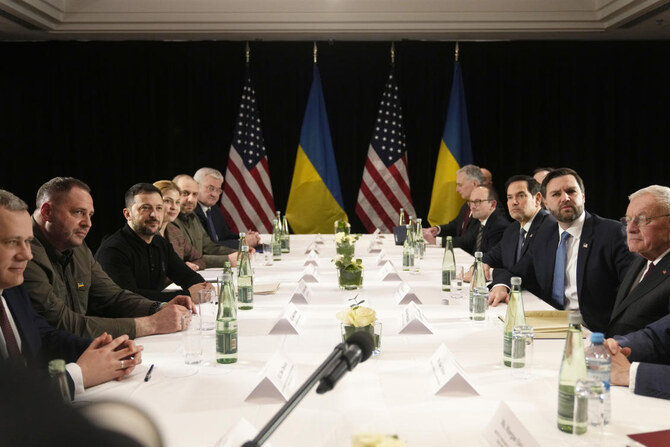
Zelensky and Vance did not discuss the details of the US document during their meeting Friday at the Munich Security Conference, the senior official said. That meeting was “very good” and “substantive,” with Vance making it clear his and Trump’s main goal was to achieve a durable, lasting peace, the senior official said.
Zelensky told Vance that real peace requires Ukraine to be in a “strong position” when starting negotiations, stressed that the USnegotiators should come to Ukraine, and that the US, Ukraine and Europe must be at the negotiating table for talks with Russia.
But Gen. Keith Kellogg, Trump’s special envoy for Ukraine and Russia, all but cut Europeans out of any Ukraine-Russia talks, despite Zelensky’s request.
“You can have the Ukrainians, the Russians, and clearly the Americans at the table talking,” Kellogg said at an event hosted by a Ukrainian tycoon at the Munich Security Conference. Pressed on whether that meant Europeans won’t be included, he said: “I’m a school of realism. I think that’s not going to happen.”
Ukraine is now preparing a “counter proposal” which will be delivered to the US in “the near future,” the official said.
“I think it’s important that the vice president understood me that if we want to sign something, we have to understand that it will work,” Zelensky said.
That means, he said, “It will bring money and security.”


