Turkiye says it would reconsider its military presence in Syria if Kurdish militants are eliminated

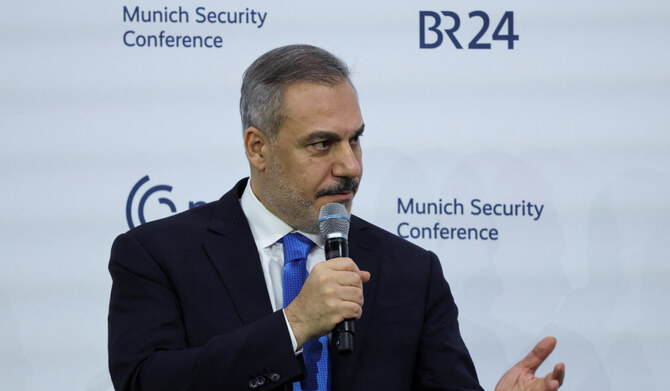
Turkey's Foreign Minister Hakan Fidan speaks during a panel discussion, "New Dawn for Damascus: Prospects for Syria's Transition", at the Munich Security Conference (MSC) in Munich, Germany, February 15, 2025. (REUTERS)
Short Url
Updated 16 February 2025
Follow

Turkiye says it would reconsider its military presence in Syria if Kurdish militants are eliminated

  • The Kurdistan Workers’ Party, or PKK, has waged an insurgency against Turkiye for decades, seeking greater autonomy for Kurds

BEIRUT: Turkiye’s foreign minister said Saturday his country would reconsider its military presence in northeastern Syria if that country’s new leaders eliminate a Kurdish militant group designated as a terrorist organization by Turkiye, the United States and the European Union.
Hakan Fidan spoke at the Munich Security Conference alongside Syrian Foreign Minister Asaad Al-Shaibani, who did not comment on the remarks. Fidan has expressed such sentiments before.
The Kurdistan Workers’ Party, or PKK, has waged an insurgency against Turkiye for decades, seeking greater autonomy for Kurds.
“We can’t tolerate armed militia in any form,” Fidan said. He said such groups should be integrated “under one national army” in Syria and noted that its new leaders have been responsive to that idea.
Al-Shaibani did speak in support of disarming all non-state factions and of including Kurds in Syria’s new government.
The presence of Turkish-backed forces in northeastern Syria has increased substantially since insurgent groups ousted former President Bashar Assad late last year, and the forces have been targeting Kurdish forces more often.
Turkiye also views the Syrian Democratic Forces, a US-backed military Kurdish alliance in Syria, as an extension of the PKK. That has led to ongoing military confrontations between Turkish-backed forces and the SDF in northern Syria.
While most insurgent groups have agreed to integrate into the new Syrian army, the SDF has refused.
“Kurds are part of the Syrian nation but they can’t have their own army, as this is against our unity,” said another speaker on Saturday’s conference panel, Hind Kabawat of the Center for World Religions, Diplomacy and Conflict Resolution.


Fledgling radio station aims to be ‘voice of the people’ in Gaza

Updated 15 February 2026
Follow

Fledgling radio station aims to be ‘voice of the people’ in Gaza

  • The electricity crisis is one of the most serious and difficult problems in the Gaza Strip, says Shereen Khalifa Broadcaster

DEIR EL-BALAH: From a small studio in the central city of Deir El-Balah, Sylvia Hassan’s voice echoes across the Gaza Strip, broadcast on one of the Palestinian territory’s first radio stations to hit the airwaves after two years of war.

Hassan, a radio host on fledgling station “Here Gaza,” delivers her broadcast from a well-lit room, as members of the technical team check levels and mix backing tracks on a sound deck. “This radio station was a dream we worked to achieve for many long months and sometimes without sleep,” Hassan said.

“It was a challenge for us, and a story of resilience.”

Hassan said the station would focus on social issues and the humanitarian situation in Gaza, which remains grave in the territory despite a US-brokered ceasefire between Israel and Hamas since October.

“The radio station’s goal is to be the voice of the people in the Gaza Strip and to express their problems and suffering, especially after the war,” said Shereen Khalifa, part of the broadcasting team.

“There are many issues that people need to voice.” Most of Gaza’s population of more than 2 million people were displaced at least once during the gruelling war.

Many still live in tents with little or no sanitation.

The war also decimated Gaza’s telecommunications and electricity infrastructure, compounding the challenges in reviving the territory’s local media landscape. “The electricity problem is one of the most serious and difficult problems in the Gaza Strip,” said Khalifa.

“We have solar power, but sometimes it doesn’t work well, so we have to rely on an external generator,” she added.

The station’s launch is funded by the EU and overseen by Filastiniyat, an organization that supports Palestinian women journalists, and the media center at the An-Najah National University in Nablus, in the occupied West Bank.

The station plans to broadcast for two hours per day from Gaza and for longer from Nablus. It is available on FM and online.

Khalifa said that stable internet access had been one of the biggest obstacles in setting up the station, but that it was now broadcasting uninterrupted audio.

The Gaza Strip, a tiny territory surrounded by Israel, Egypt, and the Mediterranean Sea, has been under Israeli blockade even before the attack on Oct. 7, 2023, which sparked the war. Despite the ceasefire, Israel continues to strictly control the entry of all goods and people to the territory.

“Under the siege, it is natural that modern equipment necessary for radio broadcasting cannot enter, so we have made the most of what is available,” she said.