

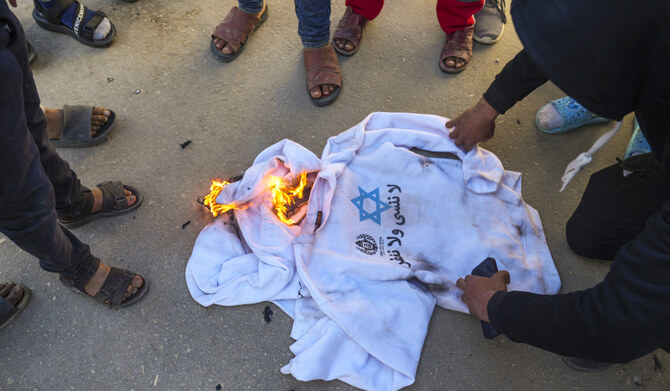
Freed Palestinian inmates set prison garb ablaze on return to Gaza

A crowd burns the shirts worn by freed Palestinian prisoners in Khan Younis, Gaza Strip, Saturday, Feb. 15, 2025, as they arrive in Gaza after being released from an Israeli prison following a ceasefire agreement between Hamas and Israel. (AP)
Short Url
Updated 16 February 2025
Follow

Freed Palestinian inmates set prison garb ablaze on return to Gaza

  • Ibrahim, 61, said he had left “prison and suffering,” but the Gaza Strip — for years under a crippling Israeli-led blockade — was “the largest prison in the world”
  • The vast majority of prisoners released on Saturday, in exchange for three Israeli hostages, were Gazans taken into Israeli custody during the war, according to the Palestinian Prisoners’ Club advocacy group

KHAN YUNIS, Palestinian Territories: As Palestinian inmates released by Israel on Saturday stepped off the buses that took them to the Gaza Strip, some flashed a victory sign and swiftly set fire to sweatshirts they were made to wear in prison.
Images broadcast on Israeli media before their release under a ceasefire deal with Hamas showed rows of Palestinian prisoners wearing the sweatshirts emblazoned with the Star of David, the logo of Israel’s prison service and the Arabic phrase “we do not forget and we do not forgive.”
The white sweatshirts could be seen on the ground wreathed in orange flames at the prisoners’ reception point in the southern Gaza city of Khan Yunis, an AFP correspondent said.
The growing blaze sent plumes of black smoke skywards over the crowds greeting the released inmates.
In previous releases under the Gaza deal, Palestinians were let out with plain grey prison tracksuits that did not bear any inscriptions.
The vast majority of prisoners released on Saturday, in exchange for three Israeli hostages, were Gazans taken into Israeli custody during the war, according to the Palestinian Prisoners’ Club advocacy group.
The Gaza-bound convoy, facilitated by the International Committee of the Red Cross, dropped off jubilant prisoners who threw victory signs and waved at the crowd welcoming them.
Other Palestinians freed Saturday were serving life sentences over attacks against Israelis, with some of them deported upon release.

Hamas, the Palestinian group whose October 7, 2023 attack on Israel triggered the war, and ally Islamic Jihad both condemned the Israeli prison service sweatshirts, calling them “racist.”
Ibrahim, 61, a freed prisoner who declined to share his last name, said he was sad to see the extent of the destruction wrought by the war in Gaza.
He said he had left “prison and suffering,” but the Gaza Strip — for years under a crippling Israeli-led blockade — was “the largest prison in the world.”
He said he had been arrested in northern Gaza’s Jabalia refugee camp, and still did not know why he was jailed for nine months.
Abd Abu Zayra, another freed prisoner, told AFP he had Hamas to thank for his release, a moment “of joy and victory mixed with sadness and tragedy.”
“We pray that the war ends and that all prisoners are released,” he said.
The buses inched forward through the dense crowd, dropping off prisoners one after the other.
Paramedics taking the freed prisoners to hospital for check-ups were overwhelmed by the sea of relatives and friends who had gathered to greet them.
Muhammad Zaqout, director of Hamas-run Gaza’s health ministry, said medical examinations would be conducted for each prisoner.
He said many have suffered “torture” and neglect in jail.

Tariq Haniyeh, a 22-year-old Gazan, told AFP he had come to Khan Yunis to welcome his relative Loay Haniyeh a year after his arrest at a refugee camp near Gaza City.
“It’s a great joy to see the prisoners freed, but I’m very sad because I still have other relatives who are still detained,” said Tariq Haniyeh.
He said his family was still in mourning after the deaths of 21 relatives during the war, including distant cousin Ismail Haniyeh, the former Hamas chief killed by Israel in Tehran in July 2024.
Unlike Ismail Haniyeh, Tariq said his relative Loay, had “no connection to any Palestinian faction, and they (Israel) arrested him like thousands of others, without reason.”
Those in the last buses, too excited to wait, began their reunion from the bus windows.
One man stood on the shoulders of another to kiss a prisoner from the window. A child was hoisted in the air to be embraced.
Some stood on their toes to try to reach the hand of a loved one, while some prisoners still on the buses grabbed the microphones of journalists to start recounting their journey.


Syrian military tells civilians to evacuate contested area east of Aleppo amid rising tensions

Updated 15 January 2026
Follow

Syrian military tells civilians to evacuate contested area east of Aleppo amid rising tensions

  • Syria’s military has announced it will open a “humanitarian corridor” for civilians to evacuate from an area in Aleppo province
  • This follows several days of intense clashes between government forces and the Kurdish-led Syrian Democratic Forces

DAMASCUS: Syria’s military said it would open a corridor Thursday for civilians to evacuate an area of Aleppo province that has seen a military buildup following intense clashes between government and Kurdish-led forces in Aleppo city.
The army’s announcement late Wednesday — which said civilians would be able to evacuate through the “humanitarian corridor” from 9 a.m. to 5 p.m. Thursday — appeared to signal plans for an offensive in the towns of Deir Hafer and Maskana and surrounding areas, about 60 kilometers (40 miles) east of Aleppo city.
The military called on the Kurdish-led Syrian Democratic Forces and other armed groups to withdraw to the other side of the the Euphrates River, to the east of the contested zone.
Syrian government troops have already sent troop reinforcements to the area after accusing the SDF of building up its own forces there, which the SDF denied. There have been limited exchanges of fire between the two sides, and the SDF has said that Turkish drones carried out strikes there.
The government has accused the SDF of launching drone strikes in Aleppo city, including one that hit the Aleppo governorate building on Saturday shortly after two Cabinet ministers and a local official held a news conference there.
The tensions in the Deir Hafer area come after several days of intense clashes last week in Aleppo city that ended with the evacuation of Kurdish fighters and government forces taking control of three contested neighborhoods. The fighting killed at least 23 people, wounded dozens more, and displaced tens of thousands.
The fighting broke out as negotiations have stalled between Damascus and the SDF, which controls large swaths of northeast Syria, over an agreement to integrate their forces and for the central government to take control of institutions including border crossings and oil fields in the northeast.
Some of the factions that make up the new Syrian army, which was formed after the fall of former President Bashar Assad in a rebel offensive in December 2024, were previously Turkiye-backed insurgent groups that have a long history of clashing with Kurdish forces.
The SDF for years has been the main US partner in Syria in fighting against the Daesh group, but Turkiye considers the SDF a terrorist organization because of its association with the Kurdistan Workers’ Party, or PKK, which has waged a long-running insurgency in Turkiye. A peace process is now underway.
Despite the long-running US support for the SDF, the Trump administration has also developed close ties with the government of interim Syrian President Ahmad Al-Sharaa and has pushed the Kurds to implement the integration deal. Washington has so far avoided publicly taking sides in the clashes in Aleppo.
The SDF in a statement warned of “dangerous repercussions on civilians, infrastructure, and vital facilities” in case of a further escalation and said Damascus bears “full responsibility for this escalation and all ensuing humanitarian and security repercussions in the region.”
Adm. Brad Cooper, commander of US Central Command, said in a statement Tuesday that the US is “closely monitoring” the situation and called for “all parties to exercise maximum restraint, avoid actions that could further escalate tensions, and prioritize the protection of civilians and critical infrastructure.” He called on the parties to “return to the negotiating table in good faith.”
Al-Sharaa blasts the SDF
In a televised interview aired Wednesday, Al-Sharaa praised the “courage of the Kurds” and said he would guarantee their rights and wants them to be part of the Syrian army, but he lashed out at the SDF.
He accused the group of not abiding by an agreement reached last year under which their forces were supposed to withdraw from neighborhoods they controlled in Aleppo city and of forcibly preventing civilians from leaving when the army opened a corridor for them to evacuate amid the recent clashes.
Al-Sharaa claimed that the SDF refused attempts by France and the US to mediate a ceasefire and withdrawal of Kurdish forces during the clashes due to an order from the PKK.
The interview was initially intended to air Tuesday on Shams TV, a broadcaster based in Irbil — the seat of northern Iraq’s semi-autonomous Kurdish region — but was canceled for what the station initially said were technical reasons.
Later the station’s manager said that the interview had been spiked out of fear of further inflaming tensions because of the hard line Al-Sharaa took against the SDF.
Syria’s state TV station instead aired clips from the interview on Wednesday. There was no immediate response from the SDF to Al-Sharaa’s comments.