HOMESTEAD: The day before President Donald Trump’s inauguration, a dozen immigrant families came to Nora Sandigo’s ranch to ask her to be a legal guardian of their children. Now they are insisting she come over to their homes to sign the necessary paperwork.
It’s a result of the many ways immigrants who are in the US illegally have changed their travel patterns as many try to stay home as much as possible and avoid going to the homes and offices of advocates such as Sandigo. Many fear they could be caught up in an Immigration and Customs Enforcement operation after Trump campaigned on a promise of mass deportations and has terminated programs that had given immigrants a legal way into the US
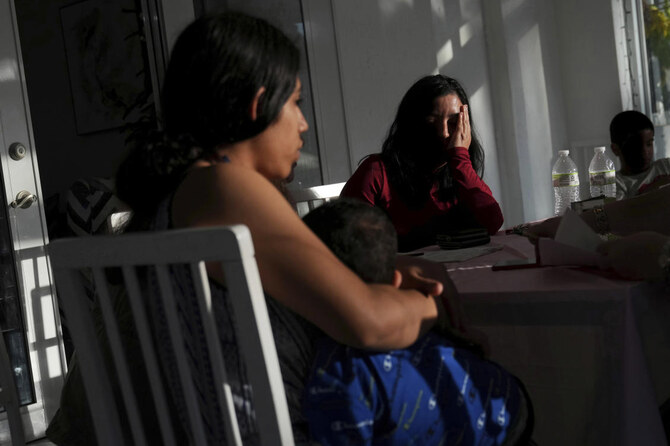
In the past few weeks, Sandigo has received hundreds of calls from immigrant parents across the US She said she has been in at least 15 houses where parents have filled out paperwork so Sandigo could sign documents on behalf of their children at schools, hospitals and courts if they are deported. The power of attorney also allows her to help the children travel to reunite with their families.
“Now people are telling us that they are afraid to go out on the street, that they are afraid to drive, that they are afraid that they will stop them on the street,” said Sandigo, a 59-year-old mother of two daughters who lives in Homestead, a city of about 80,000 people south of Miami. “They have asked me to go to where they are instead of them coming to me.”
Immigration arrests under Trump
The White House has said over 8,000 immigrants who were in the country illegally have been arrested since Trump’s inauguration on Jan. 20. ICE averaged 787 arrests a day from Jan. 23 to Jan. 31, compared with a daily average of 311 during a 12-month period that ended Sept. 30 during the Biden administration. ICE has stopped publishing daily arrest totals.
In Homestead, where many immigrants from Mexico and Central America live and work in nurseries and fruit and vegetable fields, some avoid the supermarkets and instead ask neighbors to do their grocery shopping. In front of stores like Home Depot, men no longer stand around looking for work. Others have even stopped going to Sacred Heart Church on Sundays.
“People have stopped coming, and when they come, they ask if the immigration officials came here,” said Elisaul Velazco, the owner of a clothing store downtown. “Everything is paralyzed. Sales have dropped by 60 percent.”
Parents fear their children will be taken from them
For years, Sandigo has prepared immigrant parents for the worst-case scenario: being separated from their children.
Now she goes to those parents instead of having them come to her.
One recent Sunday, she visited four houses and received documents involving over 20 children. In some cases, the children were born in the US and are citizens. The documents do not provide her full legal guardianship or transfer parental rights, but simply allow Sandigo to make decisions on their behalf.
Most parents fear if they do not name a legal guardian, their children will enter the foster care system, they will lose their parental rights and someone else will adopt their children.
Visiting immigrant parents’ homes
Julia, a 36-year-old Guatemalan woman who insisted she be identified only by her first name out of fear of deportation, waited a few minutes before opening the door for Sandigo as a group of people ran out the back door.
“It’s me, Nora, the lady you phoned to come,” Sandigo told her.
Julia opened the door a crack, saw Sandigo and then came out. Julia explained her husband had been detained days earlier while in a van with other immigrants on their way to a construction job.
After a brief conversation, Julia invited Sandigo, a notary and a volunteer into her small house.
Julia recalled that eight years ago her first husband, also Guatemalan, was deported, leaving her behind with their two American children, now 18 and 11 years old.
“We are afraid. I feel very sad with life because of what I am going through,” said Julia, her voice breaking and her eyes getting watery.
The notary asked Julia to show her daughter’s birth certificate and explained the son is an adult and doesn’t need a guardian.
“I don’t want my children to be taken away from me. If something happens to me, I want them with me,” she said before signing the power of attorney naming Sandigo as the legal guardian of the youngest.
In the backyard of another home, Albertina, a 36-year-old Mexican mother, held her 2-month-old baby while explaining what she wants for her six children if she is deported. Albertina also insisted only her first name be used.
“I am very afraid that they will grab me on the road and take me away. What’s going to happen to them?” she said of her children.
She asked Sandigo to take care of her two oldest daughters, 15 and 17, because they do not want to go to Mexico, while Sandigo should send the other four to her home country.
Sandigo has been a guardian for 2,000 children
Sandigo relates to the families she helps. A devout Catholic, she fled Nicaragua when she was 16, leaving behind her parents after the Sandinista government confiscated her family’s farm. She is now a US citizen.
About 15 years ago, she began offering to be a legal guardian to immigrant children. About 22 children of deported parents have lived in her house temporarily since then. More than 2,000 children have been under her guardianship, although some are now adults. Sandigo said she has assisted hundreds of those children.
“I feel empathy for them, solidarity, love for God. I want to do something,” she said.


Fearful immigrants ask Florida activist to sign guardianship papers for their children
https://arab.news/g8hp2
Fearful immigrants ask Florida activist to sign guardianship papers for their children

- Trump has terminated programs that had allowed immigrants a legal entrance to the US and has said all immigrants without authorization should leave


World copper rush promises new riches for Zambia
CAPE TOWN: Five years after becoming Africa’s first Covid-era debt defaulter, Zambia is seeing a dramatic turnaround in fortunes as major powers vie for access to its vast reserves of copper.
Surging demand from the artificial intelligence, green energy and defense sectors has exponentially boosted demand for the workhorse metal that underpins power grids, data centers and electric vehicles.
The scramble for copper exposes geopolitical rivalries as industrial heavyweights — including China, the United States, Canada, Europe, India and Gulf states — compete to secure supplies.
“We have the investors back,” President Hakainde Hichilema told delegates at the African Mining Indaba conference on Monday, saying that more than $12 billion had flowed into the sector since 2022.
The politically stable country is Africa’s second-largest copper producer, after the conflict-ridden Democratic Republic of Congo, and the world’s eighth, according to the US Geological Survey.
The metal, needed for solar panels and wind turbines, generates about 15 percent of Zambia’s GDP and more than 70 percent of export earnings.
Output rose eight percent last year to more than 890,000 metric tons and the government aims to triple production within a decade.
Mining is driving growth that is forecast by the International Monetary Fund to reach 5.2 percent in 2025 and 5.8 percent this year, which places Zambia among the continent’s faster-growing economies.
“The seeds are sprouting and the harvest is coming,” Hichilema said, touting a planned nationwide geological survey to map untapped deposits.
But the rapid expansion of the heavily polluting industry has also led to warnings about risks to local communities and concerns of “pit-to-port” extraction, in which raw copper is shipped directly abroad with little domestic refining.
’Dramatic new chapter’
“We need to be aware of the potential for history to repeat itself,” said Daniel Litvin, founder of the Resource Resolutions group that promotes sustainable development, referring to the colonial-era scramble for Africa’s resources.
There is a risk that elites will be enriched at the expense of the broader population, while “narratives of partnership” offered by major powers can mask underlying self-interest, he said.
Chinese firms have long dominated the sector in Zambia and control major stakes in key mines and smelters, cementing Beijing’s early-mover advantage.
Another major player is Canada’s First Quantum Minerals, Zambia’s largest corporate taxpayer.
Investors from India and the Gulf are expanding their footprint, and the United States is returning to the market after largely pulling out decades ago.
Washington, which has been stockpiling copper, this month launched a $12 billion “Project Vault” public-private initiative to secure critical minerals, part of an effort to reduce reliance on China.
In September, the US Trade and Development Agency announced a $1.4 million grant to a Metalex Commodities subsidiary, Metalex Africa, to expand operations in Zambia.
“We are at the beginning of what is going to unfold to be a dramatic new chapter in the way that the free world sources and trades in critical minerals,” US energy secretary adviser Mike Kopp said at Mining Indaba.
Sweeping US tariffs introduced last year helped send copper prices soaring to record highs, as companies rushed to buy both semi-finished and refined stocks.
Cost of rush
“The risk is that this great power competition becomes a race to secure supply on terms that serve markets and not the people in producer countries,” said Deprose Muchena, a program director at the Open Society Foundation.
Despite its mineral wealth, more than 70 percent of Zambia’s 21 million people live in poverty, according to the World Bank.
“The world is waking up to Zambia’s copper. But Zambia has been living with copper and its consequences for a century,” Muchena told AFP.
Environmental damage caused by mining has long plagued Zambia’s copper belt.
In February 2025, a burst tailings dam at a Chinese-owned mine near Kitwe, about 285 kilometers (180 miles) north of Lusaka, spilled millions of liters of acidic waste.
Toxins entered a tributary feeding the Kafue, Zambia’s longest river and a major source of drinking water. Zambian farmers have filed an $80 billion lawsuit.
“Whether this boom is different depends on whether governance, rights, and community agency are at the center, not just supply chain security,” Muchena said.