

President Erdogan gifts Turkish Togg electric car to Pakistani PM

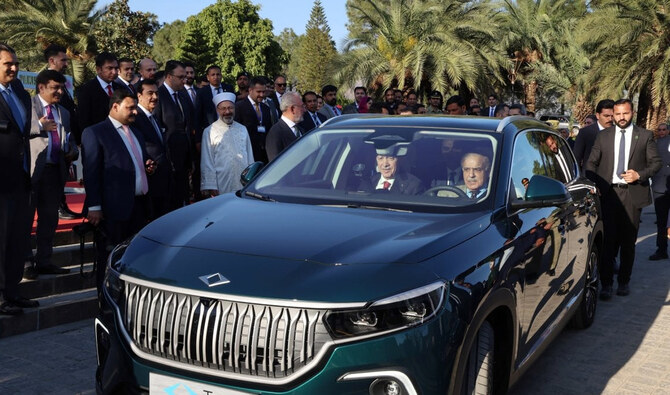
Pakistani Prime Minister Shehbaz Sharif drives a Togg T10X, Turkiye’s homegrown electric car, gifted by Turkish President Recep Tayyip Erdogan (left) in Islamabad on February 13, 2025. (Photo courtesy: Daily Sabah)
Short Url
Updated 14 February 2025
Follow

President Erdogan gifts Turkish Togg electric car to Pakistani PM

  • Turkish president gifts Sharif T10X model SUV of Togg, Turkiye’s first homegrown electric vehicle
  • Recep Tayyip Erdogan also gifted Indonesian counterpart, Malaysian premier Togg cars this week

ISLAMABAD: Turkish President Recep Tayyip Erdogan gifted a model of the Turkish homegrown electric vehicle Togg to Pakistan’s Prime Minister Shehbaz Sharif during his two-day visit to Islamabad this week. 

Erdogan gifted Sharif the T10X model Togg SUV, with a video clip showing both leaders examining the SUV’s black exterior. Sharif can be seen in the video, sitting behind the wheel with Erdogan beside him in the passenger seat as the Pakistani premier drove it. 

Later, First Lady Aseefa Bhutto-Zardari drove Erdogan and her father, President Asif Ali Zardari, in a Togg SUV as media persons watched. 

“I thank my dear brother President Recep Tayyip Erdoğan and my respected sister Madam Emine Erdogan, for honoring us with their gracious presence and for bringing along a high-powered delegation from Turkiye,” Sharif wrote on social media platform X on Thursday after the Turkish president departed. 

Pakistan was Erdogan’s third stop in his three-nation Asia tour this week. In his first two stops in Malaysia and Indonesia, Erdogan gifted a similar model of the electric vehicle to Malaysian Prime Minister Anwar Ibrahim and Indonesian President Prabowo Subianto. 

Pakistan and Türkiye signed 24 agreements and memorandums of understanding (MoUs) on Thursday as Erdogan arrived in the country to discuss how to boost trade and economic ties between the two nations. 

Erdogan said he had also held extensive discussions with the Pakistani prime minister on bilateral, regional and global issues.


Pakistan says 41 suspected militants killed in operations in restive Balochistan province

Updated 30 January 2026
Follow

Pakistan says 41 suspected militants killed in operations in restive Balochistan province

  • Military says intelligence-based raids carried out in Harnai and Panjgur districts
  • Islamabad repeats claim militants backed by New Delhi, an allegation India denies

ISLAMABAD: Pakistani security forces killed 41 suspected militants in two separate intelligence-based operations in the southwestern province of Balochistan, the military said on Thursday, alleging the fighters were linked to India. 

The operations were carried out in the districts of Harnai and Panjgur in Balochistan, Pakistan’s largest but least developed province and home to a long running separatist insurgency that frequently targets security personnel, government infrastructure and non-local residents.

“On 29 January 2026, 41 terrorists belonging to Indian proxy, Fitna al Khwarij and Fitna al Hindustan, were killed in two separate operations in Balochistan,” the military’s media wing, Inter-Services Public Relations (ISPR), said in a statement.

According to the ISPR, 30 militants were killed in Harnai district following a “heavy exchange of fire,” during which security forces also destroyed a cache of recovered weapons and explosives.

In a separate intelligence-based operation in Panjgur district, the military said 11 additional suspected militants were killed after security forces raided a hideout.

“Besides weapons and ammunition, looted money from bank robbery in Panjgur on 15 December 2025 were also recovered from the killed terrorists,” the statement said.
“The terrorists were involved in numerous terrorist activities in the past.”

Pakistan’s military and government frequently use the terms “Fitna al Khwarij” and “Fitna al Hindustan” to describe militant groups it associates with the Pakistani Taliban and alleged Indian support.

The ISPR said follow-up “sanitization operations” were underway to eliminate any remaining militants in the area, describing them as “Indian-sponsored terrorists.”

Islamabad has repeatedly accused India of backing separatist groups in Balochistan to destabilize Pakistan, an allegation New Delhi denies.

Earlier this month, Pakistan’s counterterrorism police said they killed five militants planning attacks on security forces and an attempt to block the Quetta–Sibi highway, a key transport route. On Jan. 25, the military also reported killing three militants, including a local commander, in an intelligence-based operation in Panjgur.

Balochistan is strategically important due to its vast mineral resources and its role as a transit corridor for the China-Pakistan Economic Corridor (CPEC), a multibillion-dollar infrastructure initiative linking Pakistan with China.

Separatist groups such as the Balochistan Liberation Army (BLA) accuse Islamabad of exploiting the province’s natural resources without fair local benefit, a claim the government rejects.