

UN estimates 1,400 killed in Bangladesh protests that toppled ex-PM Hasina

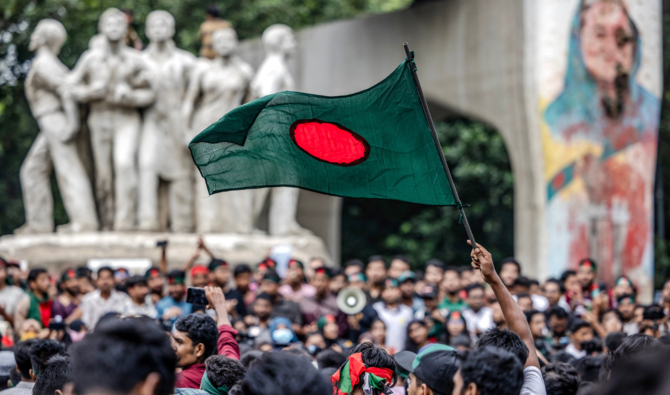
A student waves Bangladesh's national flag, during a protest to demand accountability and trial against the country's ousted Prime Minister Sheikh Hasina, near Dhaka University in the capital on August 12, 2024. (AFP/File)
Short Url
Updated 13 February 2025
Follow

UN estimates 1,400 killed in Bangladesh protests that toppled ex-PM Hasina

  • Actual number of casualties is at least double what UN investigators initially assessed
  • Special tribunal in Dhaka to rely on findings in proceedings against former government

DHAKA: At least 1,400 people were killed in Bangladesh during student-led protests last year, with the majority shot dead from military rifles, the UN’s human rights office said in its latest report investigating the events that led to the ouster of the country’s longtime prime minister.

Initially peaceful demonstrations began in early July, triggered by the reinstatement of a quota system for the allocation of civil service positions. Two weeks later, they were met with a violent crackdown by security forces and a communications blackout.

In early August, as protesters defied nationwide curfew orders and stormed government buildings, former prime minister Sheikh Hasina resigned and fled the country, ending 15 years in power of her Awami League party-led government.

The new interim administration, led by Nobel-winning economist Muhammad Yunus, has pledged to cooperate with the UN Office of the High Commissioner for Human Rights to ensure justice and accountability for all the violence committed during the month-long uprising.

UN investigators arrived in Bangladesh in late August and on Wednesday released their first fact-finding report.

“OHCHR assesses that as many as 1,400 people could have been killed during the protests, the vast majority of whom were killed by military rifles and shotguns loaded with lethal metal pellets commonly used by Bangladesh’s security forces,” they said in the document.

“Thousands more suffered severe, often life-altering injuries. More than 11,700 people were arrested and detained, according to information from the Police and RAB (Rapid Action Battalion) provided to OHCHR.”

More than three-quarters of all deaths were caused by firearms “typically wielded by state security forces and not readily available to civilians in Bangladesh.”

The number of casualties is at least double what was initially assessed by the investigators, who also indicated that around 3 percent of those killed were children subjected to “targeted killings, deliberate maiming, arbitrary arrest, detention in inhumane conditions, torture and other forms of ill-treatment.”

The UN’s human rights office has concluded that between July 15 and Aug. 5, 2024, the former government and its security and intelligence apparatus, together with “violent elements” linked to the Awami League, “engaged systematically in serious human rights violations and abuses in a coordinated effort to suppress the protest movement.”

A special tribunal in Dhaka, which in October issued arrest warrants for Hasina and her Cabinet members and began trial procedures in cases related to the killings, said it will rely on the OHCHR’s findings and recommendations in its proceedings.

“It will facilitate the ongoing trial in the International Crimes Tribunal. The information we have received through the investigation aligns with the UN report, which will also validate our findings. This will add credibility to the results of our investigation,” the tribunal’s chief prosecutor, Tajul Islam, told Arab News on Thursday.

Established in 2010 during Hasina’s rule, the International Crimes Tribunal is a domestic court tasked with war crimes and crimes against humanity.

The most important takeaway of the report was that it had identified the ousted prime minister and her government as the “responsible authority” behind the rights abuses, Islam said.

“The report clearly identified the attacks as widespread and systematic, targeting students and civilians. Sheikh Hasina and her administration were the primary orchestrators of these attacks, utilizing all of the state’s security and law enforcement ... Since it (the probe) was conducted by the UN, it has a neutral character.”


Trump insists he struck Iran on his own terms

Updated 7 sec ago
Follow

Trump insists he struck Iran on his own terms

  • “We are now a nation divided between those who want to fight wars for Israel and those who just want peace and to be able to afford their bills and health insurance,” Marjorie Taylor Greene posted on X.
  • Rubio himself doubled down on Tuesday after meeting with US House and Senate members, while insisting that “No, I told you this had to happen anyway”

WASHINGTON, United States: President Donald Trump and his team scrambled Tuesday to reclaim the narrative on why he decided to attack Iran, after his top diplomat suggested the US struck only after learning of an imminent Israeli strike.
Secretary of State Marco Rubio alarmed Democrats — who say only Congress can declare war — as well as many of Trump’s MAGA supporters on Monday when he said: “We knew that there was going to be an Israeli action.”
“We knew that that would precipitate an attack against American forces, and we knew that if we didn’t pre-emptively go after them before they launched those attacks, we would suffer higher casualties,” Rubio told reporters.
Administration officials quickly backpedalled, insisting Trump authorized the strikes because Tehran was not seriously negotiating an accord on limiting its nuclear ambitions, and the United States needed to destroy Iran’s missile capabilities.
“No, Marco Rubio Didn’t Claim That Israel Dragged Trump into War with Iran,” White House Press Secretary Karoline Leavitt posted Tuesday on X.
At an Oval Office meeting later with Germany’s chancellor, Trump went further, saying that “Based on the way the negotiation was going, I think they (Iran) were going to attack first. And I didn’t want that to happen.”
“So, if anything, I might have forced Israel’s hand.”

- Had to happen? -

Rubio himself doubled down on Tuesday after meeting with US House and Senate members, while insisting that “No, I told you this had to happen anyway.”
“The president made a decision. The decision he made was that Iran was not going to be allowed to hide... behind this ability to conduct an attack.”
Critics seized on the muddied messaging to accuse Trump of precipitating the country into a war without a clear rationale, without informing Congress — and without a clear idea of how it might end.
They noted that just two weeks ago, Israel Prime Minister Benjamin Netanyahu pressed Trump again in Washington to take a hard line, in their seventh meeting since Trump’s return to power last year.
Some Republican allies rallied behind the president, with Senator Tom Cotton, chairman of the Senate Intelligence Committee, insisting that “No one pushes or drags Donald Trump anywhere.”
“He acts in the vital national security interest of the United States,” Cotton told the “Fox & Friends” morning show.
But as crucial US midterm elections approach that could see Republicans lose their congressional majority, Trump risks shedding supporters who had welcomed his pledge to end foreign military interventions.
“We are now a nation divided between those who want to fight wars for Israel and those who just want peace and to be able to afford their bills and health insurance,” Marjorie Taylor Greene, a top former Trump ally and a major figure in the populist and isolationist hard right, posted on X.