India, Pakistan exchange fire across Kashmir border — media

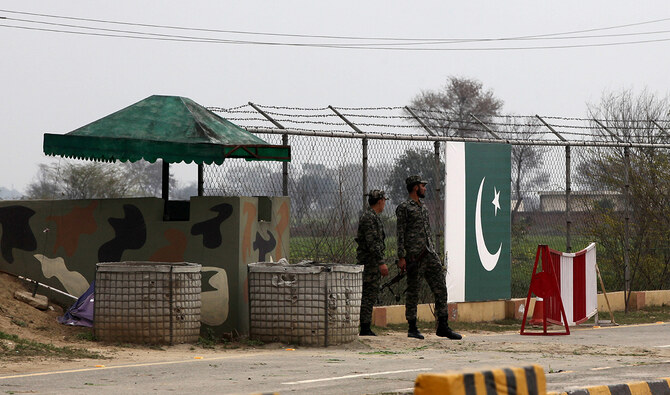
In this file photo, taken on March 1, 2019, paramilitary soldiers stand guard at a check post at Wagah border post near Lahore, Pakistan. (REUTERS/File)
Short Url
Updated 13 February 2025
Follow

India, Pakistan exchange fire across Kashmir border — media

  • State broadcaster PTV says two soldiers and two civilians were injured on the Pakistani side
  • Indian sources blame Pakistan for the incident, though no officials statements have been issued

SRINAGAR: Indian and Pakistani troops have exchanged fire across the heavily militarized Kashmir frontier that divides the two archrivals, with at least four casualties reported by the Pakistani side Thursday.
Kashmir has been divided between the neighbors since they were carved out of the Asian subcontinent at the end of British colonial rule in 1947.
Both nations claim it in full and have fought two wars and numerous smaller battles over control of the Himalayan territory.
Pakistan state broadcaster PTV, citing unnamed security sources, said Wednesday’s incident injured two soldiers and two civilians, all from that country.
Unnamed Indian security officials told broadcaster NDTV that Pakistani troops had fired unprovoked, prompting India’s forces to return fire.
Pakistan’s military declined to comment when asked by AFP. India army officials did not respond to a request for comment.
The incident comes two days after two Indian army soldiers were killed by an improvised explosive device in the region.
A border ceasefire agreement signed by the neighbors in 2003 has largely held in the decades since, but both frequently accuse the other of breaching it.
Last month, India’s army said its soldiers killed two rebel fighters along the Kashmir border as they attempted to cross into the Indian-administered territory.
Several rebel groups have fought Indian forces deployed in the territory, demanding independence for the Muslim-majority region or its merger with Pakistan.
Tens of thousands of people have died in the conflict, most of them civilians.
Fighting has decreased since 2019, when Indian Prime Minister Narendra Modi’s government imposed direct control of the territory from New Delhi after canceling its partial autonomy.
But last year, thousands of additional troops were deployed across the southern mountainous areas following a series of deadly rebel attacks that left more than 50 soldiers dead in three years.
India regularly blames Pakistan for pushing rebels across their shared frontier to launch attacks on Indian forces.
Pakistan denies the allegation, saying it only supports Kashmir’s struggle for self-determination.


Pakistan says inflation to remain within 5-6 percent range in January

Updated 4 sec ago
Follow

Pakistan says inflation to remain within 5-6 percent range in January

  •  Current account projected to remain in deficit, says Finance Division in monthly economic outlook
  •  Pakistan suffered a financial crisis in 2023, marked by inflation of 38 percent, depleted forex reserves

KARACHI: Inflation is expected to remain within the 5-6 percent range in January, Pakistan’s Finance Division said in its monthly economic outlook report on Tuesday, saying that the country’s economy is well positioned to sustain growth momentum in FY2026. 

Consumer Price Index (CPI) inflation was recorded at 5.6 percent year-on-year (YoY) basis in December 2025 as compared to 6.1 percent in November 2025 and 4.1 percent in December 2024. 

“Inflation is expected to remain within the range of 5.0-6.0 percent in January,” the Finance Division said. 

“On the external front, the current account is projected to remain in a deficit; however, robust remittance inflows and steady performance in IT and services exports are likely to cushion external pressures.”

The report said that the “positive trajectory” of the economy reflects the impact of the government’s prudent policies, ongoing structural reforms and easing of monetary conditions due to subsiding inflationary pressures.

Earlier, Pakistan’s finance ministry adviser Khurram Schehzad said S&P Global Market Intelligence’s latest macroeconomic forecast for Pakistan broadly aligns with projections issued by the State Bank of Pakistan, signaling easing inflation, manageable external balances and a gradual recovery in economic growth.

The assessment came amid stabilizing macroeconomic indicators after Pakistan went through a prolonged financial crisis marked by record inflation of 38 percent, depleted foreign exchange reserves and repeated balance-of-payments pressures, culminating in emergency support from the International Monetary Fund.

Tighter monetary policy, fiscal consolidation and external financing have since helped stabilize prices and ease pressure on the external account, prompting more measured assessments from international credit rating agencies.

“S&P’s projections broadly align with SBP’s outlook, with slight differences on growth and the current account but a shared assessment of easing inflation and gradual economic improvement,” Schehzad said in a statement.

According to S&P, inflation is expected to average 5.1 percent in 2026 and edge up slightly to 5.6 percent in 2027, staying within the SBP’s projected range of 5 percent to 7 percent over the next two years.

On the external front, S&P forecast a current account deficit of 0.5 percent of gross domestic product in 2026, broadly in line with the central bank’s expectation that the deficit will remain between 0 percent and 1 percent of GDP in the fiscal year.

Economic growth is projected to strengthen gradually, with S&P forecasting real GDP growth of 3.5 percent in fiscal year 2026, rising to 4.4 percent the following year. The SBP has projected growth of 3.75 percent to 4.75 percent for FY26.

Both S&P and SBP projections echo the government’s assessment that macroeconomic conditions are stabilizing, as Pakistan seeks to attract foreign investment and push toward export-led growth.