

Pakistan calls for credible political transition in Syria, urges sanctions removal

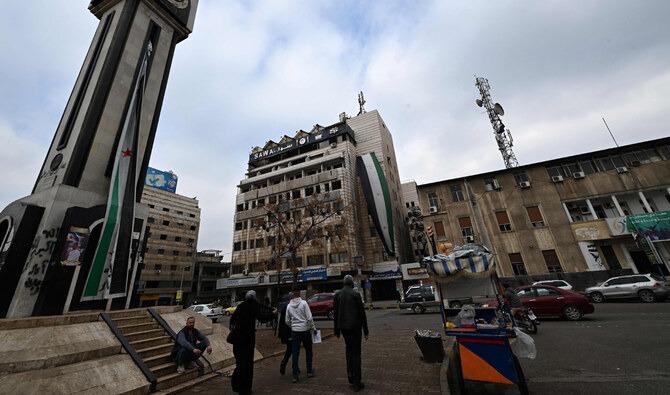
People walk in the main square of Homs on February 10, 2025. (AFP)
Short Url
Updated 13 February 2025
Follow

Pakistan calls for credible political transition in Syria, urges sanctions removal

  • Ambassador Munir Akram praises the Riyadh Meetings on Syria, calling them crucial for fostering dialogue
  • He expresses concern over reports of inclusion of ‘foreign terrorist groups’ in Syria’s governing structure

ISLAMABAD: Pakistan on Wednesday emphasized at the United Nations Security Council (UNSC) the need for a credible and peaceful political transition in Syria to ensure stability, while calling for the removal of sanctions on past leadership, saying their continuation was now hurting the Syrian people.
The statement came hours after Syria’s Foreign Minister Asaad Al-Shaibani announced his country would have a new government “representing the Syrian people as much as possible,” set to be launched on March 1.
Shaibani shared the plan on the sidelines of the World Governments Summit in the United Arab Emirates while discussing the situation following the overthrow of former President Bashar Assad.
“We take note of the assurance from the caretaker Foreign Minister today in Dubai that a new government will be launched on March 1st and will represent the Syrian people as much as possible and take its diversity into account,” Ambassador Munir Akram, Permanent Representative of Pakistan to the UN, told the UNSC briefing on Syria.
“The path to peace and stability in Syria requires a credible political transition, national unity and an inclusive governance framework,” he added. “The international community must remain engaged and constructive in supporting this process. Pakistan stands firmly with the brotherly and resilient people of Syria.”
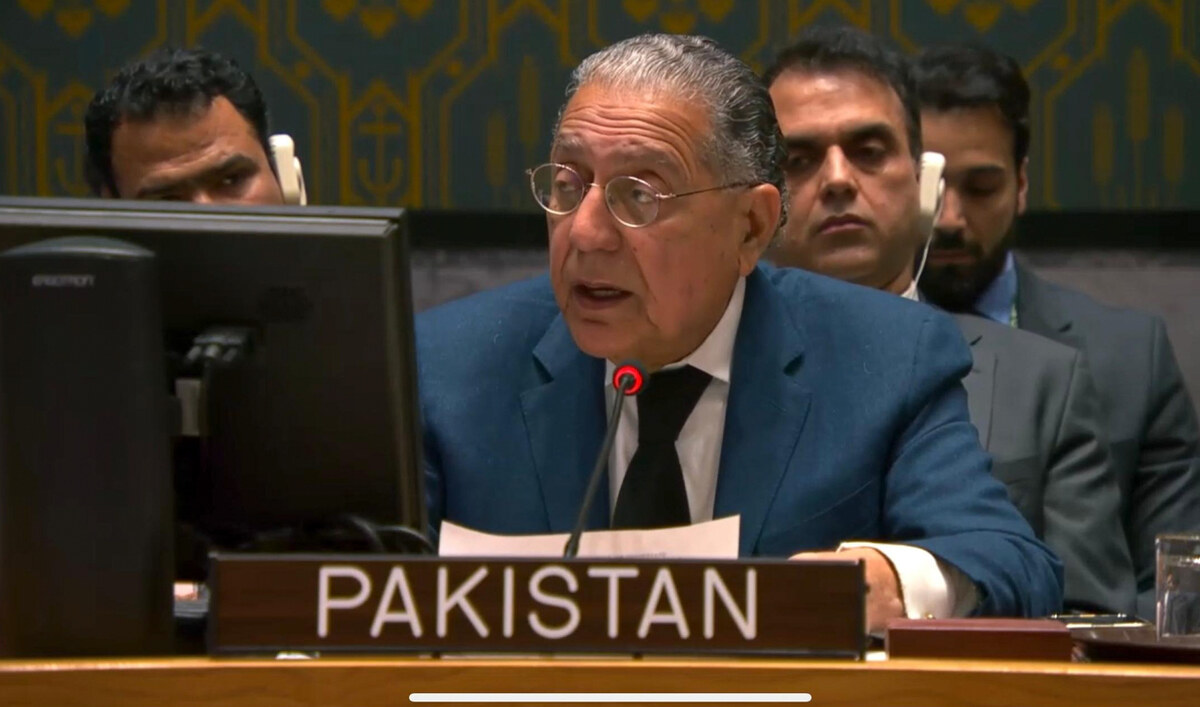


Pakistan’s UN Ambassador Munir Akram addresses UN Security Council briefing on Syria, at the United Nations Headquarter in New York on February 12, 2025. (Photo courtesy: X/@PakistanUN_NY)

Akram welcomed the Riyadh Meetings on Syria hosted by Saudi Arabia last month, calling them crucial in fostering dialogue, promoting an inclusive political transition and aiding Syria’s reconstruction within a Syrian-led framework.
The Saudi-hosted discussions focused on post-conflict reconstruction, refugee repatriation, counterterrorism and strengthening regional and international cooperation.
“Sanctions remain a major obstacle to Syria’s recovery,” Akram said. “Unilateral sanctions, originally imposed on past leadership, now primarily harm the Syrian people. These must be reassessed and reviewed to facilitate economic recovery and humanitarian relief.”
“UN sanctions should also be periodically reviewed to ensure they do not impede Syria’s reconstruction while maintaining vigilance against terrorist-affiliated entities,” he continued. “A balanced and pragmatic approach is needed to address economic hardships and the humanitarian crisis.”
The Pakistani diplomat also raised concerns about the reported presence of militant groups in Syria, warning against the Arab state becoming a safe haven for extremist groups.
“The presence of foreign fighters and groups with known terrorist affiliations requires vigilance,” he said. “Any resurgence of Al-Qaeda, [Daesh], and their affiliated groups must be prevented. We are also concerned at reports of the inclusion of foreign terrorist groups in Syria’s governing structure. No foreign fighters or armed entities should operate outside the State’s control.”


Pakistan says repaid over $13.06 billion domestic debt early in last 14 months

Updated 29 January 2026
Follow

Pakistan says repaid over $13.06 billion domestic debt early in last 14 months

  • Finance adviser says repayment shows “decisive shift” toward fiscal discipline, responsible economic management
  • Says Pakistan’s total public debt has declined from over $286.6 billion in June 2025 to $284.7 billion in November 2025

KARACHI: Pakistan has repaid Rs3,650 billion [$13.06 billion] in domestic debt before time during the last 14 months, Adviser to the Finance Minister Khurram Schehzad said on Thursday, adding that the achievement reflected a shift in the country’s approach toward fiscal discipline. 

Schehzad said Pakistan has been repaying its debt before maturity, owed to the market as well as the State Bank of Pakistan (SBP), since December 2024. He said the government had repaid the central bank Rs300 billion [$1.08 billion] in its latest repayment on Thursday. 

“This landmark achievement reflects a decisive shift toward fiscal discipline, credibility, and responsible economic management,” Schehzad wrote on social media platform X. 

Giving a breakdown of what he said was Pakistan’s “early debt retirement journey,” the finance official said Pakistan retired Rs1,000 billion [$3.576 billion] in December 2024, Rs500 billion [$1.78 billion] in June 2025, Rs1,160 billion [$4.150 billion] in August 2025, Rs200 billion [$715 million] in October 2025, Rs494 billion [$1.76 billion] in December 2025 and $1.08 billion in January 2026. 

He said with the latest debt repaid today, the July to January period of fiscal year 2026 alone recorded Rs2,150 billion [$7.69 billion] in early retirement, which was 44 percent higher than the debt retired in FY25.

He said of the total early repayments, the government has repaid 65 percent of the central bank’s debt, 30 percent of the treasury bills debt and five percent of the Pakistan Investment Bonds (PIBs) debt. 

The official said Pakistan’s total public debt has declined from over Rs 80.5 trillion [$286.6 billion] in June 2025 to Rs80 trillion [$284.7 billion] in November 2025. 

“Crucially, Pakistan’s debt-to-GDP ratio, around 74 percent in FY22, has declined to around 70 percent, reflecting a broader strengthening of fiscal fundamentals alongside disciplined debt management,” Schehzad wrote. 

Pakistan’s government has said the country’s fragile economy is on an upward trajectory. The South Asian country has been trying to navigate a tricky path to economic recovery under a $7 billion loan from the International Monetary Fund.