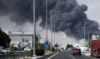
KYIV: Russia and Ukraine on Wednesday accused each other of blocking the rotation of staff from the International Atomic Energy Agency at the Zaporizhzhia nuclear power plant in southern Ukraine.
Moscow’s troops seized the facility — Europe’s largest nuclear power station — in the first days of its invasion of Ukraine, and both sides have repeatedly accused the other of risking a potentially devastating nuclear disaster by attacking the site.
Staff from the UN nuclear watchdog have been based there since September 2022 to monitor nuclear safety.
Fighting meant the IAEA staff could not be swapped out as part of a planned rotation on Wednesday — the second such delay in a week — both Kyiv and Moscow said, trading blame for the incident.
Ukrainian foreign ministry spokesman Georgiy Tykhy said in a statement: “Russia has once again deliberately disrupted the rotation of IAEA experts at the Zaporizhzhia plant.”
Inspectors spend around five weeks at the plant in stints before being swapped out in a complex procedure that involves traveling across the front line under supervision from the Russian and Ukrainian militaries.
Tykhy accused Russia’s army of opening fire near where the planned rotation was taking place, saying Moscow’s goal was to force the IAEA team to travel through Russian-controlled territory and “violate Ukraine’s sovereignty and territorial integrity.”
Russia’s foreign ministry spokeswoman Maria Zakharova said the Ukrainian army blocked the IAEA team from traveling to an agreed meeting point and were attacking the area with drones — at which point the Russian military withdrew its support team and returned to the station.
“On their return, the convoy carrying Russian military personnel and IAEA experts... came under attack by drone and mortar strikes,” Zakharova said in a statement.
The IAEA staff members were supposed to leave the station on February 5 in a rotation that was also delayed.
IAEA head Rafael Grossi was in both Ukraine and Russia last week, where he discussed the issue of rotations with officials from both countries.
In a statement, Grossi expressed his “deep regret” over the cancelation of the “carefully prepared and agreed rotation” due to excessive danger, calling the situation “completely unacceptable.”
“As a result of these extremely concerning events, I am in active consultation with both sides to guarantee the safety of our teams,” he said.


Russia, Ukraine trade blame for IAEA disruptions at Zaporizhzhia nuclear plant

https://arab.news/vz3zw
Russia, Ukraine trade blame for IAEA disruptions at Zaporizhzhia nuclear plant


How a Syrian refugee chef met Britain’s King Charles
- Alarnab, 48, said he had asked the king to come to the popular eatery when he met him at Buckingham Palace
LONDON: Pots clanged and oil sizzled inside the London kitchen of Syrian chef Imad Alarnab, as the former refugee who fled his country’s civil war recalled hosting King Charles III.
When the chef left his war-torn homeland in 2015, he never imagined that one day he would watch as cameras flashed and wide-eyed crowds greeted the monarch arriving at his Soho restaurant last year.
Alarnab, 48, said he had asked the king to come to the popular eatery when he met him at Buckingham Palace before an event honoring humanitarian work in 2023.
“I told him ‘I would love for you to visit our restaurant one day’ and he said: ‘I would love to’... I was over the Moon to be honest.”
The chef has come a long way since he arrived in London after an arduous journey from Damascus with virtually no money in his pocket.
Fearing for his life, he had escaped Syria after his family was uprooted again and again by fighting.
His culinary empire — restaurants, cafes, and juice bars peppered across the Syrian capital — had been destroyed by bombing in just six days in 2013.
Alarnab spent three months crisscrossing Europe in the back of lorries, aboard trains, on foot and even on a bicycle before he reached the UK.
“When I left, I left with nothing,” he told AFP, as waiters whirled past carrying steaming plates of traditional Syrian fare.
Starving and exhausted, he spent the last of his money on a train ticket to Doncaster where his sister lived.
“Love letter from Syria”
To make a living, Alarnab initially picked up any odd jobs, such as washing and selling cars, saving enough to bring his wife and three daughters over after seven months.
His love of cooking never left him though. In France, while he was sleeping on the steps of a church, Alarnab had often cooked for hundreds of other refugees.
“I always dreamed of going back to cooking,” he said.
So it wasn’t long before he found himself back in the kitchen, cooking up a storm across London with his sold-out supper clubs, bustling pop-up cafes, and crowded lunchtime falafel bars.
Alarnab’s friends gave him the initial boost for his first pop-up in 2017, and profits from his new catering business then covered the costs of later events.
He now runs two restaurants in the city — one in Soho’s buzzing Kingly Court and another nestled in a corner of the vibrant Somerset House arts center.
“I was looking for a city to love when I found London,” Alarnab said, adding it had offered him “space to innovate” and add his own modern twist to classic Syrian dishes.
Far from home, Alarnab said his word-of-mouth success had grown into a “love letter from Syria to the world” that needs no translation.
“You don’t really need to speak Arabic or Syrian to know that this is the best falafel ever,” he said, pointing to a row of colorful plates.
“There is hope”
For Alarnab, spices frying, dough rising and cheese melting inside a kitchen offered an unlikely escape from the real world.
“All my problems, I leave them outside the kitchen and walk in fresh.”
When he fled Syria, Alarnab thought going back to Damascus was forever off the table.
Yet he returned for the first time in October, almost a year to the day after longtime leader Bashar Assad was toppled in a lightning rebel offensive — ending almost 14 years of brutal civil war.
He walked the familiar streets of his old home, where his late mother taught him to cook many years ago.
“To return to Damascus and for her not to be there, that was extremely difficult.”
Torn between the two cities, Alarnab said he longed to one day rebuild his home in Damascus.
“I wish I could go back and live there. But at the same time, I feel like London is now a part of me. I don’t know if I could ever go back and just be in Syria,” he said.
Although Syrians still bear the scars of war, Alarnab said he had seen “hope in people’s eyes which was missing when I left in 2015.”
“The road ahead is still very long, and yes this is only the beginning — but there is hope.”