Roblox CEO announces Arabic version at World Governments Summit

Roblox, an online game platform and game creation system, has more than 88.9 million daily active users. (AN photo)
Short Url
Updated 12 February 2025
Follow

Roblox CEO announces Arabic version at World Governments Summit

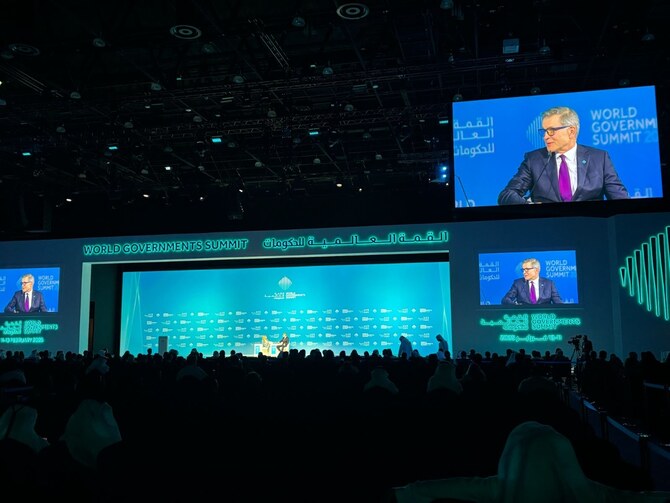
DUBAI: Roblox CEO David Baszucki announced an Arabic version of the hit game platform during the World Governments Summit on Wednesday.

Baszucki said that the new feature enabled Arabic-speaking creators to reach audiences instantly all over the world.

Through the move, everything on the platform will be available in Arabic.

“Today, we launched worldwide in Arabic, everything on Roblox: Roblox Studio, the Roblox app, automatic translation. Anyone who’s building a Roblox experience in Arabic, it will automatically translate into languages around the world,” he said.

Roblox, an online game platform and game creation system, has more than 88.9 million daily active users.

Many brands use the platform to promote their products, from cosmetics to high-end luxury goods.

“Brands are using our platforms to build 3D experiences to help promote their brands — everything from e.l.f. Beauty to Lamborghini,” he added.

“We have been growing consistently for 18 years now, over 20 percent year on year.”

In the past, the gaming platform faced criticism over safety concerns regarding children on the platform. In 2018, it was banned for several years in the UAE for exposing children to swearing, violence and sexually explicit content.

Baszucki said that child safety is a major concern for the company and that Roblox is utilizing AI technology to ensure a safe gaming experience for users.

“AI is getting so good and evolving so quickly. We have over 200 AI systems on Roblox. We are clear that we are looking at everything on the platform for safety and stability. We are so into the notion of online safety — it’s a top priority,” he said.


Pioneering Asharq Al-Awsat journalist Mohammed al-Shafei dies at 74

Updated 08 January 2026
Follow

Pioneering Asharq Al-Awsat journalist Mohammed al-Shafei dies at 74

  • Egyptian was known for his fearless coverage of terrorist, extremist groups
  • One of handful of reporters to interview Taliban leader Mullah Omar in 1970s

LONDON: Mohammed al-Shafei, one of Asharq Al-Awsat’s most prominent journalists, has died at the age of 74 after a 40-year career tackling some of the region’s thorniest issues.

Born in Egypt in 1951, al-Shafei earned a bachelor’s degree from Cairo University in 1974 before moving to the UK, where he studied journalism and translation at the University of Westminster and the School of Oriental and African Studies.

He began his journalism career at London-based Arabic papers Al-Muslimoon and Al-Arab — both of which are published by Saudi Research & Publishing Co. which also owns Arab News — before joining Al-Zahira after Iraq’s 1990 invasion of Kuwait.

Al-Shafei joined Asharq Al-Awsat in 1991 and spent 15 years on the sports desk before shifting to reporting on terrorism. He went on to pioneer Arab press coverage in the field, writing about all aspects of it, including its ideologies and ties to states like Iran.

His colleagues knew him for his calm demeanor, humility and meticulous approach, marked by precise documentation, deep analysis and avoidance of sensationalism.

Al-Shafei ventured fearlessly into terrorist strongholds, meeting senior terrorist leaders and commanders. In the 1970s he was one of only a handful of journalists to interview Mullah Omar, the leader of the Taliban, and conducted exclusive interviews with senior figures within Al-Qaeda.

He also tracked post-Al-Qaeda groups like Daesh, Hay’at Tahrir al-Sham and Boko Haram, offering pioneering analysis of Sunni-Shiite extremism and how cultural contexts shaped movements across Asia and Africa.

During the war on Al-Qaeda, he visited US bases in Afghanistan, embedded with international forces, and filed investigative reports from active battlefields — rare feats in Arab journalism at the time.

He interviewed Osama bin Laden’s son, highlighting a humanitarian angle while maintaining objectivity, and was among the few Arab journalists to report from Guantanamo, where his interviews with Al-Qaeda detainees shed light on the group’s operations.

Al-Shafei married a Turkish woman in London in the late 1970s, with whom he had a son and daughter. He was still working just hours before he died in London on Dec. 31.