Pakistani, UAE deputy PMs express concern over US proposal to dislocate Palestinians from Gaza

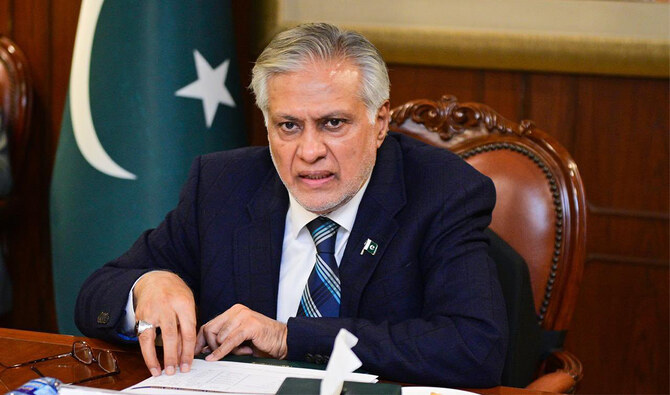
Pakistan’s Deputy Prime Minister Ishaq Dar chairs a meeting in Islamabad, Pakistan, on January 16, 2025. (Pakistan Foreign Office)
Short Url
Updated 12 February 2025
Follow

Pakistani, UAE deputy PMs express concern over US proposal to dislocate Palestinians from Gaza

  • Trump has announced plans to resettle Palestinian residents and redevelop enclave and said they should not have the right to return
  • Palestinian territory, encompassing the Gaza Strip and West Bank, including East Jerusalem, has been occupied by Israel since 1967

ISLAMABAD: Pakistan’s Deputy Prime Minister Ishaq Dar on Wednesday spoke to his counterpart in the United Arab Emirates (UAE), Sheikh Abdullah bin Zayed Al Nahyan, and expressed concern about a proposal by US President Donald Trump to displace Palestinians from Gaza, the foreign office in Islamabad said.

Trump has recently announced plans to resettle Gaza’s Palestinian residents and redevelop the enclave and said they should not have the right to return. Under Trump’s scheme, Gaza’s about 2.2 million Palestinians would be resettled and the United States would take control and ownership of the coastal territory, redeveloping it into the “Riviera of the Middle East.” Palestinians fear that Trump’s plan would enforce another Nakba, or Catastrophe, when they experienced mass expulsions in 1948 with the creation of Israel.

“The two leaders discussed the grave humanitarian situation in Gaza and expressed concerns at the proposal to displace or relocate the Palestinian people from their ancestral homeland,” the foreign office said after Dar’s call with his UAE counterpart.

The Pakistani deputy PM reiterated Pakistan’s “unwavering” support for Palestinian rights, and the foreign office said both leaders agreed to stay in close contact to achieve a “just, comprehensive, and lasting solution to the Palestinian issue.”

Israel began its latest assault on Gaza after a Hamas-led attack on Israel on October 7, 2023, that killed about 1,200 people, while some 250 were taken hostage, according to Israeli tallies.

More than 48,000 Palestinians have been killed in Israeli air and ground operations since, Gaza health authorities say, and much of the enclave has been obliterated. 

The Gaza war has been paused since Jan. 19 under the ceasefire agreement between Israel and Hamas that was brokered by Qatar and Egypt with support from the United States.

Palestinian territories – encompassing the Gaza Strip and West Bank, including East Jerusalem – have been occupied by Israel since 1967.

Pakistan does not recognize Israel and has consistently called for an independent Palestinian state based on “internationally agreed parameters.”



Pakistan weekly inflation rises 5.19% year on year as Ramadan begins

Updated 21 February 2026
Follow

Pakistan weekly inflation rises 5.19% year on year as Ramadan begins

  • Out of 51 items, prices of 17 items increased, 12 items decreased and 22 remained stable
  • The Sensitive Price Index for the week ending on Feb. 19 increased by 1.16 percent, data shows

KARACHI: Short-term inflation, measured by the Sensitive Price Index (SPI), rose 5.19 percent year-on-year in the week ending Feb 19, the statistics bureau said on Friday, reflecting higher prices of perishable food items at the start of Ramadan.

The SPI, which comprises 51 essential items collected from 50 markets in 17 cities, is computed on a weekly basis to assess the price movement of essential commodities at a shorter interval of time to review the price situation in the country.

The SPI for the week ending on Feb. 19 increased by 1.16 percent, the year-on-year trend depicted an increase of 5.19 percent, according to the Pakistan Bureau of Statistics (PBS) data.

The development came as the holy fasting month of Ramadan began in the South Asian country on Feb. 19, which often sees an increase of prices of fruit, vegetables and other necessary items.

“During the week, out of 51 items, prices of 17 (33.33%) items increased, 12 (23.53%) items decreased and 22 (43.14%) items remained stable,” the PBS said.

Major increase was observed in the prices of Bananas (16.05%), Electricity Charges for Q1 (15.41%), Garlic (5.86%), Chicken (5.49%), Onions (3.83%), Tomatoes (3.82%), Diesel (2.69%), Petrol (1.93%), Beef (1.03%), LPG (0.75%), Mutton (0.69%) and Long Cloth (0.28%), according to the PBS.

The items whose prices decreased included Eggs (11.78%), Potatoes (2.24%), Wheat Flour (2.02%), Pulse Masoor (1.47%), Sugar (0.96%), Vegetable Ghee 2.5Kg (0.72%), Pulse Gram (0.58%), Cooking Oil 5 Litre (0.19%), Gur (0.16%), Vegetable Ghee 1Kg (0.11%), Rice (0.08%) and Mustard Oil (0.07%).