

LEAP 2025: AI, smart lenses, and wearable tech take center stage

Dutch designer Anouk Wipprecht brought a futuristic vision to LEAP 2025 with her collection of robotic dresses. AN
Short Url
Updated 11 February 2025
Follow

LEAP 2025: AI, smart lenses, and wearable tech take center stage

RIYADH: Advanced technologies and innovative solutions were in focus at LEAP 2025, showcasing ideas that could shape industries and the future. 

Among the key presentations was the Saudi Accelerated Innovation Lab, which introduced Aramco’s Robotics Assistant, or SARA. 

SAIL, launched during LEAP 2024 by Saudi Aramco President and CEO Amin Nasser, also houses AramcoMetaBrain, a proprietary generative artificial intelligence model designed to enhance operational efficiency. 

SARA, an AI-powered voice assistant, was introduced by Ibrahim Al-Sowayigh, innovation and commercialization leader at SAIL. He highlighted its potential to meet the highest cybersecurity and operational standards. 

“In enterprises and highly regulated environments, there was one persistent problem: trust. That’s why one of the very first business opportunities we were introduced to was securing a device that can be trusted to connect to our internal Aramco network and comply with best-in-class cybersecurity requirements,” Al-Sowayigh said. 

“We needed a device that is secure, industrial-grade, with intuitive-personalized interactions. That’s when we decided to build, not buy, and SARA — our very own industrial Gen-AI tabletop voice assistant — was born.” 
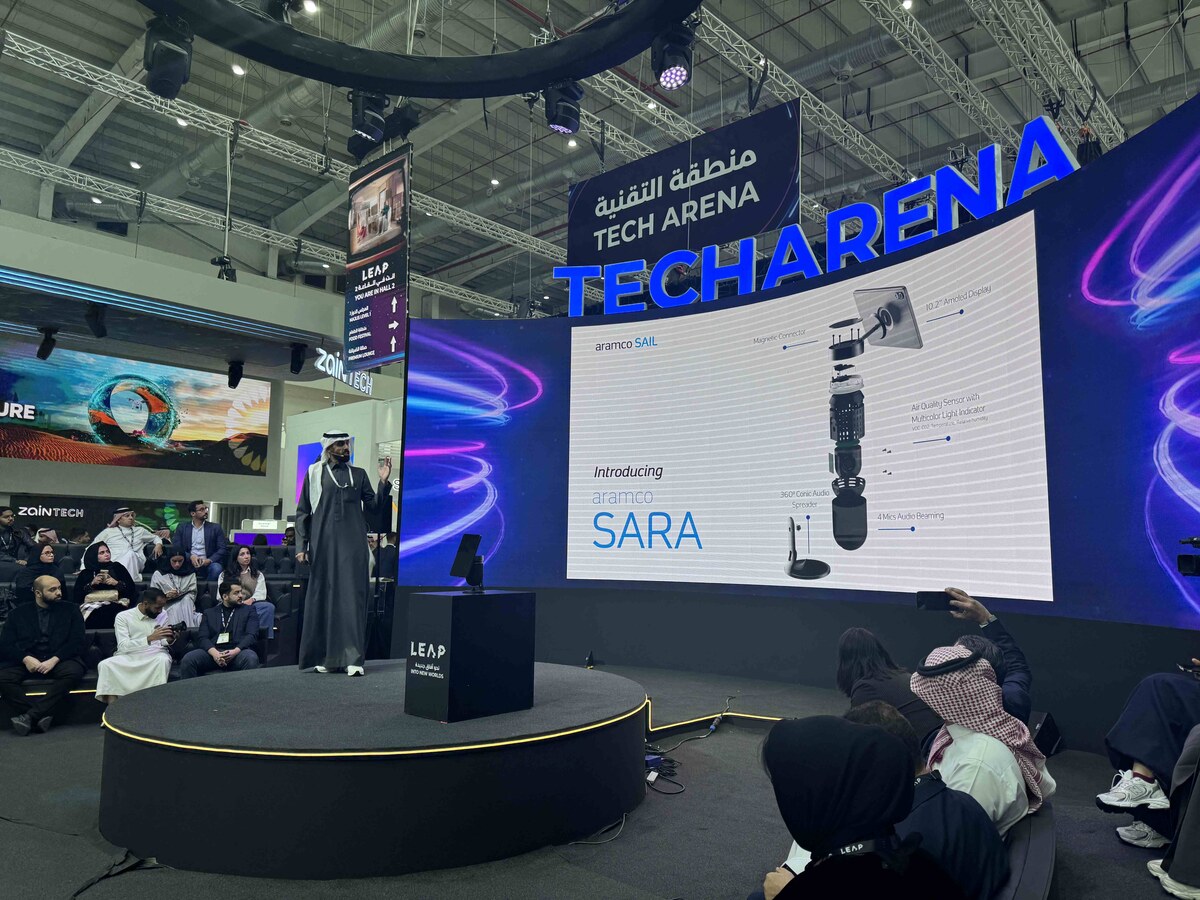


Ibrahim Al-Sowayigh introduces SARA, an AI-powered voice assistant. AN

AramcoMetaBrain powers SARA, enabling it to process vast amounts of industry-specific data, interpret complex queries, and provide highly contextualized responses. The model is trained in Aramco’s proprietary operational language, equipping it to navigate the company’s guidelines and processes. 

SARA is poised for commercialization through Aramco Digital, offering enterprises a secure, integrated AI solution. 

“SARA ensures that queries and data are processed and protected on-premise, giving organizations full control over their information while benefiting from cutting-edge AI capabilities,” Al-Sowayigh said.

“This makes SARA the ideal digital companion for industries requiring the highest levels of data security and operational efficiency.” 

Smart contact lens 

Tech innovation at LEAP 2025 extended beyond AI, with XPANCEO, a Dubai-based computing firm, unveiling a smart contact lens that aims to revolutionize vision enhancement and health monitoring. 

The lens offers a full-screen, full-color augmented reality experience while functioning as a miniature laboratory for the eye. Integrated neuro-interfacing jet electrodes enable enhanced vision, including night vision and zoom capabilities. 

“This is not actually science fiction, but rather what I will try to show you today. So this is already a rapidly developing reality,” said Valentyn Volkov, scientific partner at XPANCEO. 
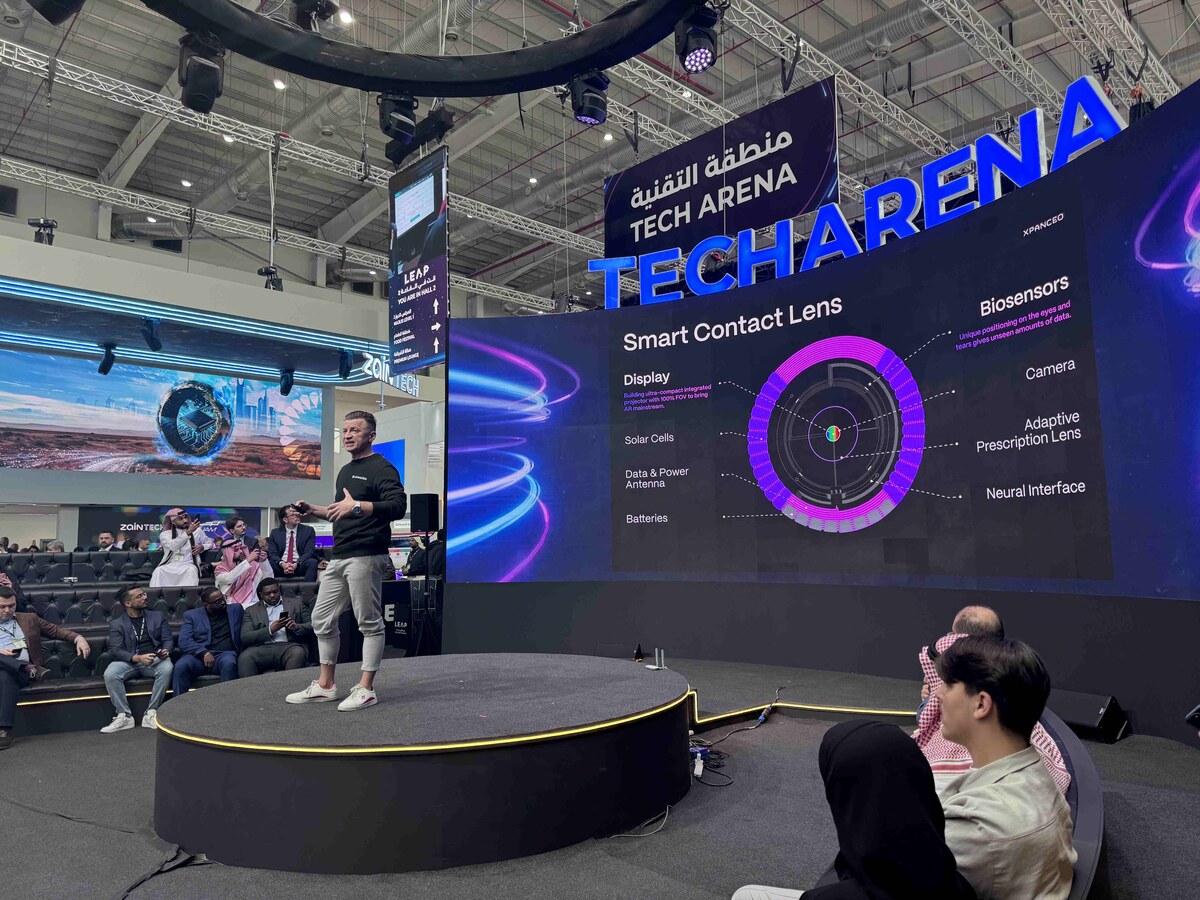


Dubai-based computing firm XPANCEO unveiled a smart contact lens. AN

The smart lenses, set for development in three phases, will initially improve vision in low-light conditions. The second iteration will incorporate health-tracking features such as stress levels, blood sugar, body temperature, and dry eyes. The final version aims to display visual content directly on the lenses, delivering a seamless augmented reality experience. 

Despite progress, technological and biological challenges remain, as developers seek to miniaturize smartphone capabilities into a contact lens while ensuring biological compatibility. 

A prototype was showcased at LEAP, with XPANCEO targeting a market release by the end of 2026. 

Wearable technology 

Dutch designer Anouk Wipprecht brought a futuristic vision to LEAP 2025 with her collection of robotic dresses that merge fashion and engineering. 

Her designs include a heartbeat-monitoring dress featuring a central crystal that blinks in sync with the wearer’s pulse. Another highlight, the Spider Dress, incorporates animatronic mechanical limbs and 3D-printed sensors to monitor and protect the wearer’s personal space. 

Using proximity and respiration sensors, the dress responds to external stimuli, adjusting its movements accordingly. Wipprecht noted that such designs are practical for crowded urban environments like New York, where wearers can use them to maintain personal space. 

LEAP 2025 continues to showcase innovations that challenge the status quo, reinforcing Riyadh’s position as a global hub for technological advancement.


First EU–Saudi roundtable on critical raw materials reflects shared policy commitment

Updated 16 January 2026
Follow

First EU–Saudi roundtable on critical raw materials reflects shared policy commitment

RIYADH: The EU–Saudi Arabia Business and Investment Dialogue on Advancing Critical Raw Materials Value Chains, held in Riyadh as part of the Future Minerals Forum, brought together senior policymakers, industry leaders, and investors to advance strategic cooperation across critical raw materials value chains.

Organized under a Team Europe approach by the EU–GCC Cooperation on Green Transition Project, in coordination with the EU Delegation to Saudi Arabia, the European Chamber of Commerce in the Kingdom and in close cooperation with FMF, the dialogue provided a high-level platform to explore European actions under the EU Critical Raw Materials Act and ResourceEU alongside the Kingdom’s aspirations for minerals, industrial, and investment priorities.

This is in line with Saudi Vision 2030 and broader regional ambitions across the GCC, MENA, and Africa.

ResourceEU is the EU’s new strategic action plan, launched in late 2025, to secure a reliable supply of critical raw materials like lithium, rare earths, and cobalt, reducing dependency on single suppliers, such as China, by boosting domestic extraction, processing, recycling, stockpiling, and strategic partnerships with resource-rich nations.

The first ever EU–Saudi roundtable on critical raw materials was opened by the bloc’s Ambassador to the Kingdom, Christophe Farnaud, together with Saudi Deputy Minister for Mining Development Turki Al-Babtain, turning policy alignment into concrete cooperation.

Farnaud underlined the central role of international cooperation in the implementation of the EU’s critical raw materials policy framework.

“As the European Union advances the implementation of its Critical Raw Materials policy, international cooperation is indispensable to building secure, diversified, and sustainable value chains. Saudi Arabia is a key partner in this effort. This dialogue reflects our shared commitment to translate policy alignment into concrete business and investment cooperation that supports the green and digital transitions,” said the ambassador.

Discussions focused on strengthening resilient, diversified, and responsible CRM supply chains that are essential to the green and digital transitions.

Participants explored concrete opportunities for EU–Saudi cooperation across the full value chain, including exploration, mining, and processing and refining, as well as recycling, downstream manufacturing, and the mobilization of private investment and sustainable finance, underpinned by high environmental, social, and governance standards.

From the Saudi side, the dialogue was framed as a key contribution to the Kingdom’s industrial transformation and long-term economic diversification agenda under Vision 2030, with a strong focus on responsible resource development and global market integration.

“Developing globally competitive mineral hubs and sustainable value chains is a central pillar of Saudi Vision 2030 and the Kingdom’s industrial transformation. Our engagement with the European Union through this dialogue to strengthen upstream and downstream integration, attract high-quality investment, and advance responsible mining and processing. Enhanced cooperation with the EU, capitalizing on the demand dynamics of the EU Critical Raw Materials Act, will be key to delivering long-term value for both sides,” said Al-Babtain.

Valere Moutarlier, deputy director-general for European industry decarbonization, and directorate-general for the internal market, industry, entrepreneurship and SMEs at European Commission, said the EU Critical Raw Materials Act and ResourceEU provided a clear framework to strengthen Europe’s resilience while deepening its cooperation with international partners.

“Cooperation with Saudi Arabia is essential to advancing secure, sustainable, and diversified critical raw materials value chains. Dialogues such as this play a key role in translating policy ambitions into concrete industrial and investment cooperation,” she added.