Pakistan stresses increasing trade, economic engagement with Europe amid EU-India deal 

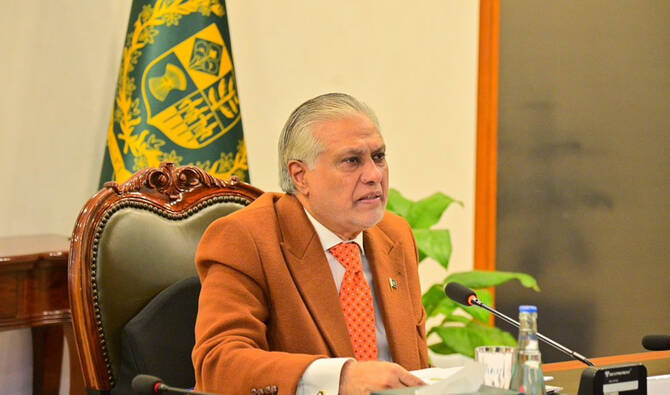
Deputy Prime Minister Ishaq Dar chairs a high-level inter-ministerial meeting to review measures aimed at strengthening Pakistan’s economic and trade cooperation with the European Union in Islamabad, Pakistan, on 9 February. 2026. (Ishaq Dar/X)
Short Url
Updated 09 February 2026
Follow

Pakistan stresses increasing trade, economic engagement with Europe amid EU-India deal 

  • Deputy PM Ishaq Dar chairs meeting to review measures to strengthen Pakistan-EU economic and trade cooperation
  • Free trade agreement grants Indian exporters sweeping tariff-free access to EU, Pakistan’s second-largest export market

ISLAMABAD: Pakistan’s Deputy Prime Minister and Foreign Minister Ishaq Dar on Monday stressed the importance of deepening trade and economic engagement with the European Union (EU) amid the bloc’s recent free trade agreement with India. 

India and EU last month announced they had successfully concluded negotiations for a free trade agreement with the EU, which Indian Prime Minister Narendra Modi described as the “mother of all trade deals.” The agreement grants Indian exporters sweeping tariff-free access to the EU, Pakistan’s second-largest export market. European Commission President Ursula von der Leyen said the deal created a free trade zone of two billion people.

The main concern for Pakistan is that the India-EU deal may significantly reduce Islamabad’s tariff advantage under the EU’s Generalized Scheme of Preferences Plus, which allows duty-free access for many Pakistani exports in return for commitments on labor rights, human rights and governance. Pakistan’s foreign office, however, has said it continues to view its trade relationship with the EU, particularly under the GSP Plus framework, as mutually beneficial.

Dar chaired a high-level inter-ministerial meeting to review measures aimed at strengthening Pakistan’s economic and trade cooperation with EU on Monday, the foreign ministry said. 

“DPM/FM underscored the importance of deepening and expanding trade and economic engagement with the EU, noting that the EU remains a key economic partner for Pakistan, particularly under the GSP Plus framework,” the statement said. 

He highlighted that Pakistan has successfully completed four biennial GSP Plus reviews, reaffirming Islamabad’s commitment to fully meeting its obligations under the scheme to expand mutually beneficial trade opportunities.

The meeting was attended by the federal minister of law and senior officials as well as Pakistan’s ambassador to the EU. 

The development takes place as Pakistan’s exports dwindle. After rising 5 percent to $32.1 billion last fiscal year, the Pakistan Bureau of Statistics reported that exports fell 9 percent to $15.2 billion in the first half of the current year through December. 

Pakistani industrialists and financial analysts have urged the government to reduce domestic production costs, particularly high power tariffs. EU accounts for a substantial share of Pakistan’s exports, particularly textiles and garments. 

“The EU-India FTA will have a definite impact on Pakistan’s textile exports to the EU,” said Shankar Talreja, the head of research at Karachi-based Topline Securities Ltd, told Arab News last month. 

“Pakistani companies’ competitive advantage to compete against a giant like India needs to be restored in the form of regionally aligned energy tariffs and policy certainty.”


Pakistan condemns Israel’s contentious move to approve land registration in West Bank

Updated 8 sec ago
Follow

Pakistan condemns Israel’s contentious move to approve land registration in West Bank

  • Israel’s cabinet on Sunday voted in favor of beginning land registration process that makes it easier for settlers to buy lands in West Bank 
  • Pakistan’s foreign office says such measures in violation of international law, UN General Assembly and Security Council resolution

ISLAMABAD: Pakistan’s foreign office on Monday condemned the Israeli cabinet’s contentious decision to approve registration of large areas of land in the West Bank as “state property,” saying the move was in violation of international law and the United Nations Security Council resolutions. 

Members of the Israeli cabinet on Sunday voted in favor of beginning a process of land registration in the West Bank for the first time since 1967. The move is being seen by many, including the Palestinian Authority (PA), as measures to tighten Israel’s control over the West Bank area by making it easier for Jewish settlers to buy land.

The ruling Israeli coalition ‌includes many ‌pro-settler members who want Israel to annex ​the ‌West ⁠Bank, ​land captured ⁠in the 1967 Middle East war to which Israel cites biblical and historical ties. The West Bank is among the territories that Palestinians seek for a future independent state. Much of it is under Israeli military control, with limited Palestinian self-rule in some areas run by the PA. 

“Pakistan strongly condemns the latest attempt by the Israeli occupying power to convert areas of the Occupied West Bank into so-called state property, and to expand illegal settlement activities,” Pakistan’s foreign office spokesperson said in a statement. 

The spokesperson said such actions are “in clear violation” of international law, UN Security Council and General Assembly resolutions. It stressed that such measures must be rejected by the international community.

“Pakistan calls on the international community to take concrete measures to end Israeli impunity, and ensure respect for international law,” the statement said. 

The foreign office reiterated its support for the people of Palestine in securing their right to self-determination, and for an independent, Palestinian state based on pre-1967 borders, with Al-Quds Al-Sharif as its capital.

The PA presidency has rejected the cabinet’s decision, saying it constitutes “a de-facto annexation of ‌occupied Palestinian territory and a declaration of the commencement of annexation plans aimed at entrenching the occupation ⁠through illegal settlement ⁠activity.”

The United Nations’ highest court said in a non-binding advisory opinion in 2024 that Israel’s occupation of Palestinian territories and settlements there is illegal and should be ended as soon as possible. Israel disputes this view.