

ISLAMABAD: Prime Minister Shehbaz Sharif said on Monday that Pakistan was having a “very close interaction” with Saudi Arabia and the United Arab Emirates (UAE) in minerals and mining sectors, amid Islamabad’s efforts to focus on key sectors to boost the country’s economy.
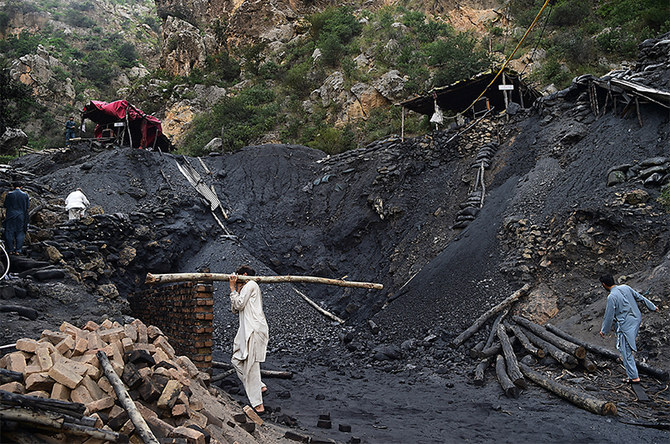
Pakistan’s landscape is a treasure trove of diverse mineral deposits from huge coal reserves in the southern Sindh province to gold and copper deposits in the southwestern Balochistan province. The northwestern Khyber Pakhtunkhwa province is home to several gemstone mines, including emerald mines in Swat, Mardan’s pink topaz mines, and peridot mines in Kohistan.
Petroleum Minister Musadik Malik said last month Pakistan and Saudi Arabia were in “advanced” stages of talks relating to investment in Reko Diq copper and gold mine, one of the world’s largest underdeveloped copper-gold mines, in Balochistan, with Saudi Arabia reportedly offering Pakistan a 15% investment stake in the project. The UAE, a key development and investment partner of Pakistan, has also recently expressed its “keen interest” in collaborating with Pakistan in mining, minerals and agriculture sectors, according to PM Sharif’s office.
While this huge mineral potential has remained largely unexplored, Pakistan has expedited efforts in recent months to exploit this untapped potential to speed up its economic growth.
“Mines and minerals, which is generally a G2G [government-to-government] corridor, in this, we are having a very close interaction with the UAE [United Arab Emirates] and Saudi Arabia,” PM Sharif told a group of Pakistani businessmen and investors in Dubai.
Sharif is currently in the UAE to attend the World Governments Summit (WGS) which is taking place from Feb. 11-13, bringing together a large number of heads of state/government, global policymakers, and leading private sector figures to discuss the future of governance, innovation and international cooperation. This is Sharif’s second visit to the UAE since assuming office in March last year.
His statement follows remarks by Petroleum Minister Malik, in which he said Pakistan and Saudi Arabia had done all the requisite homework with regard to a “very large asset.”
“Both sides have come up with valuation frameworks, the valuation ranges are in place, and both of the teams are empowered now to negotiate, and right now, we are under non-disclosure. So, I can’t give you the details, but suffice to say that we are expecting very big announcements very soon,” he said, on the sidelines of Future Minerals Forum (FMF) in Riyadh last month.
Reuters reported that Saudi Arabian mining company Manara Minerals could invest in Pakistan’s Reko Diq mine in the next two quarters, citing the Pakistani petroleum minister.
Saudi Arabia is the largest source of remittances to Pakistan, which were recorded at $728.3 million in January, and a key ally, whereas Pakistani policymakers consider the UAE an optimal export destination due to its geographical proximity, which minimizes transportation and freight costs while facilitating commercial transactions.
Pakistan, faced with a prolonged economic crisis, last year also signed several agreements worth $2.8 billion and $3 billion with Saudi Arabia and the UAE, respectively.