

Afghan wedding halls light up somber Kabul nights

1 / 6
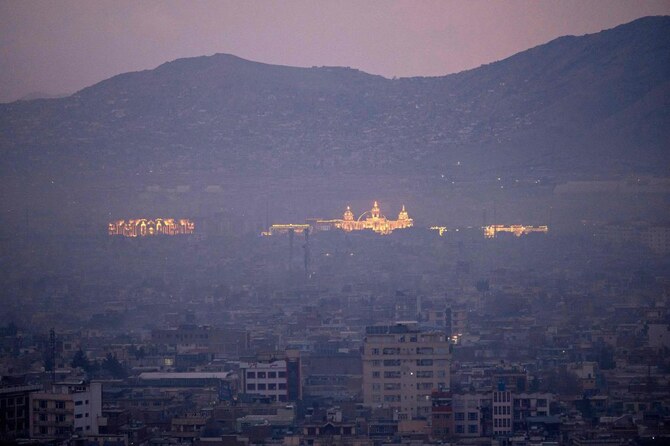
This picture taken on February 2, 2025 shows Afghan security guards standing at an entrance of a wedding hall, at night in Kabul. As night settles over Afghanistan's capital, only a few small lights and neon signs pierce the darkness and thick blanket of winter pollution. But on some street corners, glittering colossal wedding halls loom out of the gloom. (AFP)
2 / 6
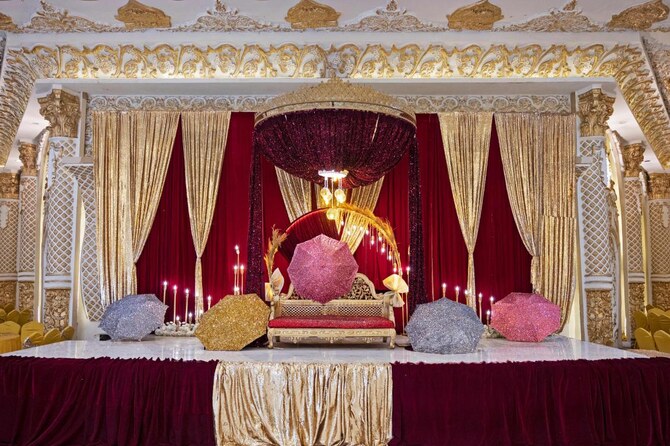
This picture taken on February 2, 2025 shows a decorated stage at a wedding hall in Kabul. (AFP)
3 / 6
This picture taken on February 2, 2025 shows Afghan workers mopping a wedding hall, at night in Kabul. As night settles over Afghanistan's capital, only a few small lights and neon signs pierce the darkness and thick blanket of winter pollution. (AFP)
4 / 6
But on some street corners, glittering colossal wedding halls loom out of the gloom. The city of more than six million people is often plunged into shadow due to ubiquitous power outages, which only the wealthiest can remedy with expensive generators or solar panels. (AFP)
5 / 6
This picture taken on February 2, 2025 photographers shooting photos of a groom at a courtyard of a wedding hall, at night in Kabul. As night settles over Afghanistan's capital, only a few small lights and neon signs pierce the darkness and thick blanket of winter pollution. (AFP)
6 / 6
This picture taken on February 2, 2025 shows a decorated wedding hall, at night in Kabul. As night settles over Afghanistan's capital, only a few small lights and neon signs pierce the darkness and thick blanket of winter pollution. (AFP)
Short Url
Updated 10 February 2025
Follow

Afghan wedding halls light up somber Kabul nights

KABUL: As night settles over Afghanistan’s capital, only a few small lights and neon signs pierce the darkness and thick blanket of winter pollution.
But on some street corners, glittering colossal wedding halls loom out of the gloom, a rare display of opulence in the Afghan capital.
The city of more than six million people is often plunged into shadow due to ubiquitous power outages, which only the wealthiest can remedy with expensive generators or solar panels.
Apart from a few vendors, the streets are deserted, a stark contrast with the chaotic hustle of the daytime.
People huddle at home to shelter from the cold and for lack of nighttime activities.
Since the Taliban took power in 2021 and imposed their strict version of Islamic law, a veil of sadness has enveloped the capital.
There is no music spilling out from restaurants because it is forbidden, women are banned from parks, and walls decorated with colorful pro-peace graffiti have been splashed with calls to holy war.
The only bright lights emanate from the wedding halls that dot the city center and escape some of the Taliban’s scrutiny, as marriage is prized in Afghan culture.
The high-ceilinged halls are segregated by gender, with music only tolerated on the women’s side.
“In Afghanistan, the marriage ceremony is the most important event for girls and boys. It’s a once-in-a-lifetime event — we don’t have much divorce,” said Mohammad Wassil Qaumi, director of the Imperial Continental, a palatial white-and-gold hall that shines with a glitz reminiscent of a Las Vegas casino.
“It’s the start of a new life so the light should be everywhere, that’s why the city is bright, it should have a little bit of luxury!” he told AFP.

DECORATIONS
Bunches of plastic flowers, throne-style sofas, gilded trimming and neon lights fill the complex’s four halls, some of which can accommodate up to 7,000 guests.
Qaumi, 32, says he spends $25,000 to $30,000 per month for municipal electricity, which provides a few hours of power per day.
To keep the lights on, he also pays just under $15,000 for generators.
To recoup his costs, he charges up to $20,000 for a wedding, in a country where 85 percent of the population lives on less than a dollar a day, according to the United Nations Development Programme.
“Weddings are a necessity in the Afghan culture, you have to invite more and more people” even if it means going into debt, said Hajji Safiullah Esmafi, owner of the Stars Palace hall.
In another district of the capital, the City Star welcomes its guests with a beige and gold facade topped with three sculpted domes and a huge sparkling arch out front.
“Electricity is very expensive,” admits the owner, 24-year-old Siyer Paiman.
But, he added, “people in Afghanistan like bright colors.”

ELECTRICITY
He has invested in solar panels and spends the equivalent of $12,000 to $19,900 on generators and electricity, which only covers six to seven hours a day, “and not always at night.”
Afghanistan depends on its Central Asian neighbors for imported electricity.
With the hopes of increasing supply, the country is involved in several regional interconnection projects, but progress is slow.
“The current demand in Afghanistan is about 7,000 to 8,000 megawatts but they currently produce locally about 1,000 megawatts and import the rest from Central Asia,” a sector expert who asked for anonymity told AFP, adding that renewable energy sources should be developed but that funding was lacking.
Power cuts also affect heating, with temperatures easily dropping below 0 degrees Celsius (32 degrees Fahrenheit).
Kabul’s residents use stoves, burning almost anything from coal and wood to plastic or household waste, creating a fog of pollution in the city slung between mountains 1,800 meters (5,900 feet) above sea level.
In the nighttime gloom, wedding halls are “the brightness of the city,” said Qaumi. “Here, everyone is very happy.”
“People come here to meet friends and family, (they) wear new clothes, jewelry... showing off so much,” he said of patrons enjoying one of the only places left in Kabul where this is still possible.


ABC signs Jimmy Kimmel to a one-year contract extension, months after temporary suspension

Updated 09 December 2025
Follow

ABC signs Jimmy Kimmel to a one-year contract extension, months after temporary suspension

President Donald Trump won’t be getting his wish. ABC said Monday it has signed late-night comic Jimmy Kimmel to a one-year contract extension.
Kimmel’s previous, multiyear contract had been set to expire next May, so the extension will keep him on the air until at least May 2027.
Kimmel’s future looked questionable in September, when ABC suspended “Jimmy Kimmel Live!” for remarks made following the assassination of conservative activist Charlie Kirk. Following a public outcry, ABC lifted the suspension, and Kimmel returned to the air with much stronger ratings than he had before.
He continued his relentless joking at the president’s expense, leading Trump to urge the network to “get the bum off the air” in a social media post last month. The post followed Kimmel’s nearly 10-minute monologue on Trump and the Jeffrey Epstein files.
Kimmel was even on Trump’s mind Sunday as the president hosted the Kennedy Center Honors in Washington.
“I’ve watched some of the people that host,” Trump said. “I’ve watched some of the people that host. Jimmy Kimmel was horrible, and some of these people, if I can’t beat out Jimmy Kimmel in terms of talent, then I don’t think I should be president.”
Kimmel has hosted the Oscars four times, but he’s never hosted the Kennedy Center show.
Just last week, Kimmel was needling Trump on the president’s approval ratings. “There are gas stations on Yelp with higher approval ratings than Trump right now,” he said.
Kimmel will be staying longer than late-night colleague Stephen Colbert at CBS. The network announced this summer it was ending Colbert’s show next May for economic reasons, even though it is the top-rated network show in late-night television.
ABC has aired Kimmel’s late-night show since 2003, during a time of upheaval in the industry. Like much of broadcast television, late-night ratings are down. Viewers increasingly turn to watching monologues online the day after they appear.
Most of Kimmel’s recent renewals have been multiyear extensions. There was no immediate word on whose choice it was to extend his current contract by one year.
Following Kirk’s killing, Kimmel was criticized for saying that “the MAGA gang” was “desperately trying to characterize this kid who murdered Charlie Kirk as anything other than one of them and doing everything they can to score political points from it.” The Nexstar and Sinclair television ownership groups said it would take Kimmel off the air, leading to ABC’s suspension.
When he returned to the air, Kimmel did not apologize for his remarks, but he said he did not intend to blame any specific group for Kirk’s assassination. He said “it was never my intention to make the light of the murder of a young man.”