

Lion cub gifted to Pakistani YouTube star causes wedding chaos

The screegrab taken from Rajab Family's YouTube channel shows YouTuber Rajab Butt holding a lion cub gifted to him at his wedding in Pakistan on December 14, 2024. (Rajab's Family/YT)
Short Url
Updated 30 January 2025
Follow

Lion cub gifted to Pakistani YouTube star causes wedding chaos

  • Rajab Butt has one of the largest online followings in the South Asian country and his week-long nuptials in late December were plastered over celebrity gossip websites
  • Pictures spread rapidly online when a sleepy lion cub was presented to him in a gold-chained cage in front of thousands of guests who partied late into the night in Lahore

LAHORE: A Pakistani YouTube star who was gifted a lion cub on his wedding day has avoided jail after promising a judge to upload animal rights videos for a year.

Rajab Butt has one of the largest online followings in the South Asian country and his week-long nuptials in late December were plastered over celebrity gossip websites.

When a sleepy lion cub, resembling young Simba from the 2019 “Lion King” film, was presented to him in a gold-chained cage in front of thousands of guests who partied late into the night in the eastern megacity of Lahore, pictures spread rapidly online.

Butt captioned a video of the event “it’s raining gifts,” racking up nearly 10 million views.

The morning after, police raided his house, confiscated the cub and kept the newly-wed in custody overnight.

“We found out about the lion cub through social media,” said Faisal Mushtaq, an inspector from the Punjab provincial wildlife department.

Police officers went to Butt’s house and found the lion cub roaming around the garage, he said.

“It was in a poor condition, as it was very cold,” said Mushtaq.
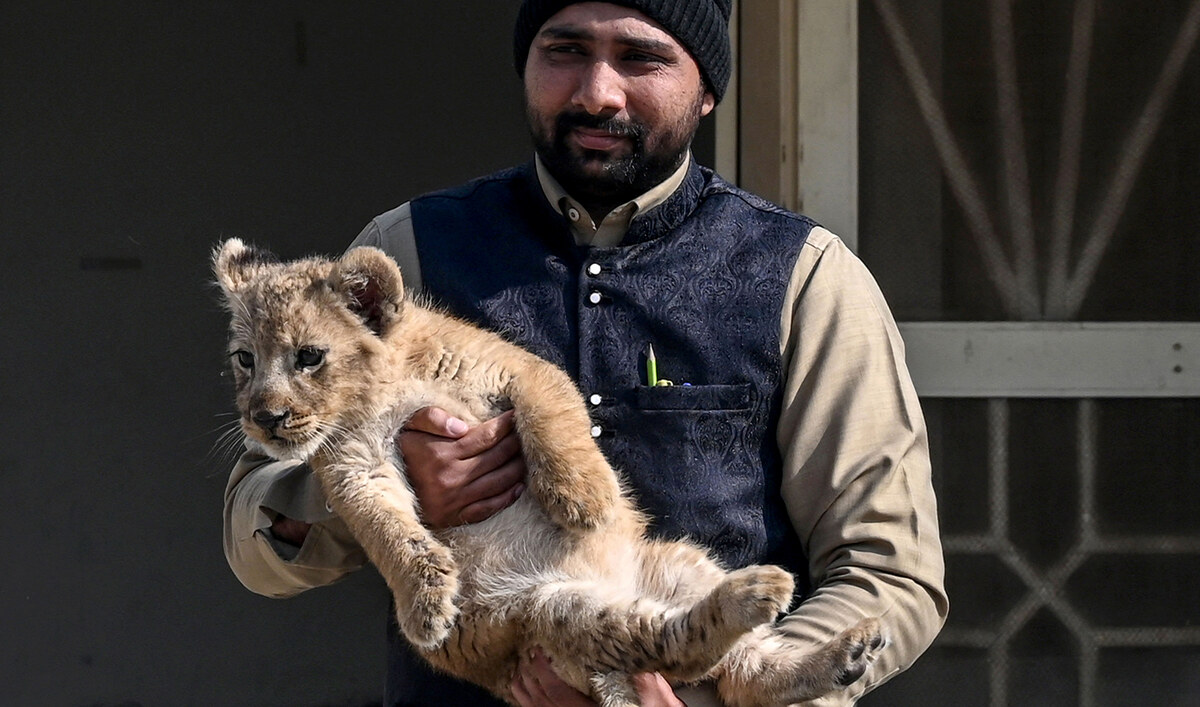


Pakistani zookeeper Mohammad Amir, holds a lion cub confiscated from YouTuber Rajab Butt, at a safari zoo in Lahore on January 28, 2025. (AFP)

Last week, Butt pleaded guilty to owning an undocumented wild animal but the judge waived a possible fine and prison sentence of up to two years for a more tailored punishment.

Every month for one year, he must post a five-minute video dedicated to animal rights, said the order by judge Hamid Ul Rahman Nasir.

The social media influencer agreed to the conditions, after admitting in a court statement that he “set a poor example” by accepting the gift and going on to “glorify it.”

Butt is one of the country’s highest-paid YouTube stars, according to the platform, and usually posts videos about his family’s daily life, from arguments to new car purchases.

Tanvir Janjua, a veteran wildlife official in Punjab, said the cub was likely bought for between 700,000 and 800,000 Pakistani rupees ($2,500-$2,900).

“It is so wrong, morally and legally, to take away such a small cub from its mother,” which was likely still feeding it, he told AFP.
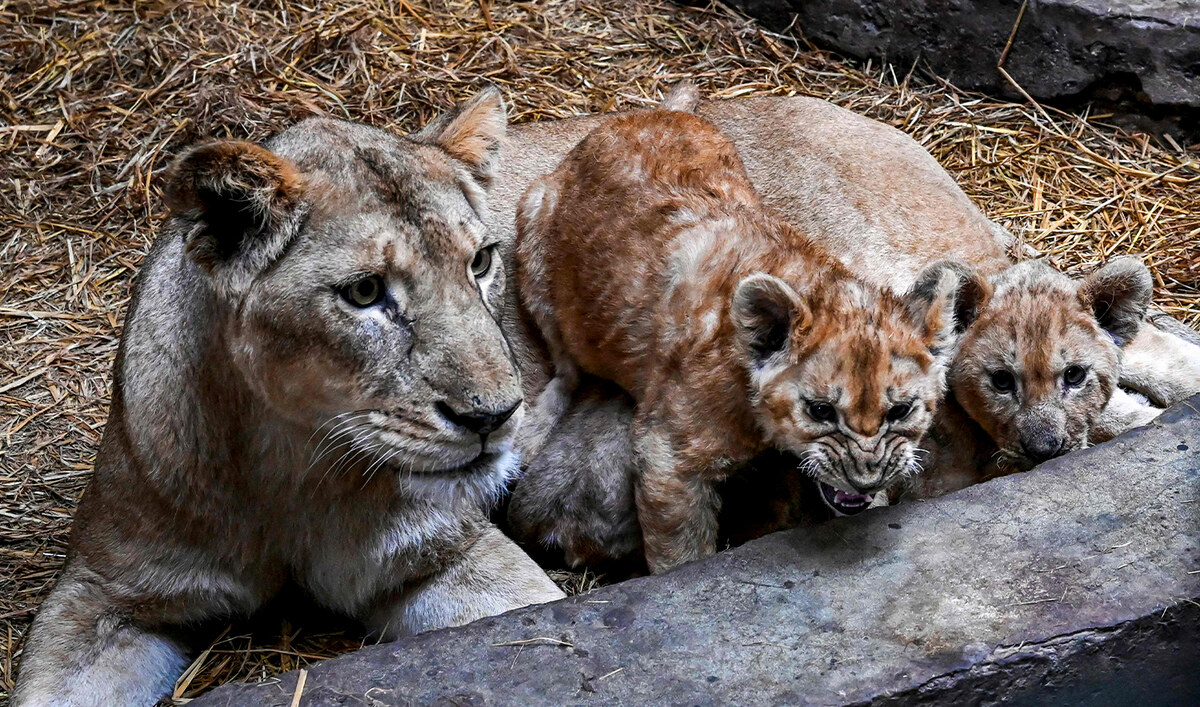


Lion cubs rest beside their mother at a safari zoo in Lahore on January 28, 2025. (AFP)

NEW REGULATIONS

A week after the YouTuber was arrested, an adult lion escaped from his cage, running through the narrow streets of a Lahore neighborhood as residents clambered to their rooftops.

The full-grown adult male was eventually shot dead by a security guard, prompting heated outrage on social media about the dangers of keeping a big cat in a residential area.

Big cats are imported and bred across Pakistan, seen as symbols of wealth and power to the elite that own them.

Last year, Pakistan Muslim League-Nawaz, which rules the government, banned supporters from bringing lions — the symbol of the party — to political rallies.

However, stringent new regulations banning private ownership of big cats in residential areas are currently making their way through Punjab’s provincial government.

Breeders would have to buy a license and have at least 10 acres (four hectares) of land on a site approved by wildlife officials.

‘NEVER BE YOUR PET’

The gifted lion cub, which hasn’t been named, is now enjoying the winter sun in an open pen at Lahore’s sprawling Safari Zoo on the edge of the city, under the watchful eye of a handler.

Janjua, also the zoo’s deputy director, has conducted hundreds of raids against owners, breeders and poachers over the past 33 years to confiscate wild animals, including lions which often had their teeth and claws removed.

“Look at these YouTubers who use these animals to get clicks. What kind of a message are they spreading by being cruel to these animals?” he said, scornful of those who parade them in their cars and at political rallies.

“They can never be your pet. For two or three months it won’t say anything but after that, it will turn aggressive.”

As he nears retirement, Janjua says attitudes toward animals have worsened throughout his career. Laws, however, have improved, he says.

“Now wildlife officials have dedicated uniforms, weapons and we will get our own courts,” he told AFP.

“The courts that already exist are now strict about animal cruelty.”


IMF warns against policy slippage amid weak recovery as it clears $1.2 billion for Pakistan

Updated 4 sec ago
Follow

IMF warns against policy slippage amid weak recovery as it clears $1.2 billion for Pakistan

  • Pakistan rebuilt reserves, cut its deficit and slowed inflation sharply over the past one year
  • Fund says climate shocks, energy debt, stalled reforms threaten stability despite recent gains

ISLAMABAD: Pakistan’s economic recovery remains fragile despite a year of painful stabilization measures that helped pull the country back from the brink of default, the International Monetary Fund (IMF) warned on Thursday, after it approved a fresh $1.2 billion disbursement under its ongoing loan program.

The approval covers the second review of Pakistan’s Extended Fund Facility (EFF) and the first review of its climate-focused Resilience and Sustainability Facility (RSF), bringing total disbursements since last year to about $3.3 billion.

Pakistan entered the IMF program in September 2024 after years of weak revenues, soaring fiscal deficits, import controls, currency depletion and repeated climate shocks left the economy close to external default. A smaller stopgap arrangement earlier that year helped avert immediate default, but the current 37-month program was designed to restore macroeconomic stability through strict monetary tightening, currency adjustments, subsidy rationalization and aggressive revenue measures.

The IMF’s new review shows that Pakistan has delivered significant gains since then. Growth recovered to 3 percent last year after shrinking the year before. Inflation fell from over 23 percent to low single digits before rising again after this year’s floods. The current account posted its first surplus in 14 years, helped by stronger remittances and a sharp reduction in imports. And the government delivered a primary budget surplus of 1.3 percent of GDP, a key program requirement. Foreign exchange reserves, which had dropped dangerously low in 2023, rose from US$9.4 billion to US$14.5 billion by June.

“Pakistan’s reform implementation under the EFF arrangement has helped preserve macroeconomic stability in the face of several recent shocks,” IMF Deputy Managing Director Nigel Clarke said in a statement after the Board meeting.

But he warned that Islamabad must “maintain prudent policies” and accelerate reforms needed for private-sector-led and sustainable growth.

The Fund noted that the 2025 monsoon floods, affecting nearly seven million people, damaging housing, livestock and key crops, and displacing more than four million, have set back the recovery. The IMF now expects GDP growth in FY26 to be slightly lower and forecasts inflation to rise to 8–10 percent in the coming months as food prices adjust.

The review warns Pakistan against relaxing monetary or fiscal discipline prematurely. It urges the State Bank to keep policy “appropriately tight,” allow exchange-rate flexibility and improve communication. Islamabad must also continue raising revenues, broadening the tax base and protecting social spending, the Fund said.

Despite the progress, Pakistan’s structural weaknesses remain severe.

Power-sector circular debt stands at about $5.7 billion, and gas-sector arrears have climbed to $11.3 billion despite tariff adjustments. Reform of state-owned enterprises has slowed, including delays in privatizing loss-making electricity distributors and Pakistan International Airlines. Key governance and anti-corruption reforms have also been pushed back.

The IMF welcomed Pakistan’s expansion of its flagship Benazir Income Support Program, which raises cash transfers for low-income families and expands coverage, saying social protection is essential as climate shocks intensify. But it warned that high public debt, about 72 percent of GDP, thin external buffers and climate exposure leave the country vulnerable if reform momentum weakens.

The Fund said Pakistan’s challenge now is to convert short-term stabilization into sustained recovery after years of economic volatility, with its ability to maintain discipline, rather than the size of external financing alone, determining the durability of its gains.