

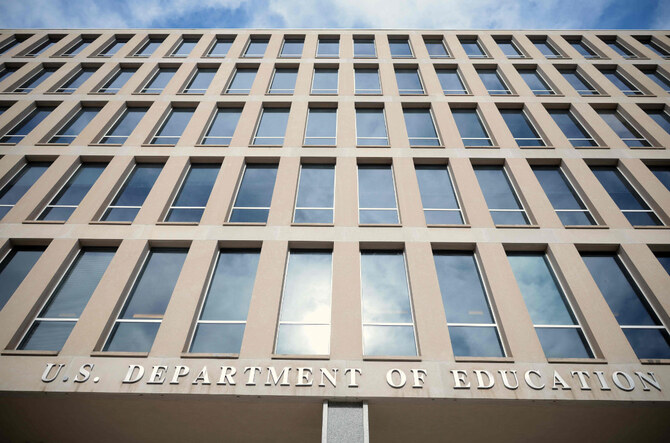

WASHINGTON : President Donald Trump has taken a wrecking ball to Washington — and his latest target is the US Department of Education.
Trump has described it as ineffective, wasteful and dominated by radical leftists, and in an interview airing Sunday told Fox News he would order Elon Musk, the man leading his cost-cutting efforts, to turn his sights next on the Education Department.
Underscoring his intention, the Republican president had earlier directed Linda McMahon, his education secretary nominee, to “put herself out of a job.”
Democratic politicians, teachers’ unions and many parents are in an uproar, calling Trump’s plan to shut down the agency an assault on public education.
Conservative groups, on the other hand, hail it as a long-overdue measure to reassert local control over American classrooms. But they acknowledge that the task of winding down the vast department will not be easy.
Becky Pringle, president of the National Education Association, the country’s largest labor union, said closing down the Education Department would be devastating for students with disabilities, low-income students and other children at risk.
“If it became a reality, Trump’s power grab would steal resources for our most vulnerable students... and gut student civil rights protections,” Pringle said, adding that the union will oppose the plan.
Gutting the Education Department is part of a broader effort by Trump and his tech billionaire adviser Musk to radically trim the US federal government.
The administration has already attempted to close down the US humanitarian agency and to put thousands of federal workers on leave. It has also offered buyouts to tens of thousands — efforts that sent shock waves around Washington and that are now being challenged in courts.
Traditionally, the federal government has had a limited role in education in the United States, with only about 13 percent of funding for primary and secondary schools coming from federal coffers, according to the NEA, the rest being funded by states and local communities.
But federal funding is invaluable for low-income schools and students with special needs.
And the federal government has been essential in enforcing key civil rights protections for students, such as the historic 1954 Supreme Court ruling that ended racial segregation in public schools, or a 1990 federal law guaranteeing access to education for students with disabilities.
“There’s been a traditional federal role in trying to make sure that the most disadvantaged kids get what they need. And the civil rights enforcement is important,” said Mike Petrilli, president of the Thomas Fordham Institute, a right-leaning think tank.
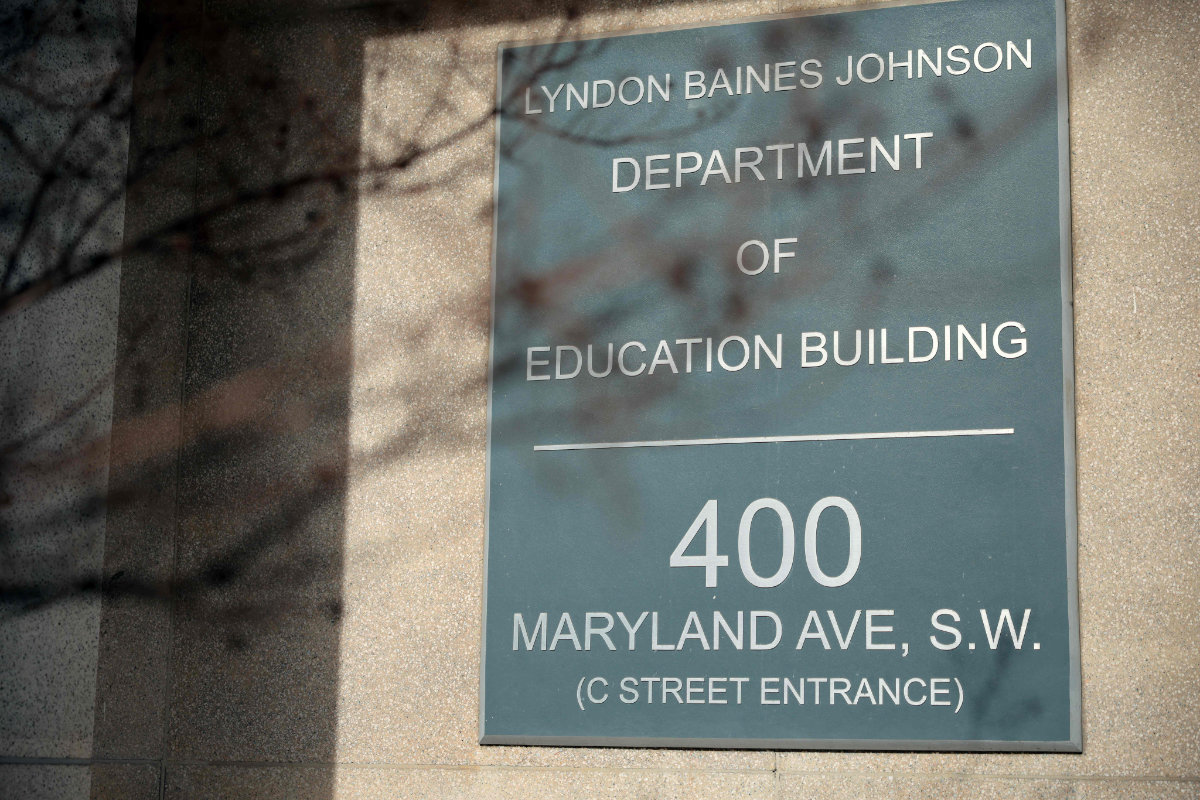
US President Donald Trump has indicated that he is seeking to abolish the Department of Education by executive order in the coming weeks. (Getty Images/AFP)
Trump has shown a willingness to use federal power to regulate school policy. Earlier this week he issued an executive order to ban transgender athletes from participating in women’s sports in schools and universities.
Lindsey Burke, head of education policy at the conservative Heritage Foundation, hailed Trump’s plan to get rid of the federal department, saying it has failed to improve academic standards, with American students continuing to lag behind their international peers.
Burke argues that education decisions must be made at the local level.
“Kids in South Carolina are different than kids in California, right? I mean, this is the United States, it’s a vast and diverse country,” said Burke.
“It is no service to families to put those dollars in the hands of distant federal bureaucrats who do not know these children’s names or their hopes or dreams or aspirations.”
But putting the education secretary out of a job might be easier said than done.
By law, the Education Department can be shut down only by an act of Congress, and most experts agree Trump lacks the votes to do that.
“This is mostly a talking point, it’s not going to happen,” said Petrilli. “A few weeks from now, I think this will be in the rearview mirror.”
It’s unclear how the Trump administration will proceed with its efforts to dismantle the department. Burke said it might seek to move some of its key units — civil rights enforcement, student loan servicing, statistics — to other agencies.
But Kevin Carey, head of education policy at the liberal New America think tank, fears the administration is now in a “strange territory of extralegality” and will not be shy about dismantling the agency one way or another.
“I think the question isn’t, ‘Will Congress abolish the Department of Education?’ It won’t. The question is, ‘Will Trump destroy the Department of Education on his own?” Carey told AFP.
Trump’s education secretary pick, McMahon, is a former professional wrestling executive with little experience in education — and known for once slapping her daughter during a televised wrestling match.
McMahon’s US Senate confirmation hearing is set for Thursday.


