

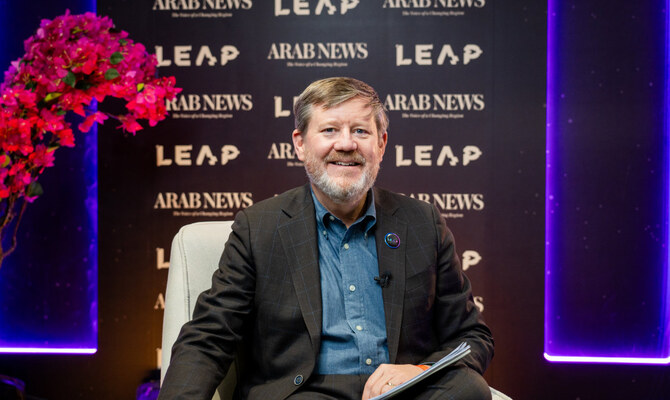

RIYADH: As Saudi Arabia accelerates its adoption of artificial intelligence, a strong regulatory framework is emerging as a key driver of US-Saudi collaboration.
In an exclusive interview with Arab News on the sidelines of the LEAP 2025 technology conference, Steve Lutes, vice president for Middle East affairs at the US Chamber of Commerce, stressed the importance of implementing clear policies that inspire investor confidence.
“One thing that’s always at the core is to have the policy and regulatory environment that is going to give confidence and clarity to investors, risk-takers, and innovators,” Lutes said.
He added that Saudi Arabia maintains an open-door policy in working with the US Chamber and industry leaders to shape its regulatory framework.
“This will catalyze finance and fuel more investment, bring more innovation, and strengthen partnerships between the United States and Saudi Arabia in AI and across the broader economy,” he said.
Saudi Arabia recently announced plans to expand its trade and investment ties with the US to at least $600 billion over the next four years, according to the Saudi Press Agency.
Crown Prince Mohammed bin Salman outlined the Kingdom’s strategy during a phone conversation with US President Donald Trump.
Lutes pointed to Saudi Arabia’s young, tech-savvy workforce as a key factor in advancing AI under Vision 2030.
“Saudi is a young country, and you have a young workforce that is embracing technology and wants to be right there, whether in the private sector or government, leading the way on technology innovation and adaptation,” he said.
He underscored that talent development, alongside a robust regulatory framework, will be critical in fostering AI innovation and scaling businesses in Saudi Arabia.
Ensuring Saudi Arabia has access to cutting-edge US technology is also a priority, Lutes noted, emphasizing that this access is essential for the Kingdom’s innovation ecosystem.
“It’s one of the things that we would put toward the top of the list,” he said, referring to high-performance AI hardware such as Nvidia’s advanced chips.
While acknowledging the importance of security measures, Lutes emphasized the need to balance protection with cooperation.
“Yes, we want to protect and make sure that the right measures are in place, but it’s absolutely critical that our strategic allies, like the Kingdom of Saudi Arabia, have access to and the ability to tap into US technology.”
He emphasized the broader economic implications of this access, noting that US companies are already playing a significant role in Saudi Arabia’s AI-driven transformation.
“What’s going on here in the Kingdom is very important to our economic relationship in the United States and to the US companies that are already here, doing incredible things,” he said.
“We want to see that only grow, deepen, and create more jobs, more investment, more innovation, and more opportunities to strengthen the US-Saudi relationship.”
Lutes expressed optimism about the future of US-Saudi AI collaboration, highlighting the role of diplomacy in achieving shared goals.
“I’m an optimist, and I believe we will get to a good place in terms of that policy,” he said.
He added that efforts should focus on ensuring everything is fueled and catalyzed to accelerate partnerships between the US and the Kingdom, with the private sector leading the way.


